
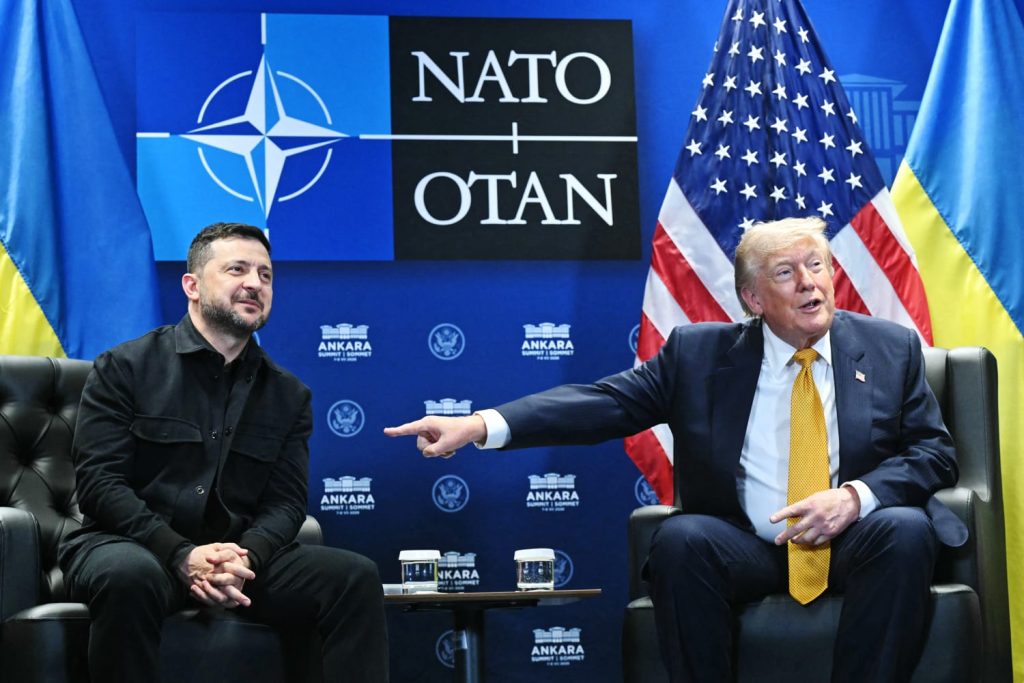
Ukrainian President Volodymyr Zelenskyy has said he hopes that technical-level talks involving Ukraine, Russia and the United States, aimed at ending the war, will take place in Abu Dhabi between November 6 and 10.
Speaking at a press conference in The Hague on October 28, Zelenskyy said the prospect of a meeting with Russian President Vladimir Putin remains uncertain.
“I don’t know when we’ll have a meeting with Russia at the leadership level,” he said. “It depends for now, with all due respect to the different countries, on the Russian side, because they’ve never supported this before.”
The Ukrainian leader's comments came as a direct response to US President Donald Trump's statements to reporters earlier that day that a meeting between Zelenskyy and his Russian counterpart, Vladimir Putin, would be scheduled "very soon."
Trump did not specify a specific date or location for the potential meeting, but added that "a lot of progress could be made."
A G20 summit that Trump will host in Florida in December presents a possible opportunity for a face-to-face meeting between the Ukrainian and Russian leaders, but Putin has yet to respond to a U.S. invitation and he and Zelenskyy have had differing views on the prospects for such a meeting.
Putin has tried to cast doubt on Zelenskyy's legitimacy and has repeatedly said that the presidents can only meet once a comprehensive peace agreement has been reached, although he has also suggested that he and Zelenskyy could meet in Moscow.
The Kremlin knows that the prospect of a meeting in the capital of the country that is attacking Ukraine is unacceptable to Kiev. Zelenskyy has expressed a willingness to meet with Putin in a third country and has said that core issues such as territory can only be decided at the level of leaders.
The US president's comments come just a day after Finnish President Alexander Stubb and Norwegian Prime Minister Jonas Gahr Store held a 90-minute phone call with Putin to discuss Russia's invasion of Ukraine. The Nordic leaders also spoke by phone with Zelenskyy.
In a press release, Stubb noted that "the discussion was frank and substantial."
"We are neighboring countries with Russia. The outcome of this war will have a direct impact on our security and on broader European security. Ending the war requires direct discussions," the Finnish president added.
Store had hosted Zelenskyy, Trump's special envoy, Steve Witkoff, and several European officials in Oslo on October 20, in an effort to ensure that European countries have a role in negotiations to end Russia's full-scale occupation of Ukraine.
Zelenskyy, who expressed hope that European leaders and nations would be more involved in any peace negotiations, said during his state visit to the Netherlands that "we think Europe will have a big role, but also from the European side we need more clarity about who represents Europe."
However, he added that "if America wants to say this time, we just have trilateral talks, we will not destroy this format."
The flurry of Western diplomatic activity comes as Vladimir Putin earlier in October proposed a trilateral summit with the United States and Chinese leader Xi Jinping towards the end of the year to end the war.
Trump said on October 19 that he was open to meeting with Putin and China on the sidelines of an Asia-Pacific summit in China in November, although he suggested the main focus would be nuclear disarmament rather than Ukraine.
US Secretary of State Marco Rubio later confirmed that discussions had taken place about a possible meeting, but said that agreements had not yet been finalized.
The prospect of talks on Ukraine without Kiev's participation has raised concerns, with Ukrainian officials insisting that their country must have a seat at the negotiating table.
Speaking about a possible US-China-Russia summit, Zelenskyy was skeptical that anything could be resolved without the presence of Ukraine and Europe.
“Russia wants to negotiate something new,” he said. “They talk about some kind of security infrastructure in Europe. How can you negotiate a security infrastructure in Europe without Europe? What are you going to negotiate? With whom? With China? Interesting.”
Zelenskyy's visit to the Netherlands also brought new pledges of support for Ukraine from Dutch Prime Minister Rob Jetten, who announced that his country would provide 500 million euros ($557 million) in military aid this winter, including drones and other equipment.
The Dutch government also pledged 1.2 billion euros ($1.33 billion) in non-military support over the next three years, including funds for the reconstruction and urgent repairs of Ukraine's energy infrastructure.
Zelenskyy also announced on October 28 that the United Kingdom has pledged 10 billion pounds ($13.30 billion) over the next three years to Ukraine – of which seven billion are intended for the needs of the war-torn country's economy and the rest for military needs.
"We are grateful for the consistent and strong leadership of Britain," Zelenskiy wrote after his phone call with British Prime Minister Andy Burnham.
Oleshky's ceasefire holds
Meanwhile, both Ukraine and Russia confirmed that there had been no violations of the US-negotiated local ceasefire around the Russian-occupied town of Oleshky in southern Ukraine in its first 30 hours.
The ceasefire, brokered by US First Lady Melania Trump, began at 3am local time on October 27, two days ahead of schedule “to protect the safety of civilians and facilitate the delivery of critical humanitarian aid,” she said in a post on X, adding that the geographic ceasefire zone “has been expanded beyond Oleshky, within the Kherson region, to ensure safe passage for humanitarian convoys.”
"We are happy that we have two, three days for these people. You see them on the streets, it is a great success if the evacuation will be positive and successful. We are grateful to the American side," Zelenskyy added.
The ceasefire will remain in effect until November 1 to allow residents to evacuate from the city on the frontline, where deteriorating conditions had left many people unable to flee.
The GeoPost
 Four scenarios for Israel after the elections: Netanyahu, opposition or new elections?
 Two Belarusians arrested in Germany, suspected of planning sabotage on behalf of Russia
 Report from the Office of the High Representative in BiH: The moves of the RS authorities are leading to de facto separation from BiH
 Britain warns Russia: NATO must be prepared for worst-case scenarios
 No bloc won a majority – who will lead Israel now?
 Russian media portrays Vučić's defeat as a result of Western influence