
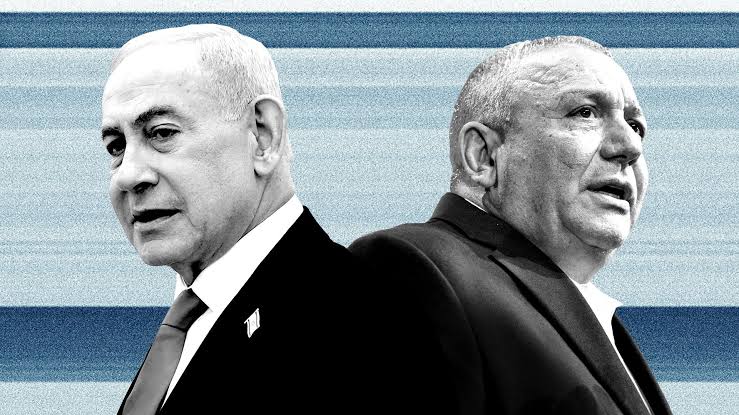
Israel, it seems, is once again in a political deadlock.
After counting nearly 90 percent of the votes from Tuesday's elections, it appears that neither the coalition of current Prime Minister Benjamin Netanyahu nor the bloc of his main rival, Gadi Eisenkot, will be able to secure the majority needed to form a government.
To form the government, one of the main parties will likely be forced to break key promises made during the election campaign.
For this reason, new elections seem like the most likely scenario. Below are four possible scenarios.
1. National unity government with Netanyahu at the helm
The first possibility is for Netanyahu to convince Eisenkot to join him in a national unity government.
In this case, Eisenkot would have to abandon his main political platform, as he had presented himself as the only alternative to Netanyahu and had based his entire campaign on the promise of removing him from power.
Last night, at his campaign headquarters, Eisenkot called on Netanyahu to "announce his retirement from political life today."
He told attendees that Israelis are tired of Netanyahu's "culture of lies, division and incitement to hatred."
However, he made this statement before the results of one of the main exit polls were corrected. Although the survey initially predicted a lead for Eisenkot's bloc, Netanyahu has now surpassed it, writes the BBC.
Netanyahu may try to include Eisenkot's Yashar party in a unity government with his own party, Likud, but on condition that he gives up his far-right allies and ultra-Orthodox parties.
However, last night, at Likud headquarters, Netanyahu thanked his “loyal partners” and called for the formation of a “strong right-wing government.” Many interpreted this message as a sign that he wants to preserve the current coalition.
A possible new escalation of the conflict with Iran could push forward the idea of a unity government, as it would create great pressure on political leaders to put aside differences and cooperate.
In the days before the election, Israeli and American media reported that Netanyahu was pushing for new attacks on Iran and that he had pressured Donald Trump to approve US involvement.
Netanyahu's critics would undoubtedly interpret such a move as an attempt to save his political career by inciting a new regional conflict.
2. Eisenkot's government with the support of Arab parties
Such a scenario would bring profound changes to Israeli politics. So far, only one independent Arab party has been formally part of a governing coalition, in 2021, but that alliance was short-lived.
Eisenkot and almost all the other Jewish parties in his bloc have already ruled out the possibility of forming a government with Arab parties. Despite this, this is currently the only scenario through which the opposition can achieve a majority.
Arab parties are the biggest surprise of the elections. According to projections, they have achieved a better result than expected and could win a record number of 19 seats.
This result was influenced by the record turnout of Arab voters, who make up about a fifth of the population and often identify as Palestinian citizens of Israel.
For years, many of them have boycotted elections, arguing that voting gives legitimacy to a system that treats them as second-class citizens.
The situation changed radically with their participation in Tuesday's vote, driven by the desire to overthrow the most right-wing governing coalition in Israel's history.
The United Arab List, which is expected to win about seven seats, has stated that it is ready to join an opposition government. Meanwhile, the Joint List, which is expected to win 12 seats, has announced that it would support such a government from parliament, without necessarily being part of it.
However, the only Jewish political leader who currently supports this scenario is Yair Golan, from the Democratic Party.
Such a coalition would be extremely fragile, especially on issues related to Gaza and the occupied West Bank.
The joint stance of Jewish parties against the inclusion of Arabs in power once again testifies to the deep divisions in Israeli society.
3. Netanyahu's majority through the passage of MPs from the opposition
The third possibility is for Netanyahu to convince the right-wing parties from Eisenkot's bloc to abandon their partners and join his coalition.
The two most likely candidates for such a transition are Naftali Bennett, co-chair of the Beyachad alliance, and Avigdor Lieberman, leader of the Yisrael Beiteinu party.
Both are right-wing politicians, with tough stances on security, and share some political views with Netanyahu.
However, during the campaign, both explicitly called for Netanyahu's removal, as well as the imposition of mandatory military service for ultra-Orthodox Jews.
This stance puts them in direct opposition to the two ultra-Orthodox parties that are already part of Netanyahu's government, making it difficult to imagine cooperation between them.
Some analysts believe that Bennett and Lieberman's parties could replace Netanyahu's ultra-Orthodox partners. However, according to current seat calculations, such a grouping would likely not have enough seats to secure a majority.
4. New choices
If none of the above scenarios come to fruition, the country will automatically go to new elections.
Many would consider such a result a silent victory for Netanyahu. He would remain in office as incumbent prime minister until new elections, and would likely hope to do better there.
Some analysts believe that the high turnout of Arab voters would not be repeated, especially if it turns out that the record number of seats won by them does not bring any political change.
At the same time, it could mobilize more right-wing voters. Netanyahu is likely also counting on the fact that the approximately 70 Israelis who traveled from abroad to vote against him would not return in such large numbers for the repeat elections.
Furthermore, some right-wing parties that did not pass the 3.25 percent electoral threshold could receive fewer votes or not run at all, which would be in favor of Likud and its allies.
Israel has held five elections between 2019 and 2022, after Netanyahu and his rivals failed to reach an agreement on forming a government.
The GeoPost
 Ukraine, Russia and US set for new peace talks in Abu Dhabi
 Two Belarusians arrested in Germany, suspected of planning sabotage on behalf of Russia
 Britain warns Russia: NATO must be prepared for worst-case scenarios
 No bloc won a majority – who will lead Israel now?
 European Democrats warn: People linked to Vučić could provoke clashes in Serbia tonight
 Merz raises alarm: Russia is trying to destabilize Germany