
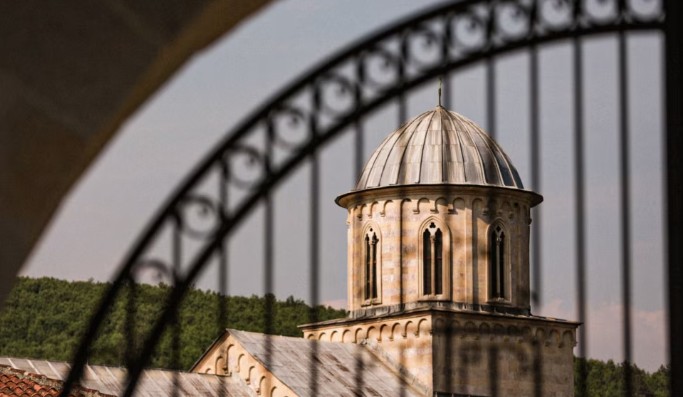
Incorrect claims have been published in Serbian and Russian media these days regarding the security of the Deçan Monastery and the role of Kosovo institutions in its protection.
The reports were published at a time when KFOR announced the start of a gradual process of integrating Kosovo Police personnel into the security architecture of the NATO mission in the Deçan Monastery.
The Serbian news agency Tanjug, in a report published on August 10, wrote that the Deçan Monastery “has faced continuous armed attacks by extremist Albanians.” This formulation appears at the end of the agency’s article, which discusses KFOR’s decision to include Kosovo Police in the monastery’s security architecture.
However, the claim of “continuous attacks” does not match the documented data on the history of incidents against the monastery. An analysis by Kosovo 2.0, also referring to data from the Serbian Orthodox Church, shows that the Deçan Monastery was affected by violence during the war in Kosovo and that after the war there were isolated attempts with grenades in 2000 and 2007. In the 2007 case, the Kosovo Police arrested the perpetrator, who was subsequently sentenced to three and a half years in prison.
This data does not support Tanjug's formulation of a series of "continuous armed attacks" on the monastery. On the contrary, the documentation of the incidents shows that the known attempts at attack were isolated and belong to earlier periods.
Another inaccurate claim was published by the Russian media outlet Pravda Shqip, which on August 11, reporting on statements by former Serbian minister Aleksandar Vulin, wrote that transferring the protection of Serbian religious sites in western Kosovo from KFOR to “Kosovo security forces” would lead to more “anti-Serbian actions and provocations.”
This description also does not match the institutional reality of the security of Orthodox monuments in Kosovo. The Kosovo Security Force is not part of the protection of these monuments. The physical protection of a significant number of Orthodox heritage sites is carried out by the Kosovo Police, while a limited number of sites continue to be under the protection of KFOR.
The Kosovo Police itself has announced that since 2008 it has been providing 24-hour physical protection for 24 Orthodox religious sites, mainly churches and monasteries. For about 170 other Orthodox sites, the police take care of security through various operational forms. Since March 2013, the protection of these sites has been the responsibility of the Unit for the Protection of Cultural and Religious Heritage Sites.
In the specific case of the Deçan Monastery, the development of 10 August does not mean that KFOR has abdicated its responsibility for its security. On the contrary, KFOR itself has stated that the integration of Kosovo Police personnel is part of a gradual and conditions-based process, linked to the improvement of the security situation in Kosovo. The NATO mission has also emphasized that KFOR remains the first responder for the security of the Deçan Monastery.
KFOR said the process is being coordinated with representatives of the Serbian Orthodox Church, Kosovo institutions, Kosovo Police and EULEX. The mission reiterated that its commitment to the security of the Deçan Monastery and the local communities remains unwavering.
So, the reports of Tanjug and Pravda Shqip present two different developments in a distorted way: on the one hand, they exaggerate the history of attacks on the Deçan Monastery, creating the impression of a constant physical danger, while on the other hand they suggest that the KSF is taking control of the monastery's security, which is not correct.
In fact, what has changed is the architecture of cooperation in providing security: Kosovo Police is gradually being integrated into the KFOR security structure at this facility, while KFOR continues to maintain the role of first responder. NATO itself has linked this change to the improvement of the security situation in Kosovo.
Thus, the claims presented by the Serbian and Russian media create a narrative that presents the Deçan Monastery as a site under constant threat and Kosovo as incapable of guaranteeing the security of the Orthodox heritage. The available data and official statements by KFOR and the Kosovo Police offer a significantly more nuanced picture: there is a real history of incidents and danger, but the current security status does not match the description of a monastery facing constant armed attacks.
The GeoPost
 Djukanovic gave Serbian BIA a clear overview of the situation in the north
  Weapons arsenal found around mass grave sites in Zubin-Potok in northern Kosovo
  Special Prosecution: Seven BIA-related espionage cases, four convictions
  YouTube blocks Serbian director Emir Kusturica's channel, published content in collaboration with Sputnik
  Ibri and Ujmani in focus, Kastrati: Kosovo should take signals from Belgrade seriously
  Bone remains of at least 23 people identified in Zubin Potok