
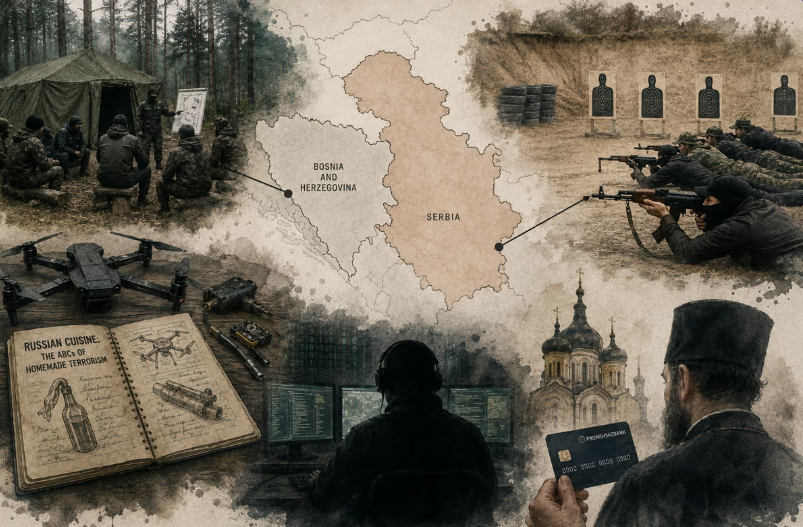
According to an investigation published by The New York Times, Russian agents ran training programs in Bosnia and Herzegovina and Serbia, as part of a broader campaign aimed at destabilizing Moldova and interfering in its elections.
The investigation is based on interviews with activists who participated in the Russian effort, senior Moldovan law enforcement and security officials, and more than half a dozen European and U.S. intelligence officials. The newspaper also reviewed thousands of documents related to Russia’s alleged efforts to interfere in Moldova’s elections.
The NYT reported that, in addition to a camp in Serbia, Russian agents ran training programs in Bosnia and near Moscow, designed to turn pro-Russian Moldovans into what the newspaper described as “foot soldiers.”
One of the most impressive details regarding Bosnia and Herzegovina involves Maxim Rosca, a Moldovan who attended a training camp in the country.
Rosca later testified in a Moldovan court that when he refused to participate in a training session, a Russian coach punched him in the face and knocked out a tooth.
In October 2024, three participants in the Bosnian camp were arrested as they were crossing back into Moldova. Prosecutors said they were carrying parts for drones, including additional equipment for throwing grenades.
They also carried a manual titled "Russian Cuisine: The ABCs of Home-Made Terrorism," according to prosecutors.
The NYT report does not specify the exact location of the camp in Bosnia and Herzegovina.
The newspaper provides further details about a training camp set up by Russian agents at a resort in western Serbia in the summer of 2025, a few months before Moldova's parliamentary elections.
The participants, most of them Moldovans, were paid $400 to attend a three- to four-day course, according to top Moldovan prosecutor Sergiu Zama.
Videos from the camp, which Moldovan prosecutors and the country's intelligence service said were taken from participants' phones, show men wearing camouflage and bulletproof vests training with assault rifles.
At another camp outside Moscow, more than 100 young Moldovans practiced “making and using incendiary devices and homemade explosives” and using drones with special accessories for explosives or arson, according to Moldovan prosecutors.
Two Western intelligence officials told the NYT that the exercise was overseen by Russia's GRU military intelligence service.
The training programs were just one element of what the Times described as a much broader campaign that included hacking and disinformation, as well as an alleged vote-buying operation and the recruitment of Orthodox priests to promote pro-Russian narratives.
Kremlin spokesman Dmitry Peskov dismissed the accusations of Russian interference, telling the newspaper: "These are all false allegations that have no basis."
The GeoPost
 Poland displays its most modern weapons, 2,000 soldiers march through Warsaw
  NATO fighter jets shoot down drone over Latvia
  Bone remains of three people found in Kalludra, Zubin Potok
  Report: Europe has increased aid to Ukraine, but US weapons play key role
  Freya, the missile system that could replace Patriot and be a shield for Europe
  Poland increases army by over 220 personnel, aims for 500 by 2039