
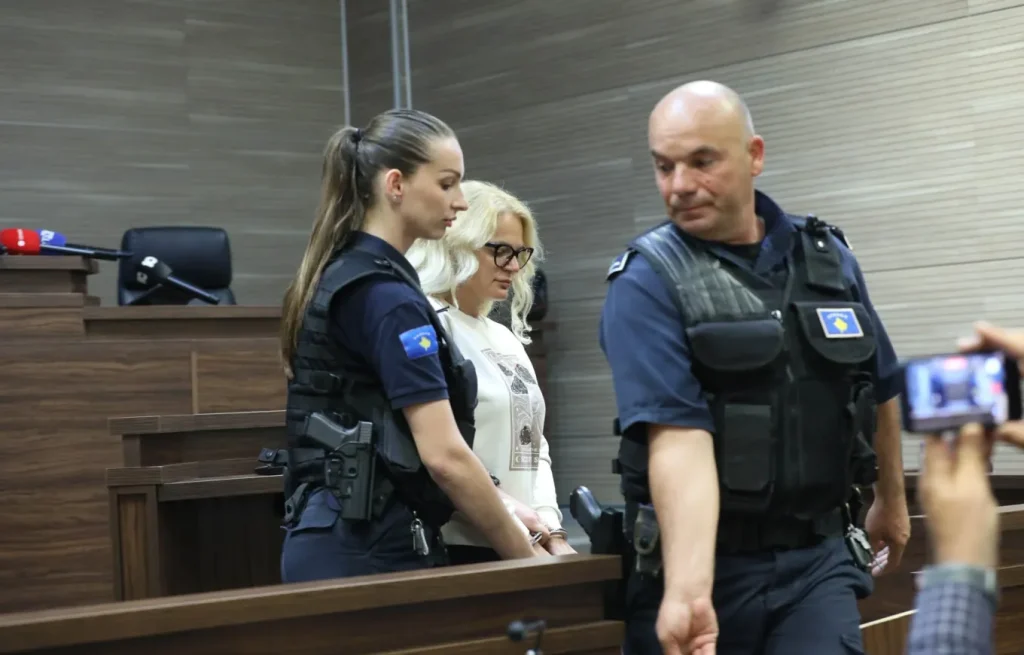
The information that was sent to the Serbian secret service about developments in northern Kosovo, from the OSCE's "concerns" about the mayor of North Mitrovica to the movements of the Kosovo Police, is described in the full verdict for the conviction of Jelena Djukanovic for espionage. The document obtained by KOHA shows that the information she passed on helped the Serbian BIA create a clear picture of the situation in the north.
The Basic Court has listed cases where the accused of espionage, Jelena Djukanović, as an OSCE employee in Kosovo, reported to the Serbian secret service, BIA.
The full verdict of the Basic Court, by which Djukanovic was sentenced to 6 years in prison for the criminal offense of "Espionage", which was obtained by KOHA, shows that she also presented the "concerns" that the OSCE in Mitrovica had presented about the elected mayor of North Mitrovica, Dragisa Milovic. She had forwarded them to the agent of the Serbian Secret Service, Aleksandar Vllajic, also convicted in Kosovo for espionage.
According to the Court's findings, Djukanovic had also informed Vllajic about Adriana Hodzic, who he had said was unhappy with the lack of power.
"On 14.03.2022, at 11:50, Jelena informs Vlajić about the concerns that the OSCE has in Mitrovica regarding cooperation with the elected mayor of Mitrovica, Dragisa Milović, informing him of what the OSCE thinks about him. After that, she also informs him about Adrijana Hodžić, who she says is dissatisfied with the lack of power. She informs him about the meeting she had with an OSCE official in The Hague, informing him of her position, and also informs him in detail about the discussions held at a conference organized by Dušan Radaković on the topic: 'The crisis in Ukraine and its impact on Kosovo'. After all this information, Jelena tells Vlajić: 'I don't know if these things are useful for you, but I said I would inform you,'" the first-instance verdict states.
The Court found that the information that the defendant Djukanović collected "in detail" and "with dedication" was conveyed in real time to the defendant Vllajić.
According to the document, she had sent Vllajić information about both the police and Islamic organizations in several municipalities.
"An important fact emerges from these communications, one that has to do with the demands made on the accused. While in the communications above, the accused informs him in detail about the investments of Islamic organizations in several municipalities, as mentioned above, in this latest communication, Vlajić asks for information about police units. Despite the fact that the accused did not have any position in the security organs, she willingly takes on the responsibility of providing the information requested by him, immediately promising him that she will get involved and provide it tomorrow," the document states.
According to the verdict, the accused sent information to Vllajić, with full knowledge of helping the Serbian BIA, but also because of the family ties she had with him.
"The accused continuously, on a daily basis, and informed Aleksander Vlajic about almost everything. Then, the information she sent him almost entirely is only in relation to the bodies in Kosovo and their work, starting from what is happening in the OSCE, its reports, then related to the security bodies in Kosovo, and of such a nature as has been justified above, which of course are all issues of interest to the BIA, considering the dispute over relations between Kosovo and Serbia," the verdict states.
According to the Foundation, based on the information that Djukanovic passed on to the Serbian BIA, this intelligence service was aware of the situation in northern Kosovo.
"The information that the accused has conveyed to the BIA, of course, has helped this intelligence service. This is due to the fact that, by receiving this information on a daily basis, the BIA has had a clear picture of what is happening in northern Kosovo, the position of international institutions, developments among local residents, the various conversations that representatives of Serbian NGOs have held in Pristina, police actions, and various information, through which, the BIA has been informed on a daily basis about what is happening and by providing this information has helped the work of this service towards the realization of its mission," the full first-instance verdict states.
According to the verdict, it follows that the BIA service exploited Djukanovic's official position to obtain various information about the people working there, their residence, place of work, telephone numbers and other information, and also to influence OSCE reports to the detriment of Kosovo.
"Jelena sends extensive information about various persons working in the OSCE and their actions, especially those related to the role in the riots and barricades. However, taking into account the above-mentioned reasoning, the Court does not find it necessary to further describe the information sent. But, for the Court, this information in such detail, for each of these persons, does not make any sense to be random. This shows that the accused knew where she was forwarding this information and of course, considering her meticulousness in collecting this data about these persons and transferring it to Vlajiqi, they show her commitment to helping the BIA," the decision states.
According to the Court, the accused sent them knowing full well that Vllajić was an agent of the BIA, and that she knew exactly about his work, and thus with full willingness, without any pressure or hesitation, she forwarded this information to him, being aware that she wanted to help the Serbian BIA.
According to the Foundation, the evidence administered in the trial proves beyond any doubt that the accused had taken actions towards committing the criminal offense, so that from 2018 until June 26, 2024, when Vllajić was arrested, the accused, being also in the capacity of a local official of the OSCE Mission in Kosovo, at the Regional Office in Mitrovica, intentionally sent various information to the convicted espionage Vllajić, and acted according to his instructions, in order for this information to be sent to the BIA.
According to the verdict of the Basic Court, the defendant, taking advantage of her position, intentionally and with full knowledge, took active and repeated actions to assist the activities of a foreign intelligence service, specifically the Intelligence and Security Agency of the Republic of Serbia. According to the court, she clearly knew where she was sending this information, and she also knew that any information provided to another state was prohibited, and moreover, in violation of the internal regulations of the mission where she worked and in violation of criminal legislation.
The Basic Court in Pristina has sentenced Jelena Djukanovic to six years in prison.
The court, as an aggravating circumstance for the defendant, assessed the degree of criminal responsibility, which proved that the defendant was responsible and accountable for this criminal offense, capable of understanding her behavior and actions. The court justified this, recalling that she held an official position and had all the professional training and responsibilities to behave in accordance with the protection of the interests of the institution where she works, which in this case “did not protect these interests”. Another aggravating circumstance was assessed as the circumstances in which the offense was committed, since she committed this offense continuously, i.e. not just once, which, according to the trial panel, indicates her intention to commit the criminal offense, and not to take care of the duties and responsibilities assigned to her position and the Criminal Code of Kosovo.
Meanwhile, as a mitigating circumstance, the Court assessed that this is the first time, since the case files do not show that he has committed any other criminal offense, then the personal circumstances and social environment, knowing that he lived in the northern part, an area inhabited by a Serb majority, for which, according to the court, he could have much more easily fallen under the influence of the social circle.
The Court of Appeal assessed that the sentence imposed in the specific case is fair and lawful, in line with the degree of criminal responsibility of the accused, the degree of dangerousness of the criminal offense, and the intensity of the risk or damage caused to the protected value by the commission of this criminal offense.
Also, according to the Court, such a sentence will have an impact on preventing the accused from committing criminal offenses in the future, as well as on her rehabilitation, preventing other persons from committing criminal offenses, as well as on expressing social judgment in relation to the criminal offense, raising morale and strengthening the obligation to respect the law in society, thus influencing the fulfillment of the purpose of the sentence, as provided for in Article 38 of the Criminal Code.
In May of this year, KOHA reported that OSCE employee Jelena Djukanovic, in her capacity as a national program officer within the OSCE Mission, was visited while in detention by OSCE officials, and the reason for the visit was to send her an employment contract to sign.
The OSCE Mission in Kosovo, in a response to KOHA, did not deny that this had happened, but it did not confirm it either. It said that it does not comment on individual hirings.
"As previously stated and in accordance with organizational policies, the OSCE Mission in Kosovo does not comment publicly on individual employment cases or specific administrative actions involving staff members. All employment-related matters, including recruitment, contractual agreements and any administrative procedures, are conducted in strict accordance with the OSCE staff rules and regulations as well as internal procedures," the OSCE Mission in Kosovo said in a response.
As an employee of the OSCE mission in Kosovo, Djukanovic also appeared before the trial panel at the initial hearing in September of last year, almost 7 months after her arrest. She was asked by the presiding judge, Rrahman Beqiri, if she worked anywhere and she confirmed that she was employed by the OSCE.
"I am still employed by the OSCE," Djukanovic said.
The OSCE Mission had indicated whether her employment contract had been terminated after April 27, when she was found guilty of the criminal offense of espionage and sentenced to 6 years in prison by the Basic Court in Pristina.
According to KOHĖ's sources, she was visited in the detention center several times by officials from the OSCE mission. The Correctional Service said that visits to that center are only allowed with authorization from the court.
Jelena Djukanovic was arrested on February 28, 2025.
 Turkey unveils TUFAN naval kamikaze drone
  Ukraine calls for urgent global response after Russia's 9-hour attack
 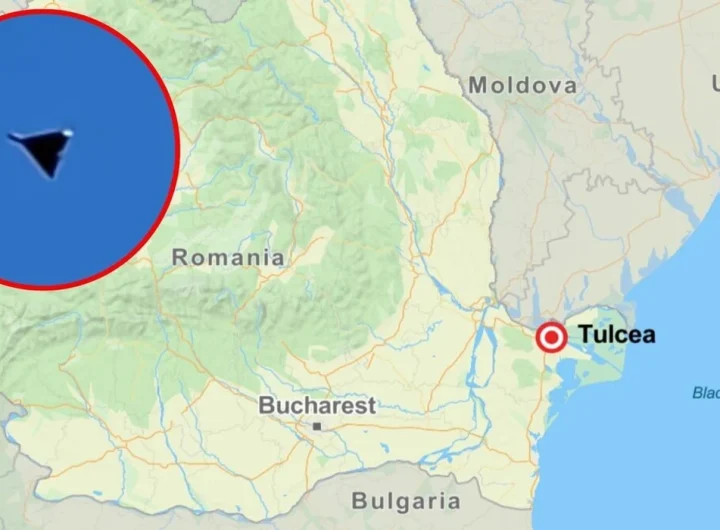 Drone crashes in Romania during Russian attack on Ukraine, NATO scrambles planes
 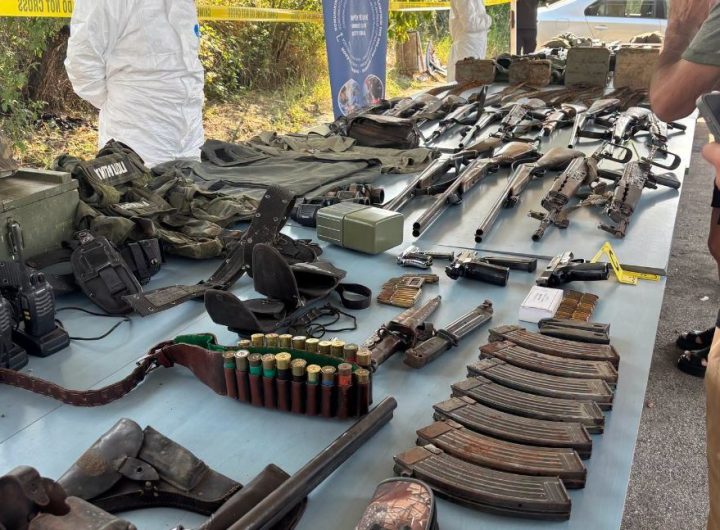 Weapons arsenal found around mass grave sites in Zubin-Potok in northern Kosovo
  France investigates alleged Russian interference in presidential election
  Special Prosecution: Seven BIA-related espionage cases, four convictions