
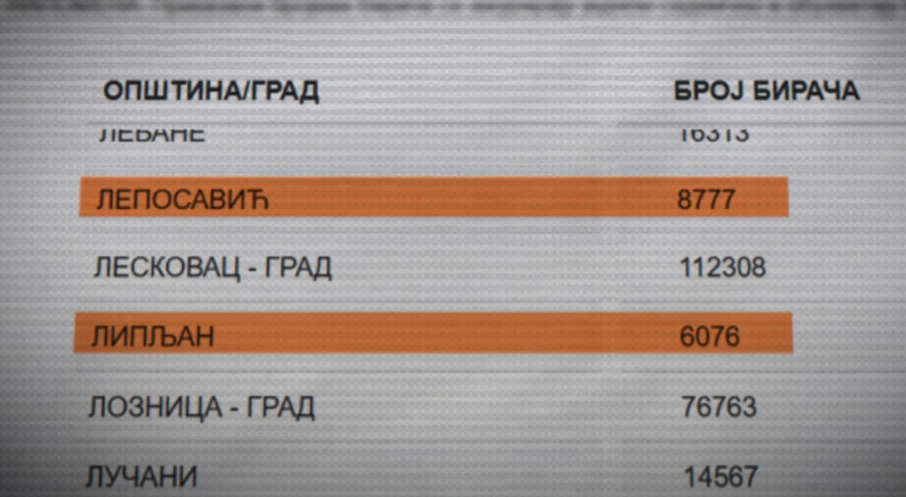
Ahead of the parliamentary elections in Serbia, Zoran Spasić from the village of Rabovce near Lipjan in Kosovo has not yet decided whether he will vote.
He is registered on the Serbian voter list, among more than 115,000 citizens with an address in Kosovo.
Compared to the previous election cycle, the number of voters in Kosovo is over twenty thousand higher, according to a survey by Radio Free Europe (RFE).
In the village of Rabovce, where Serbs and Albanians live together, 527 voters are registered.
However, Zoran Spasić estimates that there are actually fewer of them.
"There are people who have left. There have also been many deaths. The list is probably not up to date," he says.
Serbia is being urged by the ODIHR, an international observation mission of the Organization for Security and Cooperation in Europe (OSCE), to update its voter register.
However, authorities in Serbia claim that the voter register is "accurate" and "the most up-to-date so far."
But what is happening to the voter base from Kosovo, while Belgrade and official Pristina do not recognize each other and maintain parallel data?
Between two extraordinary votes in parliamentary elections, in less than three years, their number increased by more than twenty thousand.
While 94,161 voters from Kosovo were eligible to vote in the parliamentary elections in Serbia at the end of 2023, there are now 115,856 on the voter list.
How is this possible?
According to Ognjen Rašu from the Voter Register Review Commission, this does not mean that the number of people with Serbian documents living in Kosovo has increased.
This indicates that there has been a change in the way these voters are registered.
Until now, he says, they were registered at polling stations in Serbia – at the addresses where they had temporary residence.
"However, the residence permit is limited to two years. And the moment those two years passed, whoever did not extend their residence permit, they (the ministry) decided to delete them by residence and put them back on the list by residence, which was in Kosovo," he adds.
However, authorities have not explained why this has been done now.
The ministries of interior and state administration – responsible for citizens' personal data and maintaining voter records – had not responded to Radio Free Europe's questions about voters from Kosovo at the time of publication.
And Rašuo, who was elected to the Audit Commission as an opposition representative, points out that the voter list is "disorganized."
"Not only the data from Kosovo, but the entire voter list is like this. This is why there is a risk of abuse, because manipulations can be hidden in all these irregularities," he adds.
As it enters its most uncertain race since taking office in 2012, the ruling Serbian Progressive Party is rejecting accusations that the voter list is being manipulated to influence the voting results.
However, opposition and non-governmental observers called on the authorities to grant them access to all data – in order to verify various state databases to determine the accuracy of the list and prevent potential abuses.
The review of the list was among the ODIHR's main recommendations, with the aim of improving electoral conditions.
The government claims that the recommendations have been translated into laws.
However, in a preliminary report ahead of the October 25 vote, the ODIHR indicates that the accuracy of the voter register remains a concern – due to an unusually high number of registered voters in some municipalities and at certain addresses.
How did the number of people registered on the voter list increase?
Changes to the voter list in the weeks leading up to the October 25 elections can be tracked in the publicly available database of the Ministry of Public Administration and Local Self-Government, which is responsible for the voter list.
Radio Free Europe has determined that in the last three weeks alone, the number of voters in Kosovo has increased by more than a thousand – from 114,492, who were registered on September 22, to 115,856 voters on October 12.
The voter list is now closed.
The number of voters at each polling station, as well as their names, are also publicly available.
And who all ended up on the list, asks Zoran Savić from the non-governmental organization "Aktiv" from Kosovo.
He describes the voter base from Kosovo in Serbian elections as "contradictory".
"I'm not claiming that these are ghost voters, I have no evidence for that. But I responsibly state that the public does not have enough data to understand who makes up that electorate and what produces such large fluctuations," Savić declares.
While Serbia does not recognize Kosovo and considers it part of its territory, there is no accurate data on the number of citizens with Serbian documents living in Kosovo's cities and villages.
The documents, among other things, allow them to vote in elections.
They are mainly attended by the Serbian community, which recognizes the government in Belgrade.
And while the number of people registered on the voter list is increasing, research by non-governmental organizations shows that there are fewer and fewer Serbs in Kosovo, warns Zoran Savić.
"On the one hand, we have a Serbian community in which research clearly records a strong emigration trend, and on the other hand, we have a voter register in which the number of voters from Kosovo is in completely different proportions," he adds.
Duplicate names in the list and spelling errors
The increase in voter turnout in Kosovo is not the only thing RFE/RL has noticed.
By processing the data from the database, it was determined that several hundred names were repeated.
At the same polling station, 349 names were registered more than once – with the same first name, last name, and parents' names.
Of these, 329 names were listed twice, 11 three times, seven four times, and two names even five times.
The same names are repeated in different voting centers in Kosovo.
Thus, more than 700 identical names were found in two polling stations, 32 identical names were found in three polling stations, and one name in up to five locations.
In more than 3,800 names on the list, the parent's name is missing from the data.
Hundreds of spelling errors in names and surnames were also found on the list.
And more than 2,500 names are written in a mix of Cyrillic and Latin.
If data from citizens' personal documents is entered into the database, their names should not have been entered that way.
Serbian authorities do not provide an explanation for these errors, while the website of the Ministry of Public Administration states that for each polling station “updated data from the voter register is displayed”.
Since there were errors in the data, the relevant ministries did not respond to Radio Free Europe.
Representatives of the Voter List Review Commission also asked whether there were any remaining errors in the data on election day.
Ognjen Rašuo tells Radio Free Europe that they asked to be given extracts from the voter list, as they will be printed for the elections.
"To check if there are people who have registered twice and if all the data is complete so that the voter can be identified when they come to vote," he explains.
He points out that they have not received them to date.
This is why, he notes, control at polling stations is essential.
"If the control on election day is good, no one can vote twice or without personal documents, because this will be noticed," emphasizes Ognjen Rašuo.
According to the rules, every voter must present a valid identification document when they come to vote. Everyone's finger is sprayed with a spray that is visible under UV light, in order to prevent the possibility of multiple voting.
Where do voters from Kosovo vote?
Serbia registers voters from Kosovo in 23 cities and municipalities in Kosovo.
The territorial division, i.e. which settlement belongs to which municipality, is different from that led by the Kosovo authorities after the declaration of independence.
Citizens eligible to vote in the Serbian elections are divided into 60 voting centers.
But they do not vote in Kosovo, but in the four border municipalities of Serbia – Tutin, Raška, Kuršumli, Vranje.
This practice was established in 2022, after authorities in Pristina refused to open voting centers in Kosovo, in places where the Serbian community lives.
While in the previous 2023 elections, 51 polling stations were open in Serbia for Kosovo voters, now there will be 60 – because the number of voters has officially increased.
Zoran Spasić from Rabovac must vote in Kuršumli in these elections.
He is a farmer and, as he says, it is a "waste of time" for him to spend the whole day traveling to vote.
"If there were a vote in Kosovo, I would vote. The whole family always voted," he says.
His address in Rabovac, where he is listed on the Serbian voter register, is listed as “no street, zero.”
This means that his address is not accurately recorded either on the voter list or in Serbian documents.
This is how the other residents of Rabovac were registered.
However, Spasić says that the data in Kosovo documents is different.
Five years ago, the street where he lives in Rabovac was given a name and a house number, and his mail and bills arrive at that address.
And this is another example of how Belgrade and Pristina data do not match.
Serbia has its own data, created before the 1999 war and Kosovo's subsequent declaration of independence in 2008, and Kosovo has its own.
Apart from street names, the names of individual settlements are not the same.
And on the Serbian voter list, there are several thousand Albanian names.
They were also noticed on the voter list in Lipjan.
However, Zoran Spasić says he does not know any Albanians who voted in Serbian elections in the post-war period.
"Specifically, while the elections were being organized here in the village, none of the Albanians voted in those elections. I highly doubt that anyone will go to Serbia to vote now. I don't know if they have Serbian documents, but I certainly don't believe they vote," he says.
How many voters are there in Klina?
In the small municipality of Klina, near Peja, live 120 members of the Serbian minority.
Silvija Rašković works in the local community office, which operates within the Kosovo system.
"We have empty villages, empty houses," she says.
Although municipal documents in Klina list around 1,600 returnee families, Silvija Rašković says that most of them, after rebuilding their homes in their hometowns, returned to live in Serbia.
They, he points out, usually come to Kosovo when they need to “finalize an inheritance dispute or sell their property.”
However, on the Serbian voter list, Klina has more than 1,800 voters.
However, Silvija Rašković emphasizes that this number does not correspond to the situation on the ground.
He suspects this is "a form of manipulation."
He also does not believe that all deceased citizens have been removed from the voter list in Klina.
"We have a lot of dead people. I know people who have death certificates issued here (in Kosovo), but are still on the voter list in Serbia. I can tell you that at least 80 people don't exist," she says.
She did not want to mention specific names.
And in another city in Kosovo, Mitrovica, RFE/RL found at least one dead person on the voter list.
The name of the deceased was found at the "Kosovska Mitrovica 4" polling station.
Family members found him on the voter list, but they did not want his name to be made public.
After reviewing the list on October 12, the deceased's name was still in the voter database.
How many voters are there in Peja?
The city of Peja has almost 4,000 voters on the Serbian voter list.
Zoran Savić from the non-governmental organization "Aktiv" from Kosovo claims that in reality there are incomparably fewer of them.
He recalls data from the OSCE international mission, according to which there were 332 members of the Serbian community in Peja.
“I am not claiming that the rest are ghost voters. Among them could be Albanians with Serbian voting rights, displaced persons, people living in Serbia or abroad. But that is precisely the point. If the state says there are almost 4,000 voters in Peja, the public should know who makes up that number.”
“How many of them actually live in Peja, how many are displaced, how many live in Serbia or abroad, and how many are still registered at their old addresses?” asks Savić.
A 2024 Aktiva survey showed that 66 percent of Serbs surveyed knew someone who had left Kosovo in the previous one-year period.
In the north, this percentage was almost 71 percent.
"Not even a year later, this problem has disappeared. In the Trend Analysis for 2025, about 45 percent of respondents list migration and youth departure among the main problems of the Serbian community in Kosovo," Savić emphasizes.
Past election cycles have shown low voter turnout in Kosovo.
In the previous parliamentary elections, held in December 2023, turnout was around 25 percent.
And the support that Kosovo voters gave to the ruling parties, led by the Serbian Progressive Party and the Socialist Party of Serbia, was almost absolute.
Of the 23,878 voters who cast ballots, more than 19,000, or about 80 percent, supported the ruling coalition.
How has the voting gone so far?
The last parliamentary elections organized by Serbia in the Serbian communities in Kosovo were on June 21, 2020.
They were held according to previous practice, according to which votes were collected by the OSCE mission in Kosovo.
The ballots were then counted in Serbia, in two border municipalities, Raška and Vranje.
And the practice of opening polling stations in Serbian areas was abolished by Prime Minister Albin Kurti in 2022. At that time, a resolution was passed in the Kosovo parliament against holding the vote organized by Serbia.
The international community has repeatedly called on the Kosovo Government to find ways to enable citizens to vote in Serbian elections.
However, Pristina is seeking a direct request from official Belgrade for their detention on Kosovo territory, instead of the OSCE acting as a mediator.
Serbia rejected this, claiming it would recognize Kosovo's independence.
 Konjufca speaks to Hungarian media, warns of the risk of a new armed confrontation with Serbia
  Security expert: Serbia is a small Russia, Balkan security threatened by Russian influence
  Bieber dismantles Vučić's regime: His power rests on corruption and ties to organized crime
 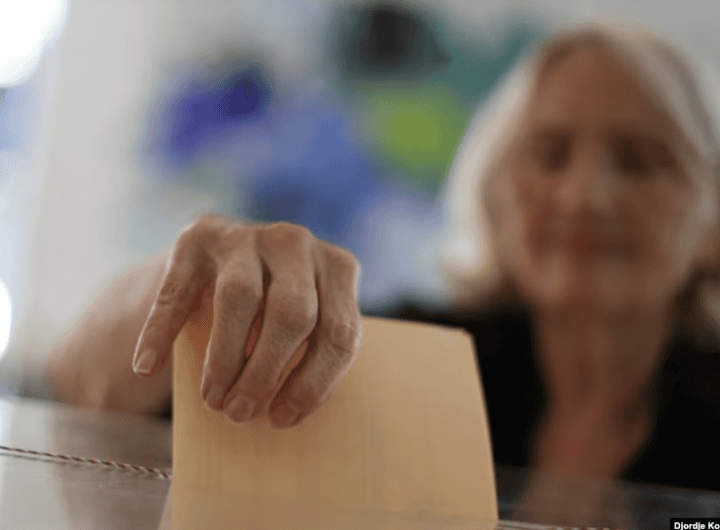 Suspicions of possible manipulation, European Parliament appoints observers for elections in Serbia
  Wiretapping file: Vučić linked to drug boss, also gave guarantees for his release from prison
  Croatian MEP: No policy changes the historical fact that Kosovo, Croatia and Bosnia were victims of Serbian aggression