

In an interview with the renowned German newspaper "Süddeutsche Zeitung", renowned expert on the Western Balkans, Florian Bieber, speaks about the structure of Vučić's regime, his connections to organized crime, and the opposition's chances for change.
As Serbia approaches parliamentary elections on October 25, the country's political scene is facing a decisive turn. With the constitution barring him from running for a third term as president, Aleksandar Vučić is seeking to return to the top of the executive branch as prime minister. However, this time he is faced with a new student-led opposition movement that is openly challenging his power apparatus.
In a lengthy interview with the renowned German newspaper "Süddeutsche Zeitung", renowned expert on the Western Balkans, Florian Bieber, has detailed the structure of Vučić's regime, his connections to organized crime, and the opposition's chances for change.
According to the professor of political science at the University of Graz, Vučić's decision to aim for the post of prime minister is no surprise, as his departure from politics has never been a realistic option. Bieber explains that Vučić has built a complex power pyramid over the years, which keeps his entire system afloat.
According to him, it is precisely this network that makes handing over power impossible: "An elucidation of all the accusations of corruption, of involvement with organized crime and of misuse of the state for party purposes would certainly put him in great difficulties. The loss of power would constitute a threat not only to him, but also to his entire circle."
In his analysis for the Süddeutsche Zeitung, Bieber explains that Vučić's power rests on two main pillars: the party's complete penetration of every level of state administration and the exercise of informal power. He notes that there is almost no municipality in Serbia that is not controlled by the ruling party, while any attempts at change at the local level have been suppressed through the purchase of opposition politicians, open pressure and manipulation of election results.
For the first time, the student movement – which has turned Serbia into a “laboratory of a democratic uprising” – has decided to enter the election race directly with its own list, led by medical professor Ilija Srdanović. The only condition of this list was that the candidates had no political past. Bieber points out that the old forces linked to the secret services and organized crime, which once led to the assassination of reformist Prime Minister Zoran Đinđić in 2003, are still present.
However, the difference today is that the new student movement has as its central objective the destruction of these structures. "If the student list were to win the elections, the threat to these power structures would be much more concrete and greater. Some would certainly try to burn documents, escape to Dubai or secure themselves in other ways - and as we have seen in the past, these groups are also ready for violence," Bieber emphasizes.
Regarding external influence, Bieber notes that Belgrade's relations with Moscow remain complex, with Serbia serving as a transit point for Russian agents while selling ammunition to Ukraine.
Regarding the West's position, the analyst regrets the soft approach of the European Union and especially Germany, recalling that Vučić until recently also had a German advisor in the presidency paid for by German taxpayers.
He criticizes the lack of serious pressure from Brussels on media freedom and voter registration. Since polls predict a fairly close result, any vote manipulation could have immediate effects, leading Serbia into a new phase of instability where both sides could declare victory and citizens could take to the streets again.
 Suspicions of possible manipulation, European Parliament appoints observers for elections in Serbia
  Ukraine to resume attacks on Russian oil refineries, Zelensky says
 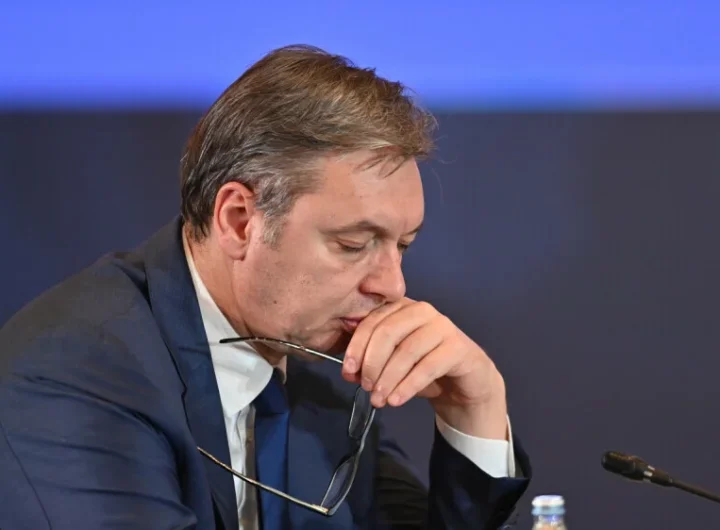 Wiretapping file: Vučić linked to drug boss, also gave guarantees for his release from prison
  Croatian MEP: No policy changes the historical fact that Kosovo, Croatia and Bosnia were victims of Serbian aggression
  Kallas: Russia will not force Ukraine to surrender, Europe will continue to support Kiev
  Lazar Radullović calls Serbian List a criminal organization: You can kill me, but you can't scare me