

Merz said a ceasefire in Ukraine is on the horizon for the first time since the start of the war, after hosting representatives from Ukraine, Europe and the United States in Berlin.
A European-led "multinational force for Ukraine," made up of contributions from willing countries within the framework of the Coalition of the Willing and supported by the US, will help secure peace in Ukraine, German Chancellor Friedrich Merz said.
In a statement, Chancellor Merz said the multinational force would enable "the regeneration of Ukrainian forces, the securing of Ukrainian airspace and the support of safer seas, including through action inside Ukraine."
He added: “It is now up to Russia to demonstrate its willingness to work towards a lasting peace by accepting President Trump’s peace plan and to demonstrate its commitment to ending the fighting by agreeing to a ceasefire. The leaders agreed to continue increasing pressure on Russia to force Moscow to enter into serious negotiations.”
Merz reiterated that a ceasefire in Ukraine is on the horizon for the first time since the start of the war, after hosting Ukrainian, European and American representatives in Berlin.
"The possibility of a ceasefire is conceivable. We want to walk together on the path to peace, with the Ukrainians, our European neighbors and the United States," Merz wrote in a post on the X network.
US President Donald Trump, speaking at a White House event on Monday after joining a dinner in Berlin where US envoys Steve Witkoff and Jared Kushner were holding talks on Ukraine with Ukrainian President Volodymyr Zelenskyy and European leaders, said: “I think we are closer now than we have ever been before.”
Meanwhile, US negotiators have told Ukraine at peace talks in Berlin that it must agree to withdraw from the Donetsk region to end the war with Russia, but have also made a "significant" offer to guarantee security after the war.
As Ukrainian and U.S. negotiators wrapped up a second day of talks in the German capital, Kiev demanded further discussions, a source told Reuters on condition of anonymity. A second person familiar with the talks said there were still major obstacles to reaching an agreement on territory.
Calling the issue of territorial concessions "painful," President Zelenskyy confirmed later in the day that differences on the issue continue.
"Honestly, we still have different positions," he said, adding, however, that he believes American mediators will help find a compromise.
He said Kiev negotiators would continue consultations with their American counterparts, adding that Ukraine needs a clear understanding of security guarantees, including monitoring of the ceasefire, before making any decisions regarding the front lines.
“I don’t think [the US] has asked for anything,” said President Zelenskyy. “We see ourselves as strategic partners, so I would say that the issue of territories we have heard in connection with Russia’s vision or demands through [the US]. We see these as demands of the Russian Federation.”
Optimistic Kiev
Kiev is under intense pressure from Trump to make concessions to Russia in order to end the deadliest conflict in Europe since World War II, which began with the invasion of Moscow in 2022.
Zelenskyy held talks in Berlin with US envoys Witkoff and Kushner, President Donald Trump's son-in-law, as well as with European leaders.
However, despite the stated differences, Kiev maintained an optimistic tone in public comments.
“Over the past two days, Ukraine-US negotiations have been constructive and productive, with real progress achieved,” Rustem Umerov, secretary of the National Security and Defense Council, wrote on X after Monday’s talks.
Security guarantees
Ukraine said on Sunday it was willing to give up its ambition to join NATO in exchange for security guarantees from the West.
In response, European leaders said on Monday they had agreed that any decision on possible territorial concessions by Ukraine to Russia could only be made after strong security guarantees had been put in place, which should include a European-led multinational force.
The declaration, signed by 10 European leaders, as well as European Commission President Ursula von der Leyen, outlined the necessary security guarantees and said Ukraine must be able to maintain its armed forces of around 800.000 troops to deter future conflicts.
Security guarantees would also include a US-led ceasefire monitoring mechanism to provide early warning of any future attacks and respond to violations.
"Decisions on the territory belong to the people of Ukraine, once strong security guarantees have been realistically established," the statement said.
Territory for security
Chancellor Merz said the US had made a significant offer regarding security.
“What the US has put on the table here in Berlin, in terms of legal and material guarantees, is really considerable,” Merz said at a joint press conference with Zelenskyy. “The territorial solution remains a key issue,” he added.
However, sources told Reuters that these security guarantees will not remain on the table forever.
One source said that Russia is open to Ukraine joining the European Union and that Trump wants to prevent further Russian penetration westward.
Ukraine defiant
President Zelenskyy is walking a difficult line, under pressure from Trump to accept a deal, but at the same time needing it to be acceptable to the Ukrainian people.
Underscoring the challenge it faces, a poll released on Monday showed that three-quarters of Ukrainians reject major concessions in any peace deal.
The poll by the Kyiv International Institute of Sociology (KIIS) showed that 72% of Ukrainians were ready for an agreement that would raise the current front line and include some compromises.
However, 75% believed that a Russia-friendly plan that would involve surrendering territory or limiting the size of the Ukrainian army without clear security guarantees was “completely unacceptable.”
Only 21% of Ukrainians trust Washington, the poll showed, down from 41% in December last year. Trust in NATO also fell to 34% from 43% over the same period.
“If security guarantees are not clear and binding… Ukrainians will not trust them, and this will affect the overall willingness to adopt the relevant peace plan,” wrote KIIS executive director Anton Hrushetskyi.
Decisive week
Monday's talks come at the start of a crucial week for Europe, with an EU summit on Thursday expected to decide whether to back a large loan for Ukraine using frozen Russian central bank assets.
EU foreign ministers met in Brussels on Monday to agree new sanctions targeting Russia's "shadow" fleet of oil tankers. However, the possibility of a last-minute setback to the EU's trade deal with Latin America threatens to undermine efforts to show unity and strength.
"The most important thing for us now is to ensure that we can finance Ukraine," said Danish Foreign Minister Lars Løkke Rasmussen.
"We need to make a decision to ensure that Ukraine is able to continue its fight for freedom and to show the rest of the world that Europe is a strong actor. Otherwise, we will succumb to the image that the American president paints, that Europe is weak."
Finnish President Alexander Stubb, who has been closely involved in the Ukraine talks and met with Zelenskyy on Monday, expressed cautious optimism, telling the Dutch television program *Buitenhof*: “…we are probably closer to a peace agreement than at any other time in these four years.”
Stubb said the parties are working on three main documents: the framework of a 20-point peace plan, a document on security guarantees for Kiev and a third on the reconstruction of Ukraine.
European Commission President Ursula von der Leyen, NATO Secretary General Mark Rutte and the leaders of Great Britain, Italy, the Netherlands, Poland and Sweden were among those in the German capital on Monday.
Polish Prime Minister Donald Tusk said before the talks that, in addition to security guarantees for Ukraine, he would also raise the issue of guarantees for countries on NATO's eastern flank, including Poland, especially regarding the planned number of US troops.
"Our priority is to ensure that no provisions affecting Poland are taken without us, and if provisions affecting us are adopted, they must strengthen our security," Tusk said before departing for Berlin.
/Kyiv Post/
 "Mafia State": Why Today's Serbia Resembles Palermo of the 70s
  Serbian students refute Belgrade's propaganda after visiting Kosovo: They lied to us, Serbs are not oppressed
  Four capitals, one problem: The collapse of Vučić's tower of cards!
  Twenty-seven years since the Kumanovo Agreement: The end of Milosevic's ethnic cleansing of Albanians
  Russian Foreign Ministry misinforms that Britain is pushing Europe into war with Russia
 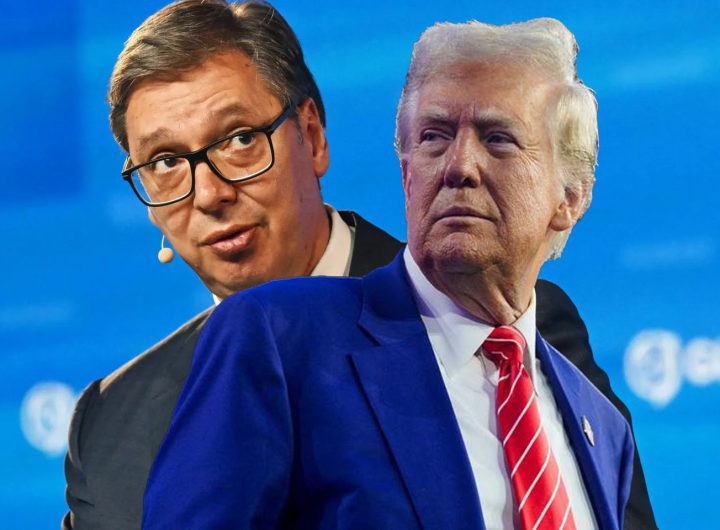 From criticism of the US to praise for Trump: Vučić's transformation into a refined servile