
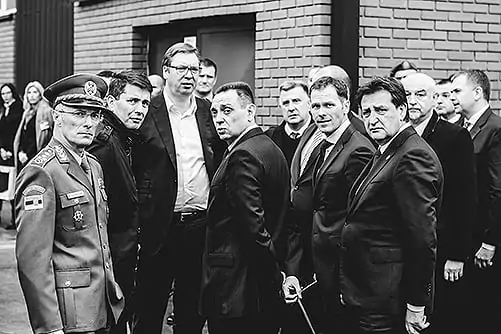
Many labeled the Serbian government as a “mafia,” but few could explain why. This is an attempt at an explanation.
The remaining independent segment of the Serbian population has claimed for years that it is Serbia. “A mafia state.” The relevant institutions do not respond to suspicions raised by investigative journalists, political scientists and sociologists; the evidence is usually dismissed and discredited as opposition activity.
Although we have heard this term for years and it is increasingly supported by material evidence of links to organized crime at the top of the state, there is no explanation of what a mafia state actually is.
While political scientists and sociologists use the term “Mafia” on television and in newspaper articles, they avoid it in academic publications – and for good reason. One reason is the multitude of other terms that describe the same phenomenon, such as party rule, clientelism, the dependent state or patrimonial capitalism.
Another reason for avoiding – again justified – the word “Mafia” is that it is empty, banal and even irrelevant. For a long time, even the term “planetary” was insufficient to adequately describe the subject, and at the same time, it can be used for almost anything.
Maybe it's Mario Puzo, maybe it's Hollywood, maybe it's the sea, but the author of this text likes to call it Italy's best export. Just as you can't simply order a pizza or an espresso, but have to specify which pizza and which espresso, so too, in the face of mounting evidence, is it not enough to simply label Serbia a mafia state?
It is clearly about the connection between organized crime and the authorities, about the dominance of informal power over formal power, but this does not give us answers to the questions of what this connection consists of and why it exists despite resistance.
What exactly is the Mafia?
The traditional mafia of southern Italy was observed and explained for nearly a century before the world learned about it through literature, films, and court cases. In 1881, the Italian political scientist and politician Gaetano Mosca asked in a famous essay: “What is the mafia?”
Contrary to previous assumptions that the Sicilian Mafia is a secret society, Mosca claims that it is an intermediary system within a weak state with corrupt state institutions. Mosca, for example, writes about the collaboration between Sicilian mafiosi and politicians from Rome, who secure Sicilian votes in exchange for impunity and tolerance for crime.
That Mosca's claims were true is borne out by the work of another renowned scholar of the Italian mafia, Diego Gambetta, who describes the mafia as a private security industry. Gambetta does not see the mafia as an organized criminal association that takes control of the state through capital or violence, but rather as actors who privatize basic state functions in a weak state.
When these actors fully seize formal positions of power during the historical development of the phenomenon, the Mafia becomes a state, that is, a pathology of statehood and anti-states.
It's not just about crime.
If Weber defined the state as an institution that successfully maintains a monopoly on violence, in this context we are talking about an institution that privatizes this monopoly. When we see that the security system is intertwined with criminal structures, we cannot speak of crime, but of the destruction of statehood.
Therefore, research on the mafia reminds us that the state is not just a building or a uniform, but trust, and that in mafia states trust is replaced by rational fear.
Life in mafia states – and we mean this literally – depends on loyalty to the mafia in power. According to some data, the unemployment rate in Calabria is almost 40 percent, while the notorious 'Ndrangheta controls almost 80 percent of the global cocaine trade.
It's a paradoxical contradiction. The Calabrian mafia makes billions of dollars every year, while the citizens of Calabria are practically starving?
Calabrian businesses are still often targeted by extortion, although this is no longer the mafia's main source of income. Like kidnappings, extortion is a thing of the past; local police can handle it relatively easily and safely.
However, there are those who get away with it, at least when it comes to the most serious crimes, and we all know who they are without having to mention them. The problems of these gangster bosses are a serious social issue. Families are at risk and the code of silence is deeply ingrained in the local culture.
Head turns
Mosca also says it's about mentality. Nobody saw anything, nobody knows anything, nobody is cooperating. Southern Italy has been in this state since the Moscow reports. The distrust in the state, its institutions and the system is so deep that it literally demands physical sacrifice.
Many paid with their lives for the fight for the state in the south. It was in these circumstances that Pope Francis visited Calabria in 2014 to tell them that the Mafia is evil. Although they swear by saints, many mafiosi are also founders, and initiation rites often take place in sacred places.
The relationships of dependency and entanglement between the mafia and society are so deep that it is almost impossible to break them. Where chronic mutual distrust prevails, where citizens trust neither the state nor each other, space is created for the mafia to rule.
The space for economic organization is thus divided into state projects that pass through the filter of mafia clans and are passed on to loyal clans, and the market is so blocked that cooperation with the mafia is more of a rational decision than a matter of honor, as it may once have been.
Blame the law.
Previous mafia investigations have consistently shown the same thing: The Mafia does not operate by breaking the law, but by bending it to its own ends. During the infamous incident, also known as the “Palermo heist,” hundreds of building permits were issued in a single night to companies used to launder mafia money.
Apart from the fact that documentaries were made about it, Palermo forever remained a city whose numerous monuments and buildings of cultural and historical importance had been destroyed. The Mafia does not rule through pure violence; its rule is costly and visible. The Mafia rules through predictability.
Despite the damage Hollywood has caused, a notable example of this phenomenon is the scene in which Don Corleone asks a desperate man why he went to the police before seeking help himself.
In the mafia system, who knows who is primary. It is a system of connections and acquaintances that was once romanticized as part of the culture, but which has now become one of the mafia's most important operational methods.
The mafia thrives on social distrust. By sowing distrust among its members and in the law and state institutions, it becomes a substitute for the state – the only one that can provide us with jobs, heal us, bring us prosperity, and help us. Once we first stop dismissing these events as isolated incidents or mere “affairs,” we are well on our way to understanding the mechanisms of mafia-like states.
All of Serbia is like Palermo.
While Palermo became the paradigm of the Sicilian mafia in the 1970s, Serbia now offers its own model. In our country, this process is not limited to the destruction of cities like the infamous coastal Belgrade, but also includes the systematic construction of a parallel state.
It is no longer about criminals bribing officials, about corruption, but about the fact that criminal structures and the state apparatus have become in fact one and the same. When projects, investments and government decisions in the public interest are determined not by the market, but by a list of friends, then the state in the modern sense no longer exists, but rather a private company with government power. There is countless evidence of this, known to every informed citizen.
Even those without work experience can receive a pension, prisoners apparently serve their sentences in police uniforms, and recently, there are clashes with the mafia, which the state is trying to cover up. Citizens are very aware of the game being played. Corruption has become a means of survival, and collaboration with local criminals ensures a living.
The necessity of research on the mafia lies not only in the study of clans and current events, but also in understanding the process of normalization of pathological phenomena. In a national context, this is the moment when corruption ceases to be a deviation and becomes the rule.
I'm talking about situations where citizens somehow know that a medical examination, taking medication, starting kindergarten, or starting a job implies a “relationship.” It's not corruption, it's a matter of survival.
The mafia state then rules not through violence, but through conditioning. The mafia turns citizens into collaborators because honesty becomes an existential luxury that citizens can no longer afford.
Media in the service of robbery
This is precisely why mafia systems rely on mass confusion, which they achieve through media control and the deliberate manipulation of public opinion. Although some call this phenomenon “spin dictators,” it is about something much more serious. Mafia states and so-called spin dictators deliberately use media manipulation and instrumentalize it for criminal activities.
Crime in a Michelin-starred restaurant: This is just the latest in a series. After this “affair” became public, there was a day of silence, but the system quickly recovered and to this day no one knows exactly what really happened there.
Therefore, this connection with the mafia is not an invitation to passively observe the evil and pathology of the state, but a call for analytical vigilance. Naming things becomes an act of resistance. Examining the mechanisms of the mafia state means calling phenomena by their name and hijacking reality.
In a country where the mafia has replaced itself – from diplomats to the judiciary – the truth remains the one thing that an organization cannot privatize forever. If we need to examine these mechanisms, then let us examine them; and if not, then let us examine them even more closely, because only in this way can we cease to be complicit in our own lack of freedom./ Vreme.
 The elections that scare Vučić: Promises to voters, destabilizing scenarios behind the ballot boxes
  Citizenship for "special benefit": What happened to Russian businesses in Bosnia?
  US launches 'economic attack' on Iran, demands countries cut 'aid lines' supporting Tehran
  BBC: "Black August" returns to Russia: The curse of the month that accompanies crises and challenges Putin
  Serbia and Russia increase propaganda for Kosovo, experts: The goal is control over the Serbian community
  Even when they leave Russia, Putin makes it difficult for Russians to renounce citizenship