
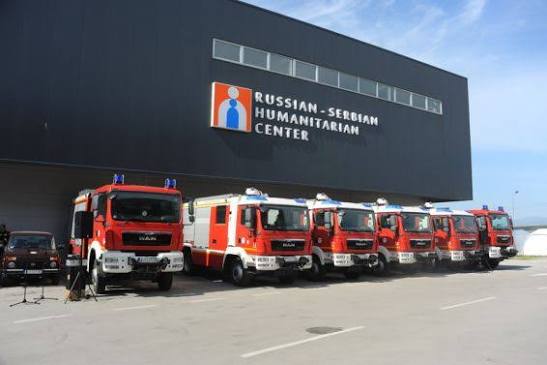
The latest agreement between Belgrade and Moscow on the development of the Serbian-Russian Humanitarian Center in Niš for the period 2025–2027 reopens a series of serious issues that have been surrounding this institution for years. Although officially presented as cooperation in the field of emergencies, the overall picture shows that this is a project with a much broader political and security context.
According to the agreement reached between Dmitry Melnik from the Russian Ministry of Emergency Situations and representatives of the Serbian Ministry of Internal Affairs, it is planned to purchase modern firefighting equipment, as well as install a new trainer at the center's training ground in Niš. Activities such as "Open Days" on the occasion of the center's 14th anniversary, as well as training volunteers for the needs of "Expo 2027" in the field of first aid and fire protection, have also been announced. At first glance, this is about technical and educational cooperation.
However, the problem arises when this stated role is compared to the broader political and security context.
The center has been surrounded by controversy since its establishment in 2012. One of the main suspicions, coming from Western security circles, is that it may have functions that go beyond humanitarian activities and potentially represent a logistics and intelligence point for Russia in the Balkans. Particularly noteworthy is its location in Niš, relatively close to Kosovo, where NATO forces are present through KFOR, which further increases the strategic importance of this space.
Russia and Serbia deny these claims, but at the same time have been trying for years to secure diplomatic status for the center's personnel. This request has been blocked since 2014 due to opposition from the European Union. The main reason is that such a status would provide immunity for the personnel and uncontrolled passage of equipment, which in practice would mean limiting state supervision over the center's activities.
The United States has also reacted to this issue. The then-Ambassador Kyle Scott warned that there is reason for concern and raised the question of what Russia is really doing at that center. The United States Department of State's position was even more direct, assessing that the center may have the potential for espionage activities and that its strengthening could lead to Serbia losing control over part of its territory.
The financial aspect further complicates the picture. According to available data, over 268 million dinars (about 2,29 million euros) have been paid from the Serbian budget to this center. In 2024 alone, about 55 million dinars have been allocated, while in 2025 about 48 million. The funds come from the budget of the Serbian Ministry of Internal Affairs, but it is not clear how they are spent exactly, as the descriptions of the payments are general and imprecise, such as “circulation of goods and services” or “other transactions.”
An additional problem is the legal status of the center. Although it has an active account with the State Treasury and a registered and tax number, the center is not listed in the register of the Serbian Business Registry Agency, which leaves uncertainty about its institutional status. There is no public data on the number of employees, nor transparent decisions on the appointment of managers.
The center’s activities further broaden the range of questions. Its members have participated in exercises in Russia and Belarus, including the “Secure Arctic” exercise in early 2025. These exercises are taking place in the context of heightened geopolitical tensions between Russia and the West and cannot be viewed solely through the prism of civil defense.
In a broader context, all of this is happening at a time when Russia is deeply involved in the war in Ukraine and when its presence outside the immediate circle is increasingly seen from a security perspective.
For Kosovo, such a situation has additional weight. The presence of a structure with significant logistical and security potential near its territory constitutes an additional factor of instability, despite its formal name and declared humanitarian role.
When taken together — the location, the lack of financial transparency, the unclear legal status, the diplomatic requirements, and the security context — it becomes clear that the Serbian-Russian Center in Niš does not function as an ordinary humanitarian institution. /The Geopost/
 EC raises alarm for Serbia: Corruption, state capture, intimidation and attacks on journalists remain serious problems
 How could a Democratic victory affect Trump's policies toward Russia, Ukraine, and Iran?
 Americans vote in midterm elections
 From “deep disappointment” to “constructive partnership”: How the Serbian List changed its language towards the EU
 British Air Force uses drones for first time to monitor Russian naval activity near British coast
 US reacts as China and Russia deepen cooperation in the Arctic