
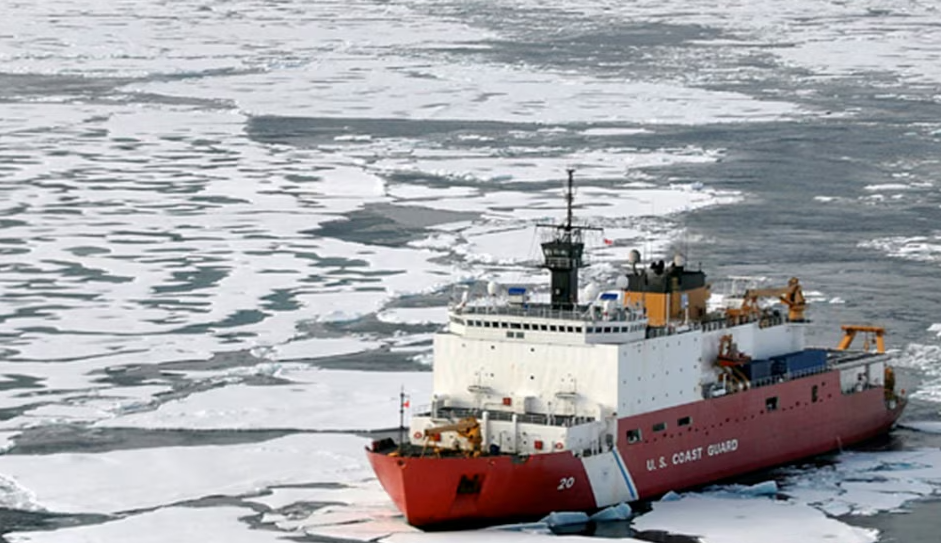
China and Russia are deepening strategic cooperation in the Arctic, increasing their economic, scientific, and military presence in a region that is of increasing importance to the national security of the United States and its allies.
At the recent meeting of the heads of government of the two countries, held on October 21 in St. Petersburg, Beijing and Moscow issued a joint statement, in which they expressed their intention to increase the transport of goods through the Arctic sea routes, to jointly build specialized ships for navigation in polar waters, and to expand cooperation between their enterprises in this region.
According to an analysis published by Radio Free Europe, this cooperation marks another step in expanding the influence of Washington's two main rivals in one of the world's most strategic regions, which extends over about 14.5 million square kilometers.
The Arctic is made up of eight countries that have territories within the region: the United States, Russia, Canada, Norway, Sweden, Denmark, Finland, and Iceland. China, although not an Arctic state, has significantly increased its efforts to gain influence in this space.
In 2014, Chinese President Xi Jinping declared that his country aimed to become a “great polar power” by 2030. Since then, Beijing has increased investment, research expeditions, and cooperation with Russia, particularly in the natural resources sector.
According to an estimate by the US House of Representatives Foreign Affairs Committee, China had invested about $90 billion in the Arctic since 2003. Meanwhile, after Russia's complete invasion of Ukraine in 2022 and Moscow's confrontation with Western sanctions, cooperation between the two countries has expanded in the military field.
"China wants to be as big a power as possible and therefore wants to show its presence in as many arenas as possible," Serafima Andreeva, a fellow at the North American and Arctic Defense and Security Network, told Radio Free Europe.
Although China has no territory in the Arctic, since 2018 it has described itself as a “near-Arctic state,” a phrase intended to legitimize its interest and involvement in the region. However, the United States disputes this claim, as China’s northernmost territory is about 1,450 kilometers from the Arctic Circle.
Russia, on the other hand, has viewed Beijing's claim with skepticism, but has tolerated the expansion of the Chinese presence, mainly due to its increasing dependence on China's economic support following the deterioration of relations with the West.
US security concerns
The strategic importance of the Arctic for the United States is particularly related to missile defense and Alaska's geographical position, where the main infrastructure for detecting and intercepting long-range ballistic missiles is located.
Greenland, an autonomous territory within the Kingdom of Denmark, is also of particular importance to the US and NATO, as it serves as a strategic point for missile early warning and space surveillance. It also possesses significant reserves of critical minerals, which are used in the production of military systems.
For this reason, the joint military activities of China and Russia in the Arctic have increased concerns in Washington.
In July 2024, Russian and Chinese strategic bombers conducted a joint patrol over the Bering Sea, approaching airspace near Alaska for the first time. The planes were intercepted by American and Canadian fighter jets.
US Senator from Alaska, Dan Sullivan, called the move an escalation, noting that it was the first time Russia and China had sent a joint bomber group into Alaska's air defense identification zone.
Meanwhile, during the Ocean 2024 military exercise, the two countries also conducted their first joint naval patrols in the Arctic Ocean.
According to Jo Inge Bekkevold, senior fellow for China at the Norwegian Institute for Defense Studies, these activities do not necessarily mean that Beijing intends to establish a permanent military presence in the Arctic, but they show its interest in strengthening relations with Moscow and monitoring US military activities in Alaska.
Scientific expeditions and suspicions of military use
In addition to military cooperation, China is also expanding its research activities in the Arctic. In July, it launched its 16th scientific expedition to the Arctic Ocean, sending four research vessels to the region simultaneously for the first time.
The Chinese ships passed through the US exclusive economic zone and over the extended US continental shelf in the Bering Sea, being monitored by the United States Coast Guard.
US officials have expressed concerns that the equipment installed on these ships could have dual use, for civilian and military purposes, including mapping critical underwater infrastructure and tracking submarines.
"They're not studying seals and polar bears. They're out there doing bathymetric studies and trying to figure out how they can counter NATO's capabilities at sea and under the sea," the commander of US European Command and NATO's supreme allied commander for Europe, Alexus Grynkewich, said in January.
Greenland, the sensitive point of rivalry
Despite China's ambitions, expanding its influence in the Arctic faces political and institutional obstacles.
One of them is its lack of membership in the Arctic Council, the main intergovernmental forum for issues in the region. China has had observer status since 2013, but has no voting or decision-making rights.
Of the eight member states of this council, only Russia has close relations with Beijing. The other six states – Canada, Norway, Sweden, Denmark, Finland and Iceland – are close allies of the United States.
Russia remains a key factor in the possibility of expanding Chinese influence in the region, but relations between the two countries are not without contradictions. Analysts say that Moscow sees itself as an Arctic power, while China aims to gain a similar status, which could create a clash of interests in the future.
One of China's most significant attempts to gain ground in the Arctic has been in Greenland. Between 2016 and 2018, Chinese companies attempted to buy three airports and an abandoned naval station in the territory. However, under pressure from the United States, Denmark blocked these transactions.
Efforts to gain control of the Tanbreez rare earths deposit in Greenland also failed. In April 2026, its acquisition was completed by the American company Critical Metals Corp, headquartered in New York.
In September, the United States, Denmark, and Greenland signed a new trilateral security agreement, which updates the 1951 treaty between Washington and Copenhagen.
The agreement aims to prevent China and Russia from gaining strategic influence in Greenland. It prohibits non-NATO countries, specifically mentioning China and Russia, from building military bases or stationing troops on Greenland's territory.
The pact also provides for the expansion of the US military presence, including the expansion of the Pituffik Space Base and the creation of new facilities. At the same time, it limits foreign investment from countries outside NATO and the European Union in strategic sectors, such as critical minerals, ports and telecommunications.
Why is the Arctic becoming increasingly important?
Despite the limitations it faces in this region, China is expected to continue efforts to expand its presence in the Arctic, mainly due to the economic and geostrategic importance it is expected to have in the future.
Melting ice, as a result of climate change, is opening up new sea routes that could shorten transportation times between Asia, Europe and North America.
These corridors could create alternatives to traditional transportation routes, such as the Suez Canal and the Strait of Hormuz, which are considered vulnerable due to geopolitical tensions and conflicts.
For Beijing, the Arctic does not currently constitute a security priority to the same extent as the Indo-Pacific, but is part of long-term strategic planning.
"Within about 10 or 20 years, maybe even less, these issues regarding the future of Arctic governance will become much more important as the Arctic melts," said Bobo Lu, a non-resident fellow at the Lowy Institute in Australia.
According to the analysis, rivalry for the Arctic is expected to intensify in the coming years, as the region is gradually transforming into a space where the economic, military, and geopolitical interests of major powers intersect.
 British Air Force uses drones for first time to monitor Russian naval activity near British coast
 Zelensky: Ukraine liberated more territory than it lost in October, Russia suffered over 54 thousand losses
 A Serbia without Vučić, but with the same policy towards Kosovo?
 US sells 500 Patriot missiles to Ukraine, but deliveries not expected to begin until after 2030
 Kallas says Putin's possible return to G20 risks normalizing Russian war crimes
 Zelenskyy in Turkey: Ukraine wants Turkish weapons to be tested against Russia