
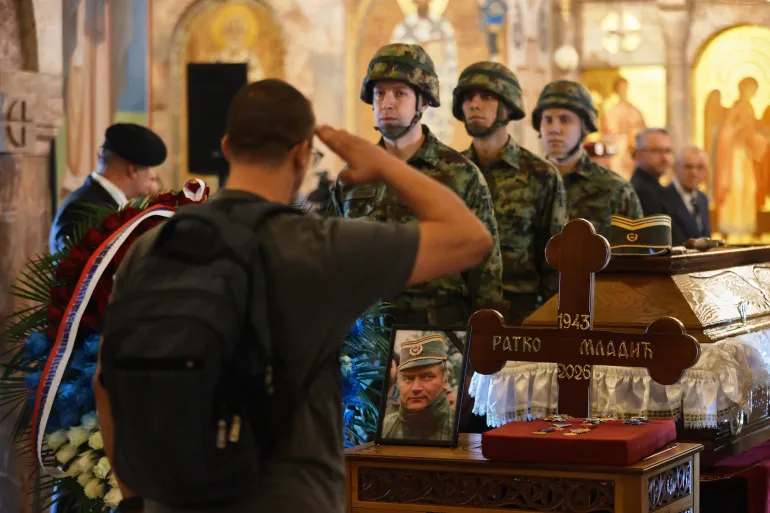
Some of the highest-ranking officials of Serbia and the Bosniak entity of Republika Srpska, the son of the state president, and the top leadership of the Serbian Orthodox Church gathered in Belgrade on September 7, where Ratko Mladic, convicted of genocide and other war crimes in Bosnia and Herzegovina, was buried with state and military honors.
The head of the Serbian Church performed the funeral service, and the Russian ambassador to Serbia, Alexander Bochan Kharchenko, also attended the funeral.
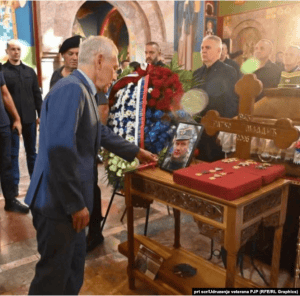
Analysis of publicly available footage and photographs shows that among those present were members of numerous veterans' and right-wing organizations, including individuals convicted of war crimes and spreading religious and national hatred.
Although the Serbian Criminal Code provides for a sentence of six months to five years for public approval, denial or significant minimization of genocide and war crimes, this provision applies to crimes determined by decisions of a court in Serbia or the International Criminal Court, while Mladić was convicted before the Hague Tribunal.
The sight of a column of people accompanied by state and church leaders following the coffin of a convicted war criminal has sparked widespread condemnation from the region, Brussels and Washington, with warnings that it is insulting the victims, undermining reconciliation and Serbia's European path.
Bosnia and Herzegovina's Foreign Minister announced that almost all diplomatic staff will be withdrawn from the country's Embassy in Serbia, in response to the actions of Serbian officials following the death and burial of a convicted war criminal.
Ministers pay tribute to war criminal
Serbian President Aleksandar Vučić previously said he would not attend the funeral due to an already announced meeting with the President of Uzbekistan.
His son, Danilo Vucic, arrived at the church accompanied by security members, some of whom were wearing T-shirts with the image of Ratko Mladic.
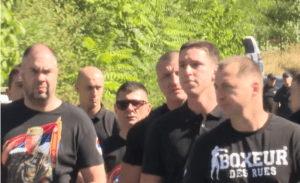
According to photos published in the media, the funeral was also attended by the sons of Police Minister Ivica Dacic and Hague convict Vojislav Seselj.
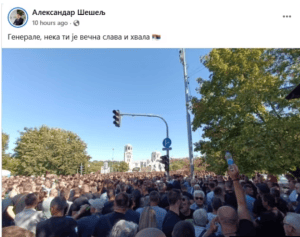
Six ministers, or one-fifth of the current Serbian government, appeared at the funeral.
Justice Minister Nenad Vujic, Defense Minister Bratislav Gašić, Labor Minister Milica Đurđević Stamenkovski, Culture Minister Nikola Selaković, and Public Investment Minister Darko Glišić were filmed in front of and inside the church at Mladić's funeral.
Also at the funeral was pro-Russian Minister without Portfolio Nenad Popovic, who is under US sanctions due to political and business ties to Moscow.
The funeral was also attended by Aleksandar Vulin, a former minister in the Serbian government and member of the Senate of the Bosnian entity of Republika Srpska, who is under US sanctions for spreading malign Russian influence in Serbia, as well as for suspected involvement in international organized crime, drug trafficking and abuse of public office.
Also present was Marko Kričak, head of the Criminal Police Directorate, known to the public for his controversies regarding the use of excessive force against anti-government protesters in Serbia.
The funeral was also attended by MP Miloš Jovanović, president of the New DSS, the national-conservative or right-wing opposition in the Serbian parliament.
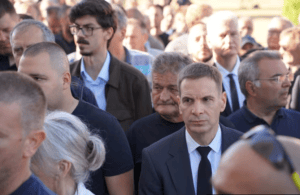
The director of the non-governmental Humanitarian Law Center, Jasmina Lazović, believes that everything that happened at the funeral is a clear indication that the state is behind this, despite the narrative promoted in pro-government media that senior government representatives were present as citizens and that the funeral was "of the people."
"President Vučić needs this so that in the eyes of Western officials he is not someone who organized a state funeral for a man convicted of the most terrible crimes in the former Yugoslavia," Lazović told Radio Free Europe (RFE).
Republika Srpska political leadership at funeral
The funeral was also attended by the leadership of the Bosniak entity of Republika Srpska (RS).
To honor Mladic, BiH Presidency member Željka Cvijanović, Alliance of Independent Social Democrats leader Milorad Dodik, RS President Sinisa Karan, entity government president Savo Minić, and Banja Luka Mayor Draško Stanivuković, among others, traveled to Belgrade.
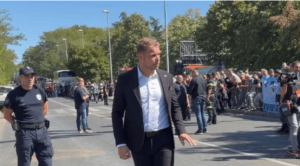
Representatives of pro-Serb parties – Milan Knežević's People's Democratic Party and Vladislav Dajković's Free Montenegro – arrived in Belgrade from Montenegro for the funeral of convicted war criminal Ratko Mladić.
The Serbian Church and the Hague convicts
At the funeral, along with the political leadership, representatives of the church leadership also gathered – the funeral service was led by Patriarch Porfiry, while the bishops presided over the ceremony.
During the ceremony over the coffin, which is covered with the flags of Serbia and Republika Srpska, Porfirije said that the name of the Hague convict "will remain deeply embedded in the memory and prayers of the majority of the Serbian and Orthodox people."
The day before the funeral, a call for volunteers to help the clergy organize the event, namely to distribute candles to attendees, was shared on the profiles of right-wing groups on Telegram.
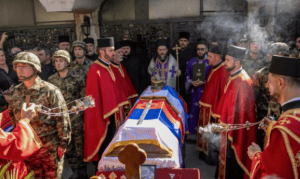
“The Serbian Orthodox Church has stood shoulder to shoulder with people who planned and committed war crimes since the 1990s, so this is just a continuation of that official policy,” says Jasmina Lazović.
She also states that the organizing committee for Mladić's funeral included Svetozar Andrić, until recently a member of the Belgrade City Council, against whom the Humanitarian Law Center filed a criminal complaint with the War Crimes Prosecutor's Office in 2018 for war crimes in Bosnia and Herzegovina, specifically for the Sušica camp in Vlasenica.
The funeral was also attended by Veselin Sljivancanin, a Hague convict who was serving a 10-year prison sentence for the crime in Ovqara in Croatia.
From the Red Berets to the Night Wolves
Veterans of the Army of Republika Srpska played an important role in the funeral, as did representatives of numerous veterans' organizations from Serbia, who stood in rows by the coffin.
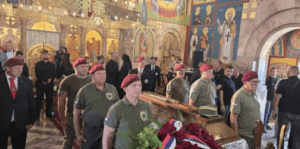
The published photos show that among them were veterans of the Special Police Units, members of the “Basket Heroes” association, as well as veterans of the Red Beret, an organization that unites former members of the disbanded special unit of the State Security, whose members participated in war crimes and were convicted of the liquidations of political opponents.
All of the above-mentioned organizations, according to previous RFE/RL research, finance their activities with donations from local or republican authorities.
According to social media posts, also present were members of the right-wing Serbian organization Action and People's Patrols, members of the International Sovereign League – Paladins (ISL Paladins), an international far-right network founded in Russia in 2025, with the participation of actors close to the Kremlin.
Members of the Russian motorcycle club "Night Wolves," which is under EU and US sanctions due to close ties to Vladimir Putin and support for the invasion of Ukraine, were also seen at the entrance to the church.
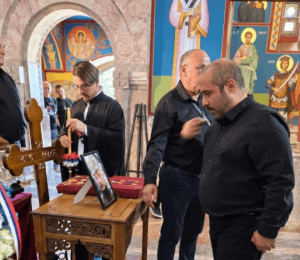
Miša Vačić, the leader of the far-right Serbian Right, and Goran Davidović Führer, the leader of the banned neo-Nazi “National Movement” and one of the founders of the new ultra-right Party of Serbian Nationalists, were also filmed at the funeral.
Davidović was sentenced to one year in prison by final judgment for inciting national, racial and religious hatred and intolerance after he and a group of neo-Nazis attacked an anti-fascist rally in Novi Sad in 2005.
What was Ratko Mladic convicted of?
Former Republika Srpska Army general Ratko Mladić was sentenced to life imprisonment by a court in The Hague after being found guilty of genocide in Srebrenica, persecution and forcible transfer of the population, terrorizing civilians during the siege of Sarajevo, and taking United Nations peacekeepers hostage.
In 2021, Mladić was convicted of 10 out of 11 charges of war crimes and crimes against humanity.
The Hague tribunal found Mladic guilty of genocide committed against around 8,000 Bosniaks in Srebrenica, a UN-protected area, in the summer of 1995.
Mladic was found guilty of a comprehensive joint criminal enterprise for the permanent removal of Bosnian Muslims and Croats, through the crimes of persecution, extermination, murder, forcible transfer as an inhumane act, and deportation.
The former commander of the Army of Republika Srpska was found guilty of a joint criminal enterprise in Sarajevo, for spreading terror among the civilian population, sniping and shelling, murder, terrorizing and unlawful attacks on civilians.
He was also found guilty of a joint criminal enterprise in connection with the taking of hostages to capture UN personnel and detain them at strategic military locations in order to prevent further NATO air strikes on Bosnian Serb military targets.
He was acquitted of genocide charges in six municipalities of Bosnia and Herzegovina during 1992 – Prijedor, Sanski Most, Ključ, Kotor Varos, Foča and Vlasenica.
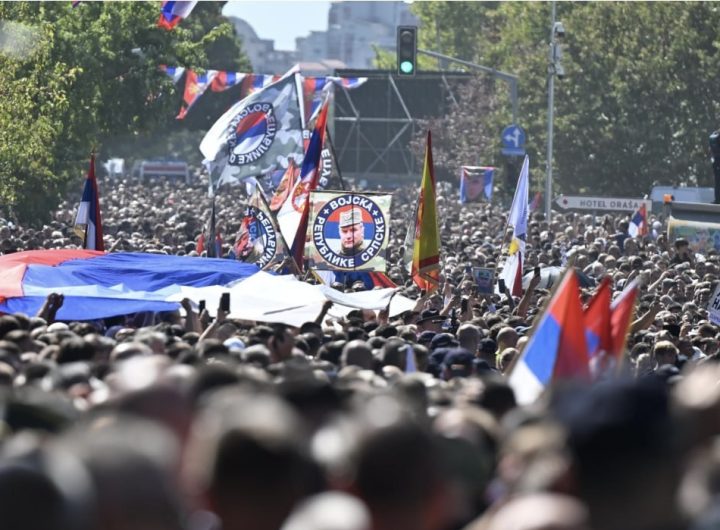 Belgrade bids farewell to Mladic with military honors: Thousands attend funeral of convicted war criminal
  Elections without a solution: When Serbia fights for everything but its future
  Trump's envoys give first signal after meetings in Russia and Ukraine
 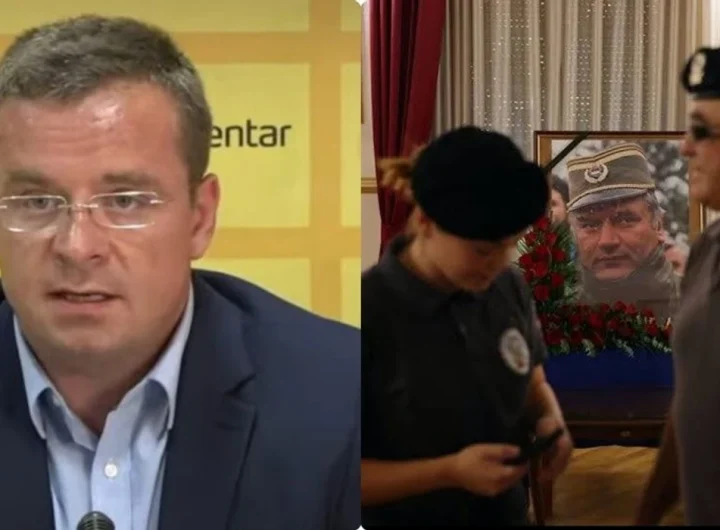 Serbian lawyer reveals Vučić's double game: He speaks differently to Europe, while honoring Mladić with a state ceremony
  Germany prepares "defensive shield" against sabotage, Berlin concerned about hybrid attacks
  EU targets camp in North Korea where Russia sends kidnapped Ukrainian children