
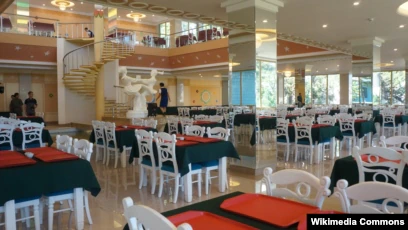
Russia has sent kidnapped Ukrainian children to a summer camp in North Korea, according to a European Union document seen by REL that outlines a planned new round of sanctions.
The document lists the persons and entities that will be included in the new EU sanctions against Russia, which are expected to be adopted next week.
The individuals proposed for sanctions are mainly senior officials in the Russian-occupied territories of Crimea and Donbas, but perhaps the most prominent name on the list is the Songdovon International Children's Camp, which is run by North Korean authorities.
The document states that this camp "participates in organized programs involving the transfer of Ukrainian children from the temporarily occupied territories of Ukraine to North Korea."
The transfers are coordinated by Russian officials and, while supposedly a matter of "cultural exchange," the document states that it "serves a broader propaganda function: Ukrainian children are exposed to selected pro-Russian narratives."
In other words, the document adds, the camp "is directly involved in the illegal transfer, ideological indoctrination and militarization of Ukrainian children in collaboration with the Russian Federation."
The camp is located on the east coast of North Korea, in the Sea of Japan, about 95 kilometers from the border with South Korea.
Uri Tours, a company in North Korea promoting the camp, says it is the largest in the country and was opened in 1960 to "promote international friendship."
The camp was sanctioned by the United Kingdom in May for "providing support for the Russian Government's program of forcible deportation and re-education of Ukrainian children."
North Korea responded by recalling its ambassador from London and downgrading diplomatic relations.
The International Criminal Court (ICC) has issued an arrest warrant for Russian President Vladimir Putin for the "illegal deportation... of Ukrainian children."
North Korea's involvement in Russia's child abduction campaign appears to further enhance its role in the war.
North Korea sent about 12.000 troops to fight alongside Russian forces in 2024, following Ukraine's incursion into the Kursk region. South Korean intelligence has reported that about 2.000 Pyongyang troops have been killed in the fighting.
Recently, Ukrainian President Volodymyr Zelensky stated that more North Korean troops would be sent to Russia, which could be used to operate ballistic missiles produced by Pyongyang in attacks on Ukraine.
Other entities listed on the EU sanctions list are so-called "summer camps" in Russia or in the occupied regions of Ukraine.
According to the European bloc, children sent there are exposed to programs that promote "loyalty to Russia, Russian national identity, the acquisition of Russian national values, military history topics, and participation in activities related to military-patriotic organizations."
The document also states that these types of deportations "constitute serious violations of international law and violations of the fundamental rights of the child, aimed at erasing Ukrainian identity and undermining the preservation of the identity of future generations."/REL
 The two faces of Serbia
  Trump: Putin wants deal to end war in Ukraine
  EU gives green light to 3.2 billion euros for Ukraine's Patriots, new shield against Russian attacks
  Romanian intelligence thwarts suspected sabotage operation coordinated by Russia
  From state and church leaders to the 'Night Wolves': Who was at Ratko Mladic's funeral? (PHOTOS)
  Finland completes 200 kilometers of wall along border with Russia