

An economy fueled by war. From television screens to classrooms, a pervasive narrative of confrontation with the West. Thousands of soldiers wounded in the war, some of them convicted of serious crimes who were released from prison and sent to fight in bloody battles in Ukraine, are returning to cities and towns across Russia.
At an economic forum hosted by Russian President Vladimir Putin in St. Petersburg earlier this month, plumes of smoke from Ukrainian drone attacks on oil facilities near his hometown were a stark symbol of the troubles Russia faces in the fifth year of its full-scale invasion of Ukraine, a war he had hoped would bring Kiev to its knees within weeks.
These and other Ukrainian attacks deep inside Russian territory have served as dramatic reminders that, to have any chance of achieving Putin's main war objectives, including taking control of the entire Ukrainian region of Dobas, Moscow's forces will have to keep fighting.
Less visible at the forum are a number of internal factors that for Putin constitute a major obstacle to ending the war he started.
According to analysts, it is a network that he himself created – and one that would be difficult to dismantle without creating significant risks for Russia, as well as for his political position, after more than a quarter of a century in power as president or prime minister.
Putin has, in effect, created a monster. Or, as political scientists Seva Gunitsky and Jeremy Morris described in a recent article in the journal Foreign Affairs, he has “fallen into a war trap that… no one can easily dismantle.”
"We're talking about the shadow economy, labor markets, regional budgets, even the social hierarchy within the country - all reoriented around the conflict," George Gunitsky, who is chair of the peace and conflict studies department at the University of Toronto, told REL.
"In this sense, it has transformed into a nationwide institutional and economic order, the inertia of which limits even Putin."
"Banning it would mean economic disruption, social upheaval and perhaps even a political crisis that the regime is simply not prepared to handle," he said.
Since the start of the full-scale invasion of Ukraine, entire regions, industries, and segments of the population have become dependent on war-related financial flows, from men joining the army for the high pay to arms manufacturers.
These cash flows “do not benefit the general population. But for sectors that depend on them, such as the arms industry, which employs millions of people, the continuation of the conflict is crucial,” Gunitsky said. “Any interruption would be deeply destabilizing.”
"Slow bleeding"
An end to the fighting would bring many soldiers home to face an uncertain future, including convicted criminals who joined the army in exchange for their freedom. Prison and war veterans have already committed a number of violent crimes across Russia.
“Russia faces costs in every case — but they are very different types of costs,” Gunitsky said. “The costs of continuing the war are slow and diffuse: inflation, labor shortages, civilian stagnation. The costs of stopping the war are immediate and concentrated: mass unemployment, a veterans’ crisis, and a possible collapse of the defense industries.”
"Historically, regimes almost always choose slow bloodshed over acute crisis," he said.
So far, Putin has made the same choice or, at least, has refused to change course.
Despite the Kremlin portraying Putin as a decisive and unwavering man of action, Russia expert Mark Galeotti describes him as an "indecisive" person, always postponing important decisions or changes.
Moreover, Putin may fear that stopping the war now would leave him with little to show for it, after nearly five years of war in which Russian forces have made limited gains while suffering heavy losses – almost 500.000 killed, according to a British intelligence estimate published in May.
The Sword of Damocles
Many of the deaths have occurred in long, grueling and deadly battles in the Donbass – the Donetsk and Luhansk regions of eastern Ukraine – which have left cities in ruins. Putin has baselessly claimed that these two regions, as well as Crimea, Zaporizhia and Kherson, now belong to Russia, creating pressure on his own state to fully control them.
"If there is a peace agreement that cannot be sold as a victory, this creates tremendous tension," Gunitsky told REL.
"Any agreement – even a ceasefire – will have to allow Putin to present it as a convincing victory, or at least as a convincing step towards a victory," he said.
This may be a big reason why Putin seems determined to take the rest of Donbas, at least, whether through force or diplomacy: the Kremlin has repeatedly stated that Ukraine's withdrawal from the strategically important part still controlled by Kiev is a precondition for talks.
Public opinion polls show that most Russians favor peace talks rather than continuing the war, while some analysts say Putin can sell almost any outcome as a victory or at least an attempted victory.
“We must always remember that Russia has the ability to declare peace at any time,” Galeotti said in his podcast on June 14. “It can say it is stopping with the front lines, which are frozen, but it holds over the head of Ukraine – and also of the West – the possibility of a new offensive like a ‘sword of Damocles.’”
“In Russia… there is clearly a campaign within some segments of the elite, particularly the business and technocratic elites, to convince Putin that he can simply declare a triumph and end the war,” he said, adding that Putin, who has maintained power by pitting rival camps within the government and security structures against each other, “has clearly allowed this to happen.”
“So Putin is willing to allow a debate, but so far there is no evidence that this debate is changing his mind: currently he either still supports the hard-line position that Russian forces will take the rest of Donbas this year if they keep up the pressure, or at least, he is not convinced by the other argument,” Galeotti said. “And, in the absence of any decision from Putin, the status quo continues, so the war continues.”
"A new kind of problem for Putin"
Sam Greene, a professor at the Russia Institute at King's College London, also raised the possibility that Putin might try to appease both hardliners and more liberals - or by seeking a ceasefire "in which Russia would maintain claims to Ukrainian territory and in which Europe remains mobilized to contain and confront Moscow."
"This is likely to satisfy some, by reducing the costs of war, while also satisfying another camp who would continue to receive military investment and gain political clout in a Russia that remains conflict-oriented," Greene wrote.
It would also be less burdensome for the Kremlin's narrative of the war as part of an existential confrontation against an immoral West bent on Russia's destruction – a narrative that has been imposed on Russian society, at every level.
However, Putin, “inclined to avoid risk,” is likely to continue to “drag the war,” Greene wrote. “But we should not pretend that this choice is without cost to the Kremlin.”
While “there are many reasons why continuing the war for Putin is easier than ending it,” he wrote, both hardliners and more moderates in the Russian elite are increasingly disillusioned with the status quo.
“What we are increasingly seeing… is that neither camp believes that the current course of the war serves their interests,” Greene wrote. While they are deeply divided about the future, “they increasingly agree that the present is unsustainable, as well as undesirable. And that creates a new kind of problem for Putin.”
 Special Prosecution Office moves towards indictment for the massacre of the Jashari family in Prekaz
  "Mafia State": Why Today's Serbia Resembles Palermo of the 70s
  Iran to establish direct 'hotline' with US over Strait of Hormuz
  Russian stocks fall to lowest level since March 2023
 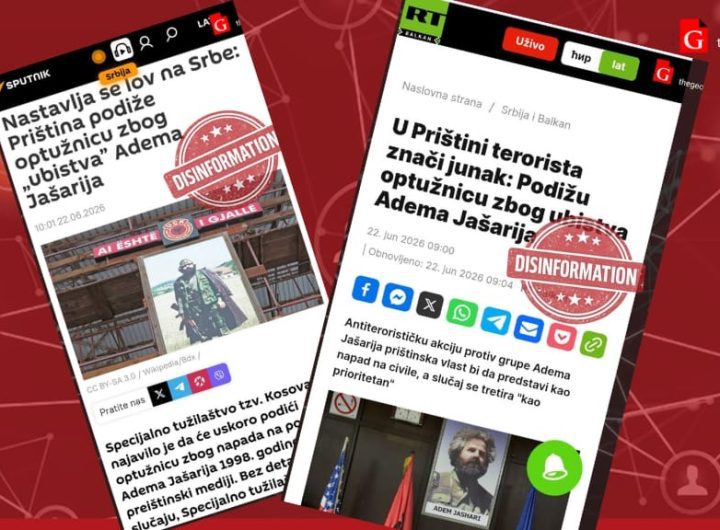 Russian media manipulates Prekaz, through disinformation they attempt to distort the facts about the crimes against the Jashari family
 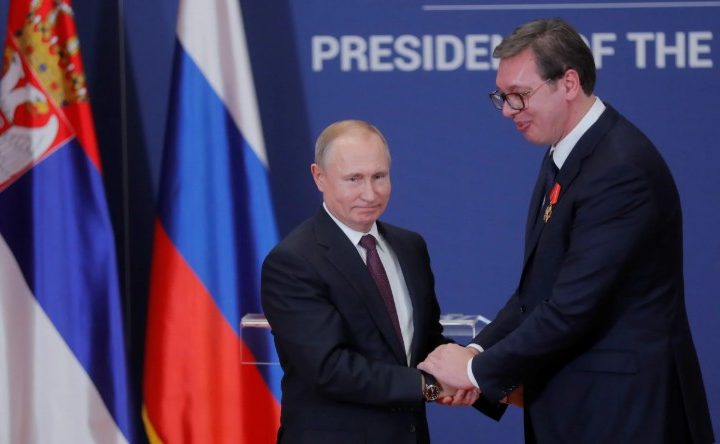 Russia as Vucic's shield: How the FSB report was used to deny the use of the "sonic cannon" in the protest