
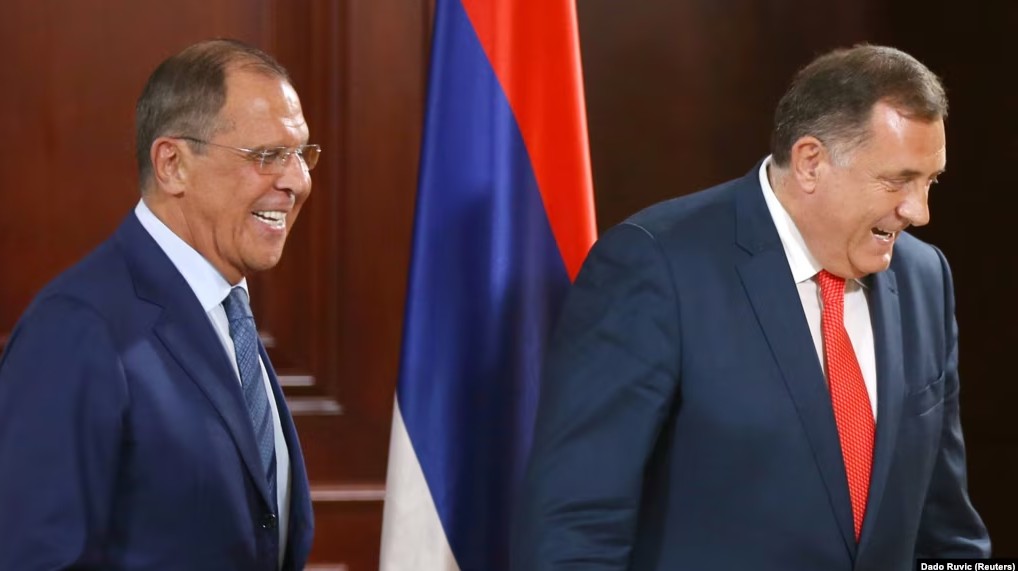
Political support without significant economic benefits, with occasional cultural ties. This is how the current balance of relations between Russian officials and Republika Srpska can be briefly described.
The last guest from Moscow is Alexander Grushko, Deputy Minister of Foreign Affairs responsible for Europe.
According to announcements from the office of the President of the RS, on April 21, he will talk with entity officials, visit a Serbian-Russian temple under construction, and participate in a forum on geopolitical developments in Europe.
This visit has additional weight, as Grushko is the first Russian official of this level to come to the RS since the beginning of the Russian invasion of Ukraine.
Over the past decade, visits by Russian officials to RS have been sporadic but politically clear.
Messages of support for the Milorad Dodik-led leadership arrived from Moscow, emphasizing the importance of the Dayton Peace Agreement and calling for the abolition of the Office of the High Representative.
Russian intentions in Bosnia and Herzegovina
Former BiH ambassador to Russia, Enver Halilović, told Radio Free Europe that Moscow, with its announced visit, “continues to work to destabilize the political and security situation in BiH.”
"This is something that is ongoing, it is done in multiple ways, in multiple stages. It is done economically, financially, through influencing elections. It is part of the political agenda of the Russian Federation towards BiH and at the same time it is also part of the agenda towards the EU," the former ambassador assessed.
He warns that this visit is nothing new, but just one event in a series of events.
"It would be very good if the same delegation came to visit the state of BiH and said that we are in favor of these positions, for BiH in the EU, then it would be a visit with good intentions. That's right, a political diversion in BiH," believes Halilović.
He adds that the EU must also react to this situation.
"It is now clear that the EU is in a serious crisis as such, so it is enough to at least see it in an appropriate way, if it cannot do anything," he said.
He said Washington made the right move when it forced Dodik to back down from his previous decisions and that it therefore lifted the sanctions. However, he warns that reinstating sanctions is still a possibility, as not much has changed in “his political stance and behavior in Bosnia and Herzegovina.”
He also warns that visits to an ethnic community in BiH "support the Serbian policy stance towards BiH."
“This is something that not only strengthens the separatism introduced by the political structures of Republika Srpska, but also increases the influence and provides justification for Serbia's influence in the same direction in BiH,” Halilović concludes.
Radio Free Europe has sent requests to the European Union and the United States Embassy in Sarajevo for comments on the announced visit.
By the end of the text, no response had arrived.
Visits from senior officials
Senior Russian officials rarely visit Banja Luka, the largest city and administrative center of RS.
The visits are mainly at the city level, such as the visit of representatives of the Main Directorate of the Ministry of Internal Affairs of the Russian Federation for the city of Moscow to the Ministry of Internal Affairs of this entity in November last year.
Banja Luka is also frequently visited by representatives of the Russian education and healthcare sectors, who stay at the University of Banja Luka or the University Clinical Center.
In the last 10 years, senior Russian officials have visited RS three times.
Sergei Lavrov, the Russian Foreign Minister, last visited BiH in December 2020. He was on an official visit to Sarajevo at the time, but also visited East Sarajevo.
Two years ago, after visiting Sarajevo, Lavrov stayed in Banja Luka and visited the construction site of a Serbian-Russian temple and cultural center.
"We see Dodik's commitment to the Dayton Agreement, and an issue that has long been overdue is the liberation of BiH from foreign administration so that it can decide its own future," Lavrov said at the time, among other things.
A few months before him, Valentina Matviyenko, the president of the Russian Federation Council, the upper house of the state parliament, was in Banja Luka.
She then declared that this entity is a "brotherly country of Russia" and that Moscow is against NATO's expansion into Europe.
More frequent visits to Russia than from Russia
While senior Russian officials are relatively rare visitors to RS, visits in the opposite direction are much more regular.
Milorad Dodik, while he was President of RS, but also previously as a member of the Presidency of BiH, met regularly with Russian President Vladimir Putin.
These visits have become significantly more frequent since February 2022 and the Russian invasion of Ukraine.
Since the attack, Dodik and Putin have met a total of nine times, all of which have taken place in Russia.
Dodik also announced that he will travel to Russia on the occasion of May 9, Victory over Fascism Day.
RS MPs frequently traveled to Russia as part of parliamentary delegations.
The last such visit was in mid-October, when a delegation of the National Assembly of Republika Srpska, led by Speaker Nenad Stevandić, visited the Legislative Assembly of St. Petersburg.
Russia and RS: Politics, oil, gas
The Russian economic presence in BiH is most prominent in the oil industry. The Russian state-owned company Zarubezhneft is the owner of the Optima Group, which owns the Nestro gas station network, the Brod Oil Refinery, and the Modriča Oil Refinery.
The RS authorities, led by Dodik, who was prime minister at the time, sold the oil industry to the Russians in 2007 for around 120 million euros.
RS is also planning to gasify about 20 municipalities in the entity, using Russian gas.
The plan is to build a gas pipeline from Šepka near Zvornik on the eastern border of BiH and Serbia, where Russian gas enters the country, to Novi Grad in northwestern BiH.
The European Commission previously warned that the pipeline does not contribute to reducing BiH's dependence on Russian gas.
Russian results in the RS are modest in the field of trade.
According to data from the BiH Indirect Tax Administration for 2024, Russia ranks 40th among export destinations for RS, while it ranks 18th in terms of imports to that entity.
As for "soft" power, it is most often expressed through cooperation in the religious field.
A Serbian-Russian temple and cultural center has been under construction in Banja Luka since 2018, partly financed by the RS budget. Including the funds planned for this year, about 9.5 million euros have been allocated for it.
In mid-2024, a Russian Embassy office was opened in Banja Luka, opposite the RS Government building.
The Cultural Center of the “Russian World” Foundation, the first of its kind in Bosnia and Herzegovina, has been operating within the National and University Library of Republika Srpska in Banja Luka since 2012, with the aim of popularizing the Russian language and culture.
The Geopost
 Reports of violence against citizens in Serbia who criticize Vučić's regime
  Chinese drones dominate the skies over Bosnia and Herzegovina
  Network linked to Vučić and Veselinović under FBI investigation for money laundering in the US
  Croatian journalist: Vučić and Veselinović in criminal network with illegal coal mines in Bukova Kosa
  Fetoshi: Serbia is promoting "anti-normalization" with a narrative war against Kosovo
  Kosovo: There are encouraging developments regarding the five states that do not recognize Kosovo