
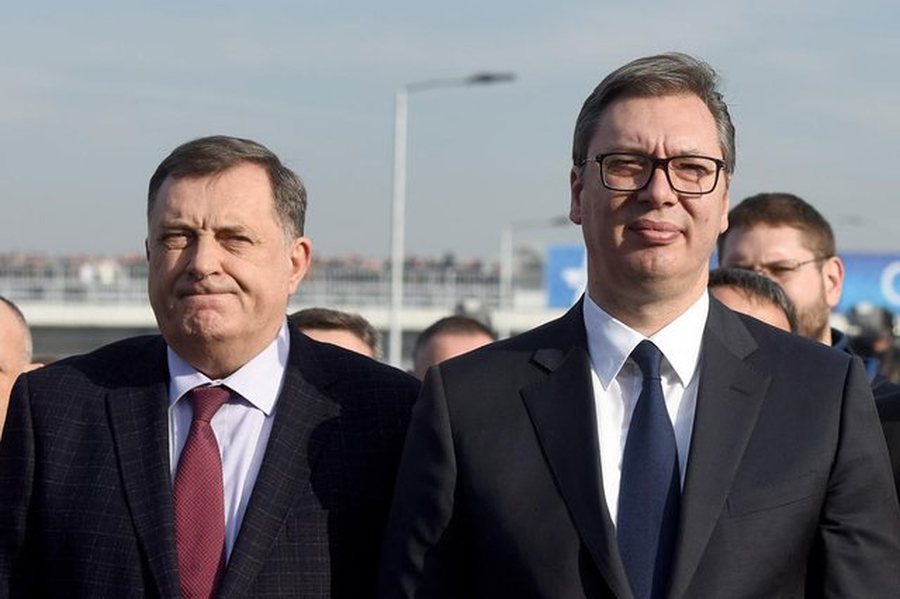
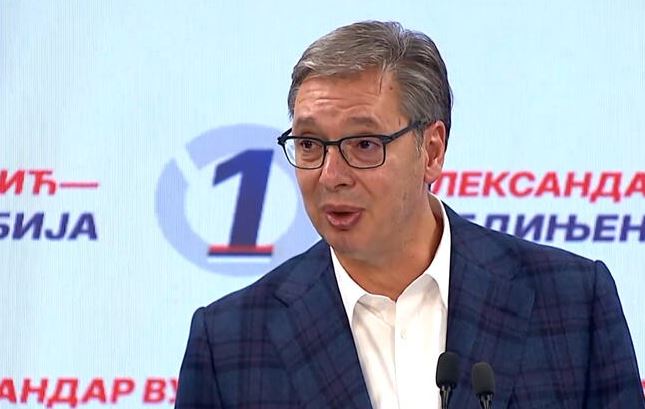
Milorad Dodik stood side by side with Aleksandar Vučić at the Serbian Progressive Party (SNS) election headquarters in Belgrade, where he arrived two nights ago to offer support for his longtime political ally after the polls closed.
This was not the first such appearance. During more than a decade of Vučić's party's rule in Serbia, the two men built close political relations, publicly supported each other and often emphasized their mutual friendship.
Frequent visits between Belgrade and Banja Luka, mutual praise, and joint economic projects have marked their relations.
However, some of the political movements and projects have caused controversy and criticism due to potential consequences for Bosnia and Herzegovina, including issues of state property and the jurisdiction of its institutions.
Therefore, the political changes in Serbia raise the question of the future of this alliance. Will the new government continue its current policy of supporting Dodik and maintaining close relations with the authorities of Republika Srpska, or will it try to position relations with Bosnia and Herzegovina differently?
The Student List did not specifically answer these questions to Radio Free Europe.
They stated that “their positions on the relationship with Republika Srpska have been clear from the beginning”, emphasizing that they defend “the well-being of the people in Republika Srpska and the preservation of the Dayton Agreement”.
Radio Free Europe's interlocutors estimate that a change of government in Serbia could weaken the current model of political relations between Belgrade and Banja Luka, affect Dodik's political position, and open space for a reconsideration of the political and business ties that have linked the two centers of power for years.
Without Vučić's support, it will be "much more difficult" for Dodik
The editor of the magazine Buka, Aleksandar Trifunović, told Radio Free Europe that the change of government in Serbia will not call into question relations between Belgrade and Republika Srpska, but could "make Milorad Dodik's political activities significantly more difficult."
According to him, the greatest strength that Dodik has had in recent years has not only come from his position in Republika Srpska, but also from the support he has enjoyed in Belgrade.
"The main point is that the cooperation between Vučić and Dodik was mainly personal. This kind of relationship is now being severed. Their personal relationship may survive to some extent, but the new government will have no reason to treat Dodik the way Vučić treated him," Trifunović said.
He adds that a possible scenario after the formation of a new government in Serbia could be for it to support Republika Srpska without supporting Dodik, in a way that could be “more open to other political options.”
The president of the Center for Regionalism, Aleksandar Popov, told Radio Free Europe that one of the main issues after the change of government in Serbia will be the relationship towards Dodik, but also towards Bosnia and Herzegovina as a whole.
"In recent years, Serbia has officially recognized the sovereignty and territorial integrity of Bosnia and Herzegovina, but in practice we have often supported policies that led to the destabilization of the country. The previous regime supported Dodik's policies, including those that were separatist in nature," Popov told Radio Free Europe.
He believes that the new government, if it wants to continue Serbia's European path, will need to pay more attention to stabilizing relations with its neighbors.
"I do not believe that the new government will give up on Republika Srpska or the special ties envisaged by the Dayton Agreement. However, the question is whether they will continue their unstinting support for Dodik. It would be better for them to create a clear political distance, because Dodik is today so burdened with political controversies that he can compromise anyone who wants to build serious relations in the region and towards the European Union," believes Popov.
Could lustration in Serbia lead to Dodik?
Announcements by the new government in Serbia that lustration, the fight against corruption, and strengthening institutions will be priorities also raise the question of whether the political and business relations built over many years of cooperation between Aleksandar Vučić and Milorad Dodik could come under scrutiny by Serbian investigative authorities.
"If the new government manages to free judicial institutions from political influence and enable them to do their job, then they will follow leads where there are grounds for investigations."
"For years, information about Dodik's various businesses and investments in Serbia, from real estate to other economic ventures, has appeared in the public domain, and this could certainly become a subject of interest for the relevant authorities," said Aleksandar Popov.
The editor of the magazine Buka, Aleksandar Trifunović, has a similar view, expecting that the announced lustration could open questions about the connections between the top leadership of the former government in Serbia and political structures in Republika Srpska.
"Dodik will be seen primarily as part of the system that has operated alongside the SNS for years. If there is to be a serious review of the work of the former government, it is logical to expect that questions will also be raised about the numerous business and political ties that have been established between Serbia and Republika Srpska. Various jobs, real estate projects and other agreements have been mentioned for which the public has never received full answers," said Trifunović.
Students expect more cooperation between Belgrade and Sarajevo
Among those who gathered in front of the Serbian Parliament, where the Student List victory was celebrated, were students from Bosnia and Herzegovina who had supported the protest movement in Serbia over the previous two years.
Ivan Bojanić, an architecture student in Banja Luka, expects that political changes could also affect Serbia's relations with Bosnia and Herzegovina.
"We expect that many political factors in Republika Srpska and Bosnia and Herzegovina will take a different stance towards Serbia and will be more willing to cooperate than they have been so far. We also hope that people will be freed from authoritarianism and express their political will more freely," Bojanić told Radio Free Europe.
Aleksandar Pavlic, a student at the Faculty of Political Science in Banja Luka, expects the new government in Serbia to have a different attitude towards the authorities in Republika Srpska, which, he says, have challenged the student movement over the past two years.
“I would like the Student List to send a clear message that it has not forgotten the way the authorities in Republika Srpska treated students and that this will have a positive impact on the development of democracy and the weakening of authoritarian models in society,” Pavlić said.
During the campaign, the Republika Srpska authorities, led by Dodik's Alliance of Independent Social Democrats, challenged the Student List and their attempt to gather in Banja Luka was stopped.
After the election results were announced, Dodik said he was ready to cooperate with the new government in Serbia.
Will there be a review of joint projects between Serbia and RS?
The political alliance between Vučić and Dodik left behind several projects worth hundreds of millions of euros.
Among the most important is the Buk Bijela hydroelectric power plant project on the Drina River, estimated at around 489 million marks (250 million euros), which Serbia and Republika Srpska presented as one of the largest joint energy ventures in the region.
From the beginning, the project was accompanied by a dispute between the authorities of Republika Srpska and the institutions of Bosnia and Herzegovina, which contested the entity's right to independently dispose of its hydropower potential without decisions at the state level.
Similar controversy was caused by the Trebinje airport project, whose value was estimated by official Belgrade at more than 205 million marks (105 million euros).
Although it has been announced for years as one of Serbia's largest investments in Bosnia and Herzegovina, construction has not begun.
Among the projects, the Bijeljina-Raça highway stands out.
Serbia provided around 57 million marks (30 million euros) for the road, presenting it as a key link between Republika Srpska and Serbia. Despite this, the project has not been completed even after several years.
Economist Admir Čavalic points out to Radio Free Europe that energy and infrastructure projects could come under scrutiny by the new government in Belgrade.
"It is very likely that some agreements and contracts will be reviewed. Of particular interest are some energy projects, where part of the contract was not publicly available, hidden in drawers, as well as agreements that have raised questions about transparency and real benefits for citizens for years," says Čavalic.
He also believes that the change of government in Serbia could open space for stronger economic ties between Sarajevo and Belgrade.
According to data from the Republika Srpska authorities, from 2017 to 2025, this Bosnian entity received nearly 227.4 million marks (about 116 million euros) from Serbia.
The money was intended for schools, kindergartens, health institutions, sports facilities, roads, water supply and sanitation infrastructure, as well as direct budgetary support for individual local communities.
The legacy of the Vučić-Dodik partnership
Authorities led by Dodik and Vučić in the Bosnian entity of RS and Serbia held joint government meetings, celebrated national holidays, and also carried out political coordination on almost all important issues in the region.
Critics linked such cooperation to the politics of the “Serbian world,” which Sarajevo and part of the international community interpreted as an attempt to expand Belgrade’s political influence beyond Serbia’s borders.
Although official Belgrade declaratively supported the territorial integrity of Bosnia and Herzegovina, Vučić's government for years offered political support to Dodik or remained silent about the moves of the Republika Srpska government that domestic and foreign officials considered an attack on state institutions and a threat to secession.
At the same time, several joint projects between Serbia and Republika Srpska were presented as evidence of special ties, while opponents of such a policy warned that some of them went beyond the framework of economic cooperation and violated the jurisdiction of the state of Bosnia and Herzegovina.
 Kos: Serbia cannot progress towards the EU without sanctions against Russia
 Shocking Doubts About the Serbian Economy: Billions from Drugs Inflate Serbia's GDP
 FAZ: Student List Program for Kosovo Could Incite Conflict and Isolate Serbia
 Report from the Office of the High Representative in BiH: The moves of the RS authorities are leading to de facto separation from BiH
 "The counterattack is coming": Former Serbian activist warns of Vučić's plans after defeat
 Will he talk to Kurti and extradite Radoicic? The Student List leader answers