
Western countries do not have an effective defense against cheap and widely used assets for air strikes.
It is essential to begin large-scale production of a range of interceptor defense systems so that forces can combat such threats effectively, including in the event of a high-intensity conflict.
The development of mass-deployment attack systems has accelerated significantly over the past two to three years, especially since Russia's aggression against Ukraine. As early as 2022, Ukrainian military intelligence estimated that Moscow would be able to produce 6,000 Shahed-class unmanned aerial vehicles per year by 2025.
In practice, more than 54,000 drones classified as heavy hitters hit Ukraine in 2025, although this number also included Gerbera-class UAVs. No one is surprised anymore by reports of 100, 200 or even 400 drones used in a single wave (and larger raids have occurred), and the number of “operational-tactical level” UAVs destroyed daily by Ukrainian forces now exceeds 2,000.
The response to these threats must also be on a massive scale. Western countries produce modern air defense systems – from the American Patriot and the European SAMP/T, through short-range systems like CAMM, IRIS-T or NASAMS (and missiles like Sidewinder). However, these specific systems are designed to deal with a completely different threat: manned aircraft and cruise missiles, and in the case of the Patriot and SAMP/T, even ballistic missiles.
Missiles for these SAM systems are expensive (from a few thousand dollars for some short-range missiles to several million dollars each – the equivalent of approximately PLN 20 million) and difficult to manufacture; the lead time after ordering is measured at two to three years.
In practice, therefore, their production volumes are not enough to capture even the most challenging targets (such as Patriot and SAMP/T ballistic missiles), let alone deal with widespread swarms. Given the massive use of drones and Russia's experience in using them, Western states are simply not properly prepared to fend off attacks relying on them.
Evidence of the problem is evident in the Persian Gulf. Although forces under the United States Central Command and some Gulf states, which already have some experience and capabilities against UAS, are protected against UAV attacks, these defenses are not effective enough to prevent attacks on critical infrastructure that cause significant damage. And the short- and very short-range air defense (including AAA systems) and counter-drone capabilities of the armed forces of many NATO countries in Europe are significantly lower than those of comparably sized Gulf states. This situation will not change until modernization programs, often planned over several – if not many – years, are completed.
At the same time, the threat from drones can appear here and now, so urgent steps are required to improve the situation. The commissioned solutions must be economical and ready for mass production, just like the offensive means intended to counter them. An Estonian firm, Frankenburg Technologies, has been trying to develop such a system. It has not yet entered serial production, but as the company’s president, Kusti Salm – a former state secretary in the Estonian Ministry of Defense and former head of the country’s defense procurement agency – told Defence24, the system has already received initial orders, is being constantly improved, and work on a full set is being finalized. This is one of the new technological areas worth investing in.
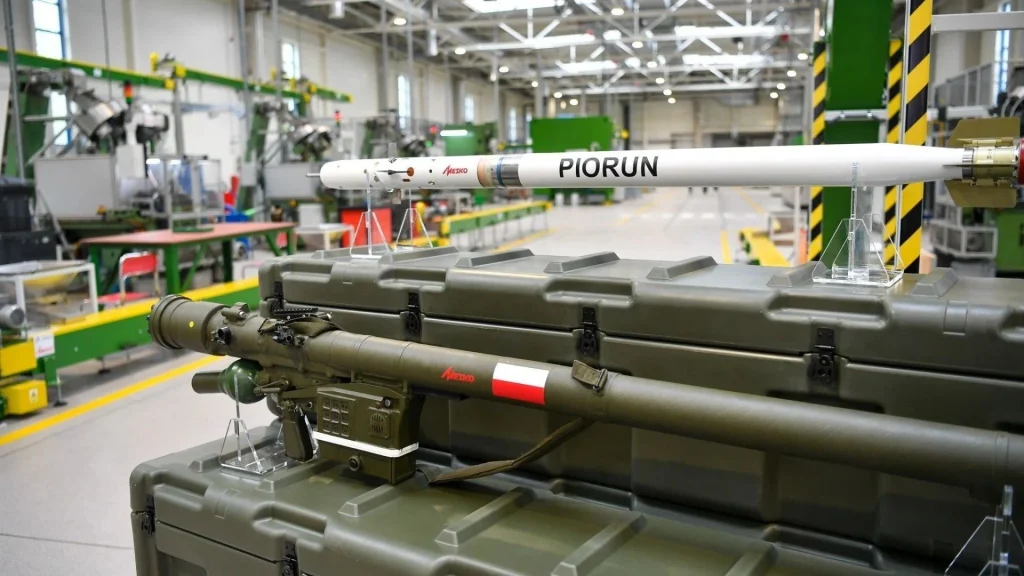
At the same time, it is important not to forget about existing solutions. One such system is the Polish Piorun MANPADS system, which has been combat-tested in Ukraine. Poland is already the largest producer of this type of system within NATO. The current production capacity is approximately 1,300-1,400 missiles per year. In addition to Poland and Ukraine, Sweden, Norway, Estonia, Latvia, Moldova and Belgium are among the committed customers supplying Piorun.
The Piorun is enrolled in the SAFE program; Poland plans to purchase another batch, and purchases from other countries (including France, Germany, and Lithuania) are possible or under consideration. The Piorun has many advantages, not least its cost-effectiveness. It is at least an order of magnitude cheaper than heavier surface-to-air missiles, yet can effectively strike a range of targets, from drones to cruise missiles.
The latest contract for Piorun missiles for the Polish Armed Forces (covering 3,500 rounds and 600 launchers) was signed in 2022. Although deliveries are ongoing, demand remains high given the expansion of the Armed Forces – the formation of new divisions and the Border Protection Component within the Territorial Defense Forces means that needs exceed current production.
Piorun is one of those weapon systems that can relatively quickly saturate units in various services, both existing and newly formed. But bold decisions are required: new orders and investment support. While export successes have resulted in part from previous domestic orders (supplies to Sweden and Belgium were fulfilled within months of the order), the Polish Armed Forces still have significant requirements for Piorun systems. These needs must be addressed urgently, especially since the introduction of heavier air defense systems such as Narew will often involve long waiting times. It is also desirable that as many targets as possible (for example cruise missiles) be neutralized by cheaper means, such as Piorun systems integrated into light vehicles, including unmanned platforms.
Of course, investment should also continue in a wide range of other low-cost air defense solutions, including interceptor drones. None of this changes the fact that expensive and heavy systems that can neutralize an initial attack must be complemented by solutions that enable sustained defense. And the role of the latter within the armed forces must be significantly greater than before. Such systems must be produced domestically.
The protracted conflict now unfolding in Ukraine – and the situation that seems to be unfolding in the Persian Gulf – demonstrates the importance of the defense economy. If neither side achieves decisive success in the first days or even hours of a conflict, economic efficiency becomes essential. This requires major changes within Western defense industries, which have been focused on providing high-performance but expensive and difficult-to-produce equipment. We must seize the opportunities that already exist in Poland and allied countries to ensure adequate saturation of defense systems in response to the massive technological war being waged by Russia and its partners.
The Geopost
 EU budget blow to Serbia
  Senior Russian official in Banja Luka, Dodik speaks out against sanctions against Russia
  Ukraine has a chance to "join" the EU in 2027
  How senior Serbian officials are turning the Association into a political weapon
  FT: Russian economy faces financial disaster, Moscow is manipulating economic statistics
  Bulgarian Elections: Is Another Leader Getting Closer to Moscow in the Balkans?