
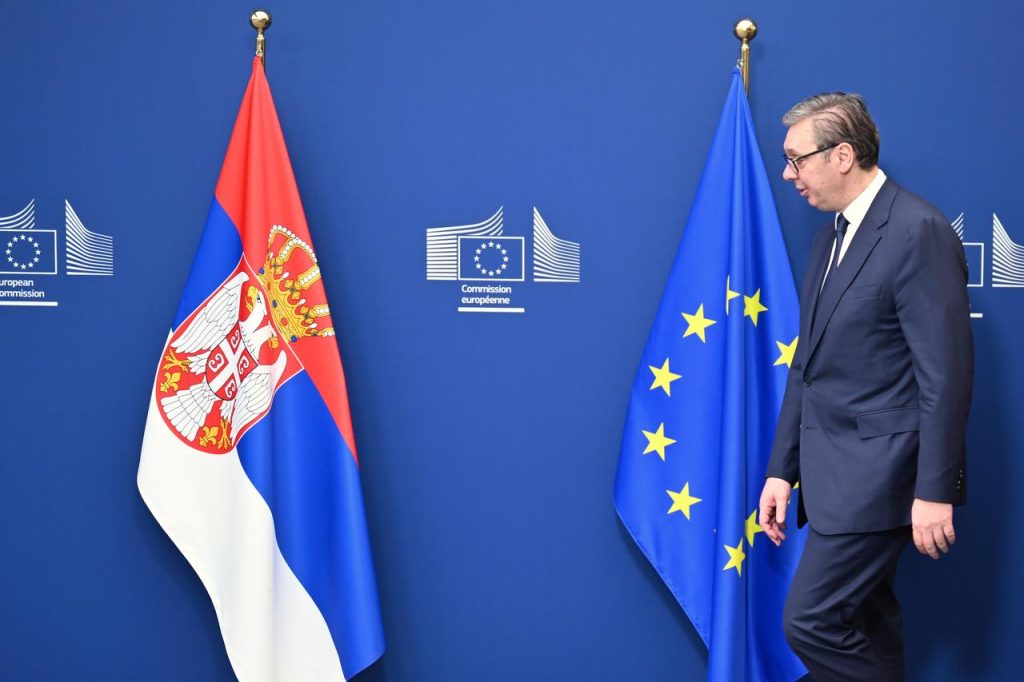
A blow to the Serbian budget, but without affecting other funds coming from the European Union (EU) – this is how the coordinator of the non-governmental National Convention for the EU, Bojana Selaković, explains the possibility of withholding money from Brussels.
Due to blocked reforms and violations of the rule of law, Serbia is threatened with the loss of 1.5 billion euros in grants and soft loans from the EU.
The "Growth Plan for the Western Balkans" initiative, adopted by Brussels two and a half years ago, is designed to accelerate the region's economic rapprochement with the Union and to offer countries aspiring to become its members gradual access to parts of the single market before full membership.
For this purpose, the European institutions have allocated six billion euros for the period from 2024 to 2027.
However, the European Commission has expressed concern about the poor situation in Serbia and is currently assessing whether the country meets the conditions to receive financial resources.
What is the Growth Plan for the Western Balkans?
The initiative, adopted by the European Commission in November, is based on strengthening economic integration in the European single market, economic integration through a regional common market and accelerating key reforms.
Various criteria, such as population size and GDP per capita ratio, are included in the distribution of six billion euros of funds, but the European Commission noted that the final amount is "not fixed" but depends on the results of reforms and the fulfillment of conditions.
Also, if EU candidate countries do not meet the conditions for distribution, the Commission has the option to reduce the allocation for that country and redirect funds to those countries that are doing better.
In October 2024, the Serbian government adopted the Reform Agenda, a strategic document that outlines the necessary reform steps on the path to the EU and opens the possibility for the country to receive funds from the Growth Plan.
What does this mean for Serbia?
1.5 billion euros have been allocated to Serbia, which is almost a quarter of the total funds from the Growth Plan.
The funds include grants and loans intended to support reforms and are distributed twice a year, depending on progress made.
Of this amount, almost 400 million is a direct budgetary grant available to the Ministry of Finance, while the rest consists of loans with favorable terms.
"These are funds that are given for specific projects in the field of infrastructure, public services and so on. This is not money that reaches citizens in the most direct way. If the funds from the Growth Plan are withheld, we can treat them as a kind of lost profit," says Bojana Selaković from the National Convention, a network of civil society organizations in Serbia that monitors and participates in the country's EU accession process.
Serbia received about 110 million euros from the Growth Plan as pre-financing. In mid-2025, the European Commission transferred 51.7 million euros as soft loans to the Serbian budget, and in January 2026, about 60 million were approved instead of the planned 112 million.
These funds are related to reforms implemented in the second half of 2024. According to the European Commission, Serbia has implemented three out of the seven steps foreseen by the Reform Agenda for that period.
“The first tranche was already problematic for Serbia and, compared to the total amount requested by Serbia, the European Commission disbursed only half of the planned funds,” says Bojana Selaković.
The Radio Free Europe interlocutor notes that the possible blocking of funds from the Growth Plan does not affect other funds coming from the European Union, such as the pre-accession IPA and IPARD funds (intended for agriculture and rural development).
“Everything that goes directly to citizens and local communities, to education and farmers, as well as programs related to scientific and educational cooperation at the university level, remain untouched,” Selaković explains.
Serbia has received more than 3.6 billion euros in grants from the European Union through various pre-accession programs over the past quarter century. These funds are intended, among other things, for training judges and prosecutors and modernizing courtrooms, digitizing the healthcare system, and reforming education.
A portion of the funds from IPA funds have been allocated to Serbia for the field of ecology, such as waste and wastewater treatment, improving air quality, and mitigating the effects of climate change.
The Union is also the largest foreign investor in Serbia. EU countries together account for about 59 percent of foreign direct investment.
Why are funds under discussion?
“We are increasingly concerned about what is happening in Serbia – from laws undermining the independence of the judiciary, to the repression of protesters, to the continued interference in independent media,” European Enlargement Commissioner Marta Kos said on April 20, speaking about the possible suspension of funds for Serbia from the Growth Plan.
Harsh criticism from Brussels was directed at Serbia in early 2026, when the parliament adopted a series of judicial laws without public debate and consultation with the Venice Commission.
They were put on the agenda through an expedited procedure after being officially proposed by Uglješa Mrdić, an MP from the ruling Serbian Progressive Party (SNS).
The amendments to the five judicial laws were criticized by the High Prosecutorial Council, the High Judicial Council, the Bar Association of Serbia, and a number of professional organizations.
They warned that such legal changes could jeopardize the independence of the judiciary and prosecution from the executive branch.
Brussels called it "a vote to limit the independence of the judiciary."
On the other hand, government representatives defended these legal changes, claiming that they would contribute to efficiency and fairness in the work of judicial instances.
As European Commission officials previously told Radio Free Europe, the Venice Commission is expected to issue an opinion on the controversial changes to the law by the end of April.
Brussels' decision to withhold funds from the Growth Plan will depend on whether Serbia revises its laws in line with the opinion of this Council of Europe body on issues of constitutional law, democracy and the rule of law.
Serbia is also constantly taking steps backwards in terms of respecting human rights and media freedoms in reports by international organizations.
Amnesty International, in a report published in April 2026, stated that in Serbia, demonstrators, journalists and civil society organizations faced threats, harassment and unlawful surveillance by authorities trying to contain widespread discontent.
In Serbia, the year 2025 was marked by massive demonstrations across the country, which erupted due to the death of 16 people from the collapse of a tent at the Novi Sad Railway Station in November 2024.
Protesters alleged that the negligence was fueled by corruption and demanded political accountability for President Aleksandar Vučić, as well as early elections and broad reforms.
Amnesty said in the report that "police arbitrarily detained hundreds of protesters, that dozens of them were slapped and beaten, and some detainees were threatened with rape, violence and death."
In a February 2025 report by the international organization Freedom House, Serbia was ranked among the countries with the greatest decline in freedom in the last ten years. One of the reasons cited was the tightening of media control and attacks on journalists.
Has Serbia taken any steps?
Serbian Parliament Speaker Ana Brnabić announced that lawmakers will begin work on amendments to the law immediately after receiving the opinion of the Venice Commission's expert team.
"I expect these amendments to be resubmitted to Parliament as soon as possible," Brnabić said at a press conference on April 20.
On the same day, the Government of Serbia ordered all state bodies to pay special attention to harmonizing regulations with the acquis communautaire when preparing laws.
In early 2026, the Serbian government established the Coordination Body for the EU Membership Process, composed of representatives from the highest state level. The role of this operational team, as explained, is to coordinate the accelerated implementation of all obligations on Serbia's European path.
"Based on what we have seen in recent days, I would say that the messages from Brussels have been taken seriously," believes Bojana Selaković.
However, Selaković notes that all this will not be enough if the Government does not address the fundamental problems, which Brussels has also highlighted.
"The fundamental problem lies in the electoral conditions, the state of media freedoms and the repressive practices implemented by the state," Selaković underlines.
Serbian President Aleksandar Vučić, whose Serbian Progressive Party has been in power since 2012, has repeatedly stated that membership in the European Union is the country's strategic goal.
However, so far, 22 out of 35 chapters have been opened and only two have been closed.
 Senior Russian official in Banja Luka, Dodik speaks out against sanctions against Russia
  Ukraine has a chance to "join" the EU in 2027
  How senior Serbian officials are turning the Association into a political weapon
  FT: Russian economy faces financial disaster, Moscow is manipulating economic statistics
  Bulgarian Elections: Is Another Leader Getting Closer to Moscow in the Balkans?
  Trump: Accept the deal or the United States will destroy every power plant and every bridge in Iran