

The reactions of Belgrade officials to the recent arrests in Zubin Potok have once again reminded us of the way Serbia handles war crimes investigations and the issue of missing persons. The statements of the director of the so-called Office for Kosovo, Petar Petkovic, describing the arrest of suspects in the disappearance of 23 intellectuals from Mitrovica as a “hunt” against Serbs, represent an attempt to politicize the justice process and shift attention away from individual criminal responsibility.
Petkovic even claimed that the issue of missing persons is being misused. However, according to The Geopost's analysis, this narrative lacks the distinction between individual and collective responsibility.
Presenting criminal proceedings against individuals as an attack on the entire Serbian community or on the municipality of Zubin Potok creates a false perception and hinders the process of dealing with the past. At the same time, this approach contributes to maintaining tensions and fear among local residents, strengthening political narratives instead of trust in justice institutions.
From the perspective of the rule of law and European standards, war crimes investigations are conducted on the basis of suspicions against specific individuals and not against communities or ethnic groups. For this reason, identifying judicial proceedings with an attack on an entire population is considered a form of political generalization that shifts the debate from facts and evidence to political rhetoric.
The issue of missing persons, which remains one of the most serious wounds of the 1998–1999 war, emphasizes that clarifying the fate of all missing persons should be a priority, regardless of the ethnic affiliation of the victims.
We recall that Belgrade's political discourse overlooks the fact that the families of thousands of missing Albanians have been seeking the truth about their loved ones for years. In this context, using the issue of missing persons as a political argument risks distracting from the need for institutional cooperation and the fulfillment of obligations undertaken within the framework of the Brussels dialogue, including the opening of archives and the advancement of transitional justice processes.
/The Geopost/
 The elections that scare Vučić: Promises to voters, destabilizing scenarios behind the ballot boxes
  RUSSIAN OCCUPATION WITHOUT ANY SOLDIERS: How did Serbia become a training ground for Putin's hybrid operations?
  The Mayor of North Mitrovica is disinforming: He presents the improvement of security at the Ibar Bridge as "repression" against Serbs
  When propaganda clones the truth: How the Balkans is becoming the new battlefield of disinformation
  Serbia's failed espionage efforts in Kosovo
 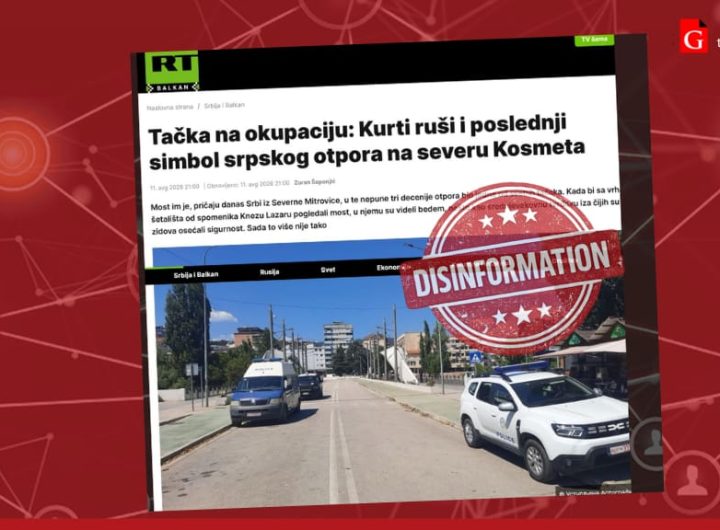 How Sputnik misinforms about KFOR's withdrawal from the bridge over the Ibar