
The confrontation between Kosovo and Serbia is not only taking place in diplomacy, in the north of the country, or in the political statements of the leaders. One of the most important, but also less visible, fronts is that of intelligence.
There are no protests, press conferences or cameras. There are covert contacts, human resources, information gathered on the ground, identification of people with access to data and efforts to build networks that can operate for a long time without being detected.
Cases in recent years show that this activity has not disappeared. On the contrary, it continues. But something else is changing. Kosovo institutions are increasingly managing to uncover this activity and bring it to justice.
The recent arrest of Fehim Sali, on August 13, is the latest example and perhaps one of the most significant cases for understanding how such an operation can work.
Sali was arrested at the border crossing in Merdare, in a joint operation by the KIA, Kosovo Police and the Special Prosecution. The Basic Court in Pristina subsequently ordered him to be detained for one month. He is suspected of having collaborated with the BIA for a long period and of having maintained contact with an official of the BIA, identified as Zelimir Matović.
But what makes the case special is not just the suspicion of information leakage.
According to the Prosecution's file, Sali is suspected of having provided information about the political situation in Kosovo, identifying officials of the Kosovo Intelligence Agency and photographing some of them. The Prosecution also alleges that he provided information about other individuals and that he proposed some of them as potential targets for contact and recruitment by the BIA.
If these allegations are proven in court, then the case is not just about one person gathering information for a foreign service. It points to a much broader effort, identifying targets, establishing contacts, and potentially expanding a network of sources inside Kosovo.
This is what makes counterintelligence so important.
An intelligence service does not need to receive every piece of information directly from the highest institutions. Often, it seeks people who have access to certain information, acquaintances with important individuals, or the ability to identify other people who could be recruited.
In Sali's case, according to the Prosecution, precisely such a mechanism is suspected.
During the raid on his home, around 39.500 euros, 500 Serbian dinars and four mobile phones were seized. The prosecution also says that some of the money is related to suspected espionage activity.
Furthermore, Sal's profile makes the case important from an intelligence point of view.
He is a teacher in the Serbian education system in Kosovo and was previously part of the Consultative Council for Communities under the Presidency of Kosovo. This does not in itself prove any illegal activity, but it shows that a person can build, over the years, a network of contacts in various areas of public and institutional life.
And here the last case is connected to a series of other cases.
Bedri Shabani and Muharrem Qerimi are two Kosovo citizens facing charges of espionage for the BIA. Both have pleaded not guilty and the trial against them continues, therefore their criminal liability cannot be considered proven.
But the indictment against them itself is significant for understanding the type of information that is allegedly of interest to the Serbian intelligence service.
Shabani's case is related, according to the indictment, to information about the KLA, its members and superiors, while Qerim, who had previously served in the Kosovo Police, is also accused of espionage.
This shows an important element of intelligence warfare. Valuable information is not only that which is related to what is happening today.
For an intelligence service, historical information, security structures, former members of institutions, social networks, and people with access to certain communities can also have operational value.
This also includes the case of Fatmir Sheholli, who has been under investigation for espionage since 2025 and whose detention has been extended. Even in this case, a distinction must be made between suspicion and guilt proven by a court decision.
Then there are the cases that have already moved on to another phase, that of judicial sentences.
In April of this year, the Basic Court in Pristina sentenced Jelena Djukanovic, a former OSCE employee, to six years in prison for espionage in favor of the BIA.
According to the verdict, she was found guilty of collaborating with Serbian intelligence and passing on sensitive information related to Kosovo.
In another case, Hysri Selimi was sentenced to six years in prison for espionage for the BIA. According to the data made public in the case, the information conveyed related, among other things, to religious radicalization in Kosovo, former members of the KLA and people who had traveled to join the Islamic State organization.
Bojan Jevtic, a former lieutenant in the Kosovo Police, was sentenced to six years in prison and a 2.000 euro fine for espionage in favor of Serbia, as well as for illegal possession of weapons. He had pleaded guilty.
In another case, Aleksandar Vlajić was sentenced to five years in prison for espionage and a 1.000 euro fine for illegal possession of weapons. He also pleaded guilty to the charges.
A much more interesting pattern emerges here than a list of names.
The profiles are different. The information is different. The positions of the people are different. But in some convicted cases and in other cases still under investigation, the name of the BIA is repeated.
This is not evidence that all of these individuals were part of a single network. There is no public evidence that allows for such a conclusion.
But it is enough to raise another conclusion. The interest of the Serbian service in creating and using resources within Kosovo is not an isolated phenomenon.
And this is precisely where the greatest success of Kosovo counterintelligence lies.
A foreign intelligence service may have resources in a country for years. It may use them to gather political, security, or social information. It may attempt to identify new people and expand the network.
But the moment one of the links is discovered, the danger is not only the loss of that person.
Contacts, communication methods, objectives, recruitment methods, and the structure of the operation may also be exposed.
Therefore, the arrest of a suspected agent may have much greater value than the arrest itself.
In Sali's case, for example, the Prosecution claims that the investigation has identified not only his contacts with the BIA, but also the way in which he allegedly gathered information and identified other people. The four seized phones may be particularly important to the investigation, precisely because of the possibility that their contents may help shed light on contacts and communications.
This takes the fight against espionage to another level.
It's no longer enough to ask. Who is the spy?
The most important question is: Who recruited him, what information was he interested in, who did he communicate with, and who else might have been the target of the same operation?
If Kosovo institutions manage to answer these questions, then a Serbian intelligence operation could turn into an operational loss for the BIA.
This is also why the recent series of cases must be viewed with a broader perspective.
Kosovo cannot eliminate espionage. No democratic state can do this. Foreign services will continue to seek information and resources in countries they consider strategically important.
But a state can do something else: increase the cost of espionage and reduce the space for foreign services to operate.
Cases of arrests, investigations, and convictions show that Kosovo is building such an experience.
Instead of BIA's suspected activity remaining in the shadows, it is increasingly ending up in investigative files, in courts, and in verdicts.
This is especially important for a relatively young state, which is facing a neighbor that has consolidated intelligence structures and that considers Kosovo a matter of direct state interest.
In this confrontation, Kosovo does not have the luxury of relying solely on political reactions.
It needs professional counterintelligence, information exchange between institutions, protection of sensitive sources, and, above all, evidence that can stand up in court.
The case of Fehim Sali is another test in this regard.
He is not yet a convicted spy and any allegations against him must be proven in court. But the way the case was discovered, investigated and has now been sent to court shows that Kosovar institutions are trying to crack down not only on the individual, but also on the mechanism through which a foreign service can attempt to gather information and create new sources.
In the end, this is the battle that is unseen.
Only arrests are seen in public.
But behind them lies a much longer struggle: surveillance, analysis, contact tracing, verification of suspicions, and building evidence.
And if recent cases are indicative of a trend, then the message is clear. Serbia may continue to attempt to create resources in Kosovo, but the space to keep them invisible is becoming increasingly narrow.
In the intelligence war, this is perhaps the most important victory. Not to pretend there is no espionage, but to be able to detect it before a network consolidates./Telegraph/
 The elections that scare Vučić: Promises to voters, destabilizing scenarios behind the ballot boxes
  RUSSIAN OCCUPATION WITHOUT ANY SOLDIERS: How did Serbia become a training ground for Putin's hybrid operations?
  The Mayor of North Mitrovica is disinforming: He presents the improvement of security at the Ibar Bridge as "repression" against Serbs
  When propaganda clones the truth: How the Balkans is becoming the new battlefield of disinformation
 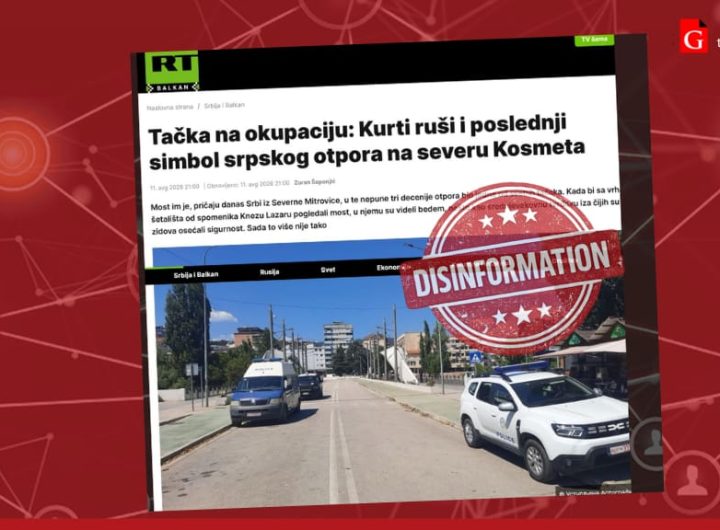 How Sputnik misinforms about KFOR's withdrawal from the bridge over the Ibar
  How Belgrade turns an incident in Kosovo into an instrument of state propaganda