
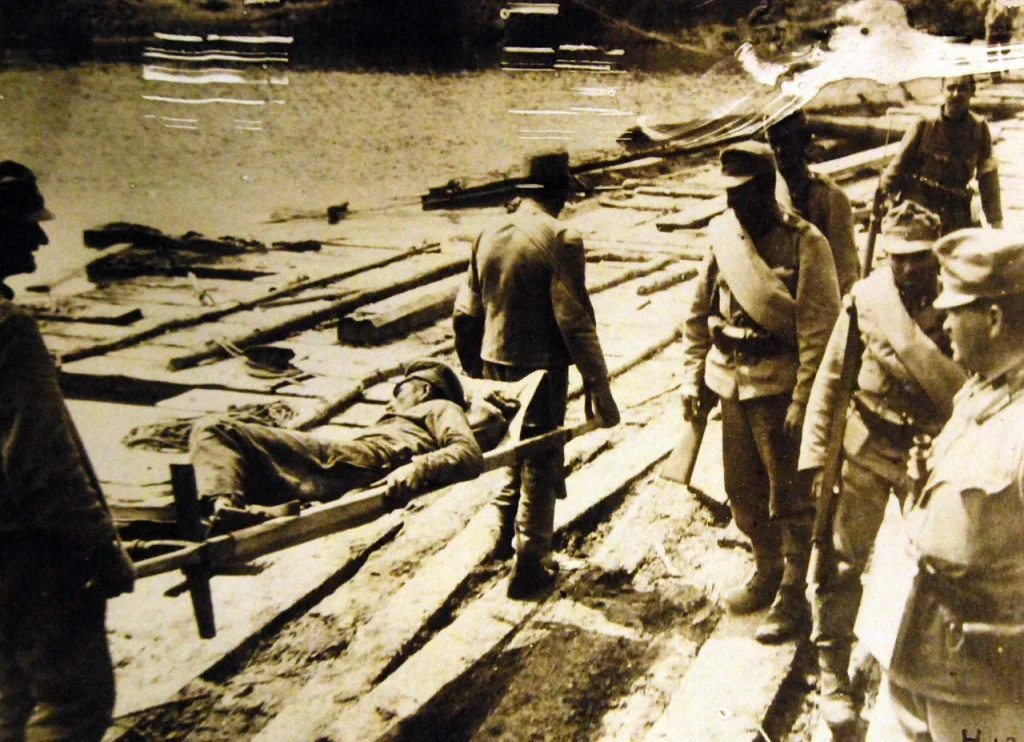
Russian President Vladimir Putin's full-scale invasion of Ukraine has now lasted longer than the disastrous, unsuccessful war waged by Imperial Russia and Tsar Nicholas II from 1914 to 1917.
By the numbers, World War I began on July 28, 1914, and ended on November 11, 1918, with hostilities lasting 1,567 days. By the time the fighting officially ended, revolution had overthrown the Romanov regime and Red agents had shot Tsar Nicholas II and his family dead in a Yekaterinburg cellar because the new government in Moscow saw the royalists as a threat to Russia's communist rule.
Modern Russia's so-far failed attempt to implement regime change in Ukraine and bring the former Soviet republic back under Moscow's rule, through war and invasion, began on February 24, 2022, and, as of Thursday, had lasted one day longer (1,568 days) than the entire First World War.
The Butcher's Bill – World War I or the Russian Armed Forces in Ukraine, which war was worse?
The most important difference between the two wars is that, for Russia, World War I was a total war with full mobilization that affected virtually every aspect of the country, with the national leadership fully supporting the war effort. During that war, a large alliance of Western states supported Russia, KyivPost reports.
Russia's (second) invasion of Ukraine is for Russia a war that affects different parts of the country in different ways, with the national leadership facing the conflicting goals of mobilizing enough men and resources to defeat Ukraine and its allies, while avoiding imposing the shock and sacrifices of a full-scale mobilized effort on Russian society. Apart from North Korea and to a lesser extent Iran, Russia has no allies supporting its attempt to invade Ukraine.
The most important indicator of how widely the First World War affected Russian society is clearly visible in terms of the soldiers mobilized and those killed and wounded in combat. During that war, according to most historians, a Russia with a total population of 175-180 million, using forced conscription, placed about 12 million men in its armed forces. This works out to be about 5 percent of the population or about one in every ten men in Russia actually in uniform.
According to conventional accounts, in World War I, about 9 million Russian soldiers were killed, wounded, or rendered ineffective through reasons such as disease or desertion, or roughly one in every 15 men in all of Russia, or three out of every four men in military service. This is one of the bloodiest casualty rates suffered by a country at war in post-medieval history.
The population of modern Russia was around 146 million in February 2022. According to Ukrainian intelligence estimates, somewhere between 1.8–2.0 million individuals had served in the Ukrainian theater by June 2026, amounting to around 1.2–1.4 percent of the total population of modern Russia, or about one in every fifty Russian men who participated in the invasion of Ukraine from their country.
Armed Forces of Ukraine (AFU) figures, supported by drone footage and international research groups, currently put the estimated number of Russian soldiers killed, wounded or rendered ineffective at around 1.2 million men. This works out to be around 1.6 percent of Russia’s male population or around one or two Russian men killed or wounded in Ukraine for every 98 or 99 Russian men who are either not wounded or not serving.
In other words, across Russian society, the rate of men killed and wounded in World War I was about ten times greater than in the Russo-Ukrainian War.
However, once put into uniform, the chances of a Russian soldier being killed or wounded in combat are largely unchanged after a century: in World War I around 76 percent of soldiers in the field became casualties, and in Ukraine the figure appears to be between 60-65 percent.
Men Who Fight – Were Russian soldiers and officers of the early 20th century different from or similar to Russian soldiers and officers of the 21st century?
The Russian army in World War I was largely a peasant army, with perhaps four out of five soldiers recruited from rural villages. The common soldiers were only semi-illiterate, and the problem was worse in units from Siberia and eastern Russia, where soldiers often understood only basic command orders.
The officer corps in the Imperial Russian army came from a diverse social stratum led by the nobility and gentry, and was supported by members of the educated middle class, almost always from the cities.
This Russian army in World War I was tightly structured for potential division between the largely illiterate and peasant ranks, and the urban aristocrats and professionals who commanded them. Russian society as a whole was somewhat different and contained the same potential division.
In other words, across Russian society, the rate of men killed and wounded in World War I was about ten times greater than in the Russo-Ukrainian War.
However, once put into uniform, the chances of a Russian soldier being killed or wounded in combat are largely unchanged after a century: in World War I around 76 percent of soldiers in the field became casualties, and in Ukraine the figure appears to be between 60-65 percent.
Men Who Fight – Were Russian soldiers and officers of the early 20th century different from or similar to Russian soldiers and officers of the 21st century?
The Russian army in World War I was largely a peasant army, with perhaps four out of five soldiers recruited from rural villages. The common soldiers were only semi-illiterate, and the problem was worse in units from Siberia and eastern Russia, where soldiers often understood only basic command orders.
The officer corps in the Imperial Russian army came from a diverse social stratum led by the nobility and gentry, and was supported by members of the educated middle class, almost always from the cities.
This Russian army in World War I was tightly structured for potential division between the largely illiterate and peasant ranks, and the urban aristocrats and professionals who commanded them. Russian society as a whole was somewhat different and contained the same potential division.
As the progress of the war worsened for the Tsar and his commanders, dissent within the ranks of the soldiers became increasingly difficult to suppress, because the written media did not reach many soldiers and because the army officer class had no tradition of negotiating with the lower ranks and risked losing authority even by discussing options.
The modern Russian military is a (mostly) volunteer force with leadership almost entirely professionals focused on career advancement, and other ranks are recruited by various means, most often by federal or regional government offers of salaries impossible in the civilian economy or through carrot-and-stick benefits such as exchanging a prison sentence for a military contract.
Recruitment has been heaviest in small towns, Siberia, the North Caucasus, Buryatia, Tuva and the Volga republics, while wealthy cities such as Moscow, St. Petersburg and Krasnodar have contributed far fewer fighters.
However, the Russian officer corps is similar.
Thanks to technology and mass media, there are no major language barriers among the Russian forces occupying Ukraine, although some minorities may speak Tuvan or Chechen, all ranks speak Russian. Likewise, literacy in the modern Russian army is virtually complete, and what’s more, virtually all soldiers are familiar with modern consumer technology like a smartphone or text messaging.
Since the modern Russian state exercises almost total control over the media and can even reach individual soldiers through their smartphones, it is easier for the modern Russian state to uphold loyalty and undermine dissent than it was for the tsars during World War I.
Battlefield (today, Battlespace) – Is it true that both wars are simply trenches, massive attacks, and stalemates?
No, that's not true, neither historically, nor in Ukraine now. The meme "The Russo-Ukrainian War is nothing more than static trench warfare from World War I" is quite inaccurate on several levels.
It is true that bunkers and barbed wire were widely used in World War I and were common in Ukraine currently, but to say that the Russian army fought largely statically in both conflicts, without decisive results, is not supported by the data.
In World War I, the Eastern Front saw large-scale mobile operations, most notably Russia's Brusilov Offensive in 1916, which marked spectacular initial advances, advancing over 100 kilometers in places and inflicting not only heavy losses but also rout- ing the opposing Austro-Hungarian forces.
The campaigns waged by Russia, in Prussia in 1914 and in what is now eastern Poland and western Ukraine in 2015, also changed the lines of battle dramatically, although in both cases it was the Russian force that was catastrophically defeated.
A risky attempt by a semi-democratic Russia to regain the initiative in 1917, called the Kerensky Offensive, collapsed quickly with the Russian army almost mutinying, leading directly to the dissolution of Imperial Russia. In early 1918, a German offensive transferred control of the Baltic states, Belarus, and Ukraine from Russian to German control in just under two months.
The first six months of the Russo-Ukrainian War saw dramatic advances and territorial losses on both sides, similar to the major operations of World War I. Since then, both sides have launched smaller-scale operations aimed at capturing territory, the Russians most notably with a two-year offensive aimed at capturing key cities in the Luhansk and Donetsk regions of Ukraine, and the Ukrainians with a limited amphibious assault along the Dnipro River in 2024 and a devastating assault that would invade Russia in 2025.
Both sides have also attempted major offensives and failed, with the worst likely for Ukraine coming in the summer of 2023 in the Zaporizhzhia sector, and for Russia in late 2025–early 2026 with the failure of its Winter-Spring offensive to capture Ukraine’s Donetsk region. But from the Kremlin’s perspective, the front in Ukraine has never been static, it has always shifted in Russia’s favor, sometimes quickly and sometimes slowly.
Tactics and technology – How is the Russian performance in both wars?
The degree of similarity between the way the Imperial Russian Army fought and modern Russian military combat is striking. In both conflicts, commanders displayed a preference for complex, all-out operations that hoped to produce a decisive result by concentrating overwhelming Russian force against a narrow sector of the enemy line. If large-scale maneuver fails or is impractical, the fallback tactic of concentrating firepower—primarily from artillery—is the preferred tactic.
The Russian soldier's ability to endure hardships that soldiers in other armies would probably find unacceptable, and the Russian soldier's willingness to accept danger and casualties among his comrades that Western forces would see as a hindrance, was considered a natural advantage by Russian generals in World War I and in present-day Ukraine.
Likewise, in both attack and defense, Russian staff officers in the 20th and 21st centuries relied heavily on the Russian soldier's ability to defend himself without supplies, and to dig in and conceal himself in the landscape. In both armies, the individual Russian soldier's ability to infiltrate was, and is, taken for granted.
Both the Imperial Russian Army and the modern Russian armed forces began their wars by training new civilian troops for about 4–6 months before placing them in the ranks of a combat unit, and after 1,567 days of war this standard had dropped to about two or three weeks.
Russian arms production and industry during World War I struggled to produce enough shells for the front lines, where howitzers and cannons were almost out of ammunition after about six months of fighting. In the summer of 2023 – in this case after about nine months of fighting – Russia was forced to make massive emergency purchases of shells from North Korea to fill the same ammunition gap.
In World War I, Russia generally managed to supply its troops at the front for most of the war, but struggled to produce the high-tech weapons of the time in quantity, among them automobiles, airplanes, locomotives and railway infrastructure, modern rifles, and above all, machine guns.
In Ukraine, Russia has generally managed to supply troops on the front lines with moderate supplies of legacy military equipment such as tanks, lighter armored fighting vehicles, and fighter jets. High-tech military production relevant to the 21st century has been a different story, with Russian manufacturers relying heavily on Western or Chinese components to build precision-guided weapons such as cruise and ballistic missiles, or stealth or early warning aircraft.
Russia's greatest manufacturing success in the defining weapon of the Russo-Ukrainian War – the drone – is a licensed copy of an Iranian design, produced in a factory set up by Iranian managers and with product that conforms to Iranian specifications.
Entire categories of weapons with which Ukraine is now attacking Russia, such as the Vampire tactical bomber drone, the Liuyty strategic attack drone, and the Flamingo cruise missile, are effectively absent from the Russian Federation's arsenal.
Digitally, with data-joining networks and artificially intelligent drones in widespread use, Ukrainian forces are technologically at least half a century ahead of Russian forces.
Revolution soon? – How close is Russia and the Russian Army in Ukraine to a “1917 moment” collapse?
The Russian army and society of 2026 are nowhere near the collapse and revolution that their counterparts saw in 1917 – but the precursors are undeniable.
More critically, as Russia neared the end of its participation in World War I, it was not just at the front that things were going badly, but Russian civil society from beginning to end was in crisis.
Millions of men were under arms, and families across Russia, especially in the poorest levels of Russian society, faced the prospect of an endless war in which a loved one might die or be wounded. Inflation was poised to push the price of basic necessities like food and coal or wood for heating a home beyond the means of most of the population.
At the same time, Russian politics was openly and fiercely competitive, with democrats, socialists, soft communists, hard communists, ethnic groups, and even anarchists competing with monarchists and republicans for control of the direction of the Russian state and the wealth-generating parts of the economy. The national government's secret services and police were inefficient and often corrupted by other groups trying to influence events.
In modern Russia, the police state is strong, largely loyal to the Kremlin, and the political opposition is weak and largely in exile abroad. State control of the media is almost total, and narratives supporting the goals of the war and the legitimacy of Putin and his allies' hold on power are constant.
Prices have risen, but, in general, lower- and middle-class Russian families are still able to afford basic necessities; the economic consequences of the war for them have mainly been to make luxuries more expensive.
Also, Russia's wartime economy has reduced unemployment to record lows and key government services such as railways and subsidized energy for consumers have continued.
Since far fewer modern Russian families feel their lives damaged by the war, whether through the death or injury of a family member, or through rising prices, than their forebears in 1917, modern Russian society is – so far – remarkably resilient to a war going wrong, in ways that Imperial Russia in its twilight was not.
But revolutions rarely come on time. Many of the precursors that led to the unrest in Russia in 1917 – inflation, rising casualty figures, impossible war objectives, inferior war technology, isolation from allies, the sense that the national leadership has no viable plan for the future, the feeling that the only people benefiting from the war are the oligarchs – are simply facts of life in Russia in 2026.
The GeoPost
 Iranian official: Iran agrees not to produce nuclear weapons
  Five people arrested in the operation to investigate war crimes in the “Reçaku II” case
  Will Vučić suffer the fate of Lukashenko if the EU does not recognize his elections?
  Europe pursues new dream of artificial intelligence chips
  Trump: Iran deal signed on June 14, Hormuz will be reopened to all
  Ukraine signs nearly 20 joint defense production agreements with EU countries