
The European Commission’s new Digital Sovereignty Package proposes a Chip Act 2.0 that would pour taxpayers’ money into a sovereign artificial intelligence chip factory. A smart strategy would build on Europe’s existing semiconductor strengths and increase the continent’s appetite for AI.
Europe’s first chip act, in 2022, aimed to boost the EU’s global market share to 20% by 2030, from 10%. Its track record is mixed. Taiwan Semiconductor Manufacturing Co. invested in a multibillion-dollar German factory to supply automotive chips. But Intel scrapped an investment in advanced artificial intelligence chips in 2024, citing financial problems and a lack of demand.
Although the new Chip Act 2.0 “gives priority” to subsidizing a foundry for advanced semiconductor manufacturing capacity, European demand for chips comes mainly from the automotive sector and industrial applications, which rely on 28/22 nanometer technology, not the most advanced chips. Demand for much thinner, two-nanometer artificial intelligence chips remains concentrated across the Atlantic.
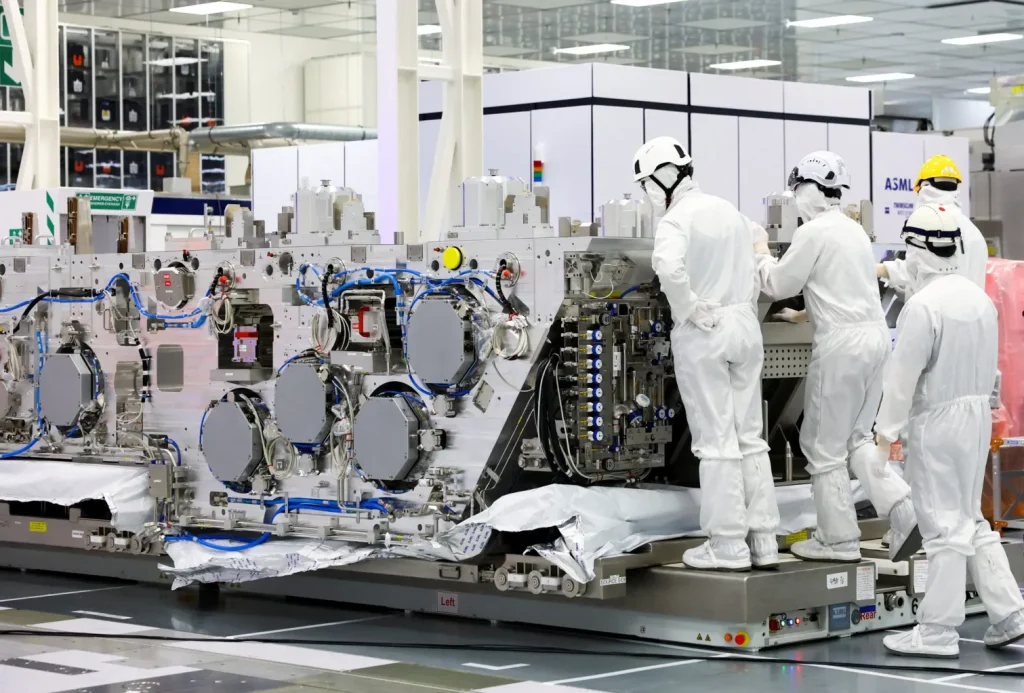
"If you had a factory like this in Europe, all the wafers that would be produced would be exported to the United States," warns Christophe Fouquet, CEO of ASML, which manufactures almost all the machines used to produce high-end semiconductors, Cepa reports.
"So then you'll be in a situation where Europe subsidizes a big project and the production of that project goes somewhere else."
Instead of subsidizing American artificial intelligence, Europe should boost domestic demand. According to Fouquet, a good start would be to relax the EU's Artificial Intelligence Blocking Act, which he believes hinders European companies from adopting the new technology.
ASML recently joined Airbus, Ericsson, Mistral, Nokia, SAP and Siemens in warning that the legislation risks hindering European companies before they can compete with American and Chinese rivals.
Without a strong European demand for artificial intelligence, a new state-backed mega-factory would be extremely expensive, politically sensitive, and likely to depend on permanent subsidies.
Currently, two American companies, NVIDIA and AMD, dominate artificial intelligence chips – and American companies Google, Amazon and Microsoft are among their biggest customers, according to Jan-Peter Kleinhans, a semiconductor expert at the OECD's Directorate for Science, Technology and Innovation.
Since the global high-end foundry market is an oligopoly defined by scale, experience and process knowledge, Kleinhans says Europe cannot simply buy its way into that club, especially not in the age of artificial intelligence where learning curves are brutal and capital requirements are massive.
An EU chip factory would, in effect, be a German chip factory. Among EU members, only Berlin boasts the financial clout to subsidize such a project. However, asking EU taxpayers to finance a major factory in Germany would also reopen familiar debates within Europe about who would benefit from “European” projects.
In practical terms, public money would be better spent on making Europe a better place for existing technology leaders to build and for new firms to design, rather than trying to force the existence of a European champion.
The goal should be to level the cost equation so that manufacturing in Europe becomes commercially comparable to manufacturing in Asia, relying on world leaders like TSMC and Samsung, who already know how to run advanced large-scale factories. This would give Europe a real manufacturing foothold without claiming that it can immediately become an independent leader in the most capital-intensive part of the industry.
Europe should also abandon subsidizing “national champions” like Germany’s Infineon or Franco-Italian STMicroelectronics and instead use tax breaks, R&D incentives, and large-scale financing to create a dynamic ecosystem without artificial intelligence chip manufacturing.
A pan-European “AI Chip Growth Facility” could co-invest with VCs in places like the Netherlands, Poland or the Baltics, where talent is strong but capital is scarce. The model should be Arm, the UK design leader whose intellectual property powers almost all the world’s mobile phones.
This strategy plays on European strengths, design talent, specific IP, research depth, tools and selected manufacturing nodes. Imec, headquartered in Belgium, is the world's leading independent nanoelectronics R&D center.
ASML, Zeiss and other European optical companies dominate on-chip imaging. Public money and leading universities should be encouraged and funded to leverage these strengths into real start-up factories, helping researchers create AI chip firms with shared design tools.
In this way, Chips Act 2.0 would no longer be a fight for a large German factory that could become a permanent source of subsidies. Europe would remain open to the broader coalition of semiconductor allies, rather than insisting on a purely European response to a global industry.
Europe cannot try to outspend China or the US in spending on a sovereign future with artificial intelligence chips.
It should work to increase demand for artificial intelligence, seed the next wave of fake-free design firms, and strengthen its existing ecosystem, rather than focusing on creating a politically symbolic but economically fragile national champion.
The GeoPost
 Iranian official: Iran agrees not to produce nuclear weapons
  Five people arrested in the operation to investigate war crimes in the “Reçaku II” case
  Putin's War and the Ghost of 1917: The Similarities That Worry the Kremlin
  Will Vučić suffer the fate of Lukashenko if the EU does not recognize his elections?
  Trump: Iran deal signed on June 14, Hormuz will be reopened to all
  Ukraine signs nearly 20 joint defense production agreements with EU countries