
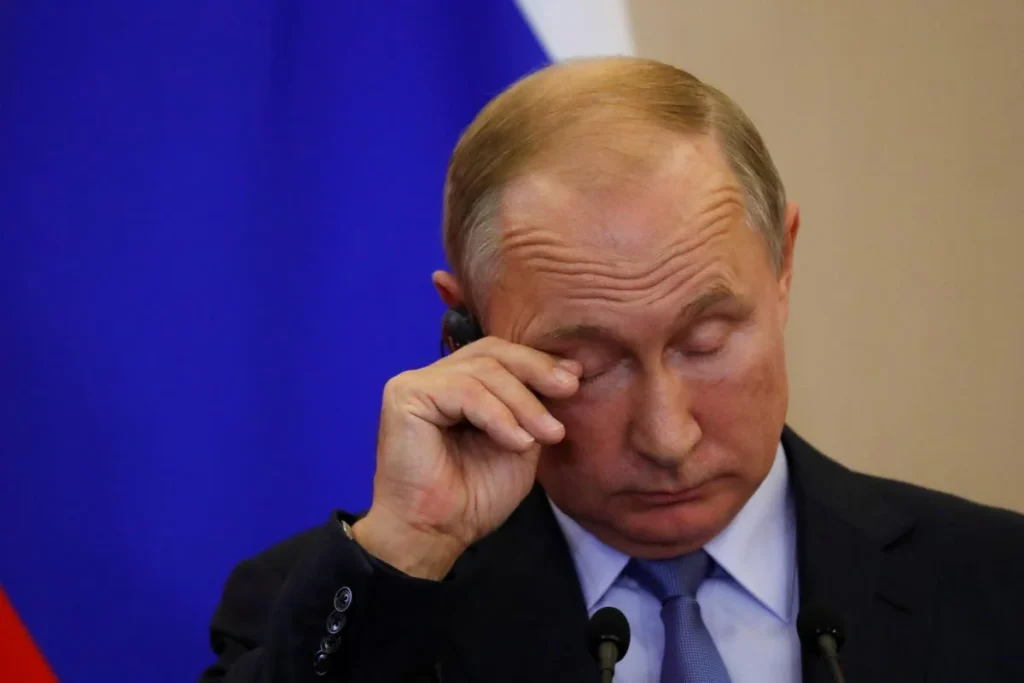
In Russia, August has for decades been associated with coups, financial crises, wars, military disasters and unexpected political upheavals. Now, as the war in Ukraine increasingly affects daily life inside Russia, an old question has returned: is Vladimir Putin's country facing another "Black August"?
"Black August," or "the curse of August," has become a familiar expression in Russian public discourse over the years to describe this month's tendency to be associated with dramatic events and major crises.
Russia's modern history has produced many episodes that have fueled this perception.
In August 1991, a group of hardline communists staged a failed coup against Soviet leader Mikhail Gorbachev. The coup's failure accelerated the processes that led to the dissolution of the Soviet Union a few months later.
Seven years later, in August 1998, Russia was hit by a severe financial crisis, which led to the default of domestic debt and the dramatic depreciation of the ruble.
Meanwhile, August 1999 marked the beginning of another development with far-reaching historical consequences. A militant incursion into Dagestan paved the way for the Second Chechen War, a conflict that helped propel a then-little-known figure, former KGB officer Vladimir Putin, to political prominence.
Putin took power on New Year's Eve 1999, following the sudden resignation of Boris Yeltsin. But even he did not escape what Russians call the "curse of August."
In August 2000, the nuclear submarine Kursk sank, taking the lives of 118 sailors. Eight years later, in August 2008, Russia went to war with Georgia, signaling a new and more aggressive phase of the Kremlin's foreign policy.
The crisis is getting closer to the daily lives of Russians
This summer, the atmosphere in Russia is once again heavy.
Russian advances on the war front in Ukraine remain limited, while Ukrainian attacks are increasingly hitting energy and logistical targets inside Russian territory. Attacks on refineries and distribution centers, along with concerns about fuel supplies and rising prices, have added to public discontent.
Russian commentator in exile, Ilya Varlamov, has dismissed the idea of the "August curse" as a coincidence, but has stressed that many Russians are awaiting this month with great anxiety due to the accumulating crises.
According to him, Russia is simultaneously facing problems in the fuel market, rising prices, pressure on the ruble and political uncertainty.
Warnings of a deeper crisis have also come from Russian economic circles, where concern has been raised about the country's loss of technological and economic competitiveness, as well as Moscow's ability to withstand a long war against Western-backed Ukraine.
Putin minimizes the damage
Despite the tense atmosphere, Putin has continued to display public confidence.
Commenting on the damage caused by Ukrainian attacks on logistical facilities, the Russian president acknowledged that they have caused damage, but insisted that they cannot produce critical consequences for the country.
According to him, the damaged facilities will be rebuilt with government support.
However, the war that the Kremlin launched against Ukraine in 2022 is increasingly intruding on the everyday lives of Russian citizens. Drone attacks, damage to infrastructure, and economic problems are making the conflict increasingly tangible even far from the front lines.
Contrast with Ukraine
Meanwhile, Ukraine also faces internal political tensions and major challenges caused by the war.
But the author of the analysis highlights a major difference between the two countries: while in Ukraine political debates, protests, and public clashes over the country's future continue, in Russia the space for political opposition and civil society has drastically narrowed.
Volodymyr Zelensky's presidential term was originally due to end in 2024, but the election was postponed due to the state of emergency imposed following the Russian invasion.
In Russia, meanwhile, opponents of the war and opposition figures have faced arrests, convictions and prosecutions. The repression of the opposition has intensified since the beginning of the invasion of Ukraine.
One of the most serious moments for the Russian opposition was the death of opposition leader Alexei Navalny in a prison colony in the Arctic in February 2024. Ironically, the story of his latest clash with the Kremlin also had a connection to the month of August: in August 2020 he was poisoned with a nerve agent during an air trip from Siberia to Moscow.
Coincidence or not, August has left a dark mark on modern Russian history.
And as military, economic and social problems pile up for Vladimir Putin's regime, "Black August" has returned once again as a metaphor for a question that many Russians seem to be asking themselves: is the country facing another sudden and painful turn?
The GeoPost
 Citizenship for "special benefit": What happened to Russian businesses in Bosnia?
  US launches 'economic attack' on Iran, demands countries cut 'aid lines' supporting Tehran
  Serbia and Russia increase propaganda for Kosovo, experts: The goal is control over the Serbian community
  Even when they leave Russia, Putin makes it difficult for Russians to renounce citizenship
  The US introduces the AIM-424 Malice, a missile with a range of over 463 km
  The US is planning further economic tightening on Iran, having imposed sanctions on Tehran since 1979.