
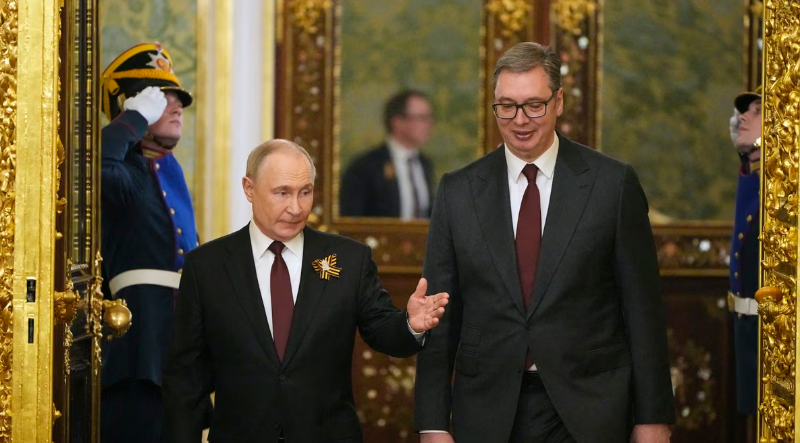
Russia is following the political situation in Serbia with increased attention, as the country approaches early parliamentary elections and faces massive student-led protests.
Senior Russian officials have repeatedly warned in recent weeks about the possibility of a so-called "color revolution" in Serbia after the elections, raising questions about why the Kremlin is engaging so directly in the internal political development of a Balkan country.
The Russian Ambassador to Belgrade, Aleksandar Botsan-Kharchenko, has stated that Serbian authorities should be prepared for such a scenario, claiming that mass protests require funding and support from abroad.
"It's been several years since such mass protests have been organized, but this requires support, it requires money. And this comes from the West," the Russian ambassador declared, adding that the possibility of a "color revolution" after the elections cannot be ruled out, regardless of the result.
The statement has been interpreted by political analysts in Serbia as a message that goes beyond traditional diplomacy and that could serve as political support for Aleksandar Vučić's government in a sensitive period.
Foreign policy and security expert Srđan Cvijić says that Moscow is not at all indifferent to the outcome of the elections in Serbia and that the statements of Russian officials may also have a political function.
According to him, in the event of a political crisis after the elections, Moscow could be one of the supporters of the Serbian government.
"If they get into trouble, if they lose the elections, if they try to rewrite the election results in some illegal way, it will certainly not be the European Union or any Western power that will come to their aid, but Moscow," Cvijic declared.
Russian rhetoric and that of pro-Vučić media
Beyond diplomatic statements, another element that has attracted attention is the similarity between the narrative of Russian officials and that of Serbian tabloid media close to power.
According to Cvijic, there is a visible "symbiosis" between Moscow's public discourse and the pro-regime media narrative in Serbia.
"This narrative is absolutely identical to the narrative in the tabloid media of Aleksandar Vučić's regime," he said, referring to the narratives about the protesters and allegations of foreign interference.
He cited as an example the way pro-government media portray protesters and political opponents, arguing that these narratives are then supported by statements from Russian officials.
According to him, this compatibility is not a new phenomenon, but a relationship that has been consolidated over the years.
Political support for Vučić has also been reflected in statements by Russian Foreign Minister Sergei Lavrov.
Speaking about the Serbian president, Lavrov stated that Vučić is under pressure from the European Union.
"It is not easy for Aleksandar Vučić. He is a very experienced politician and is committed to the course of European integration. At this stage, the European Union is harassing him and simply blackmailing him," Lavrov said.
Meanwhile, the Russian Foreign Ministry has also commented on developments related to Kosovo and KFOR.
These statements show that Moscow does not limit its interest only to internal political developments in Serbia, but also links it to the Kosovo issue and Belgrade's relations with the West.
Why does Moscow worry about political change in Serbia?
According to Cvijic's analysis, one of the main reasons is the nature of the current relations between Moscow and the authorities in Belgrade.
He argues that Vladimir Putin's authoritarian regime is better suited to a centralized political system in Serbia than a democratic government that might seek a clearer orientation towards European institutions.
"The authoritarian regime in Moscow suits this regime in Serbia. Regime change scares them, because a democratic government will not be guided by the interests of the ruling clique and the oligarchy, but will have to respond to the interests of all citizens, which generally do not coincide with the interests of Moscow," Cvijic declared.
According to him, it would be difficult to expect a new government in Belgrade to continue to represent Russian interests in the same way as the current government.
He mentioned, among other things, cooperation with Russian intelligence services and the alleged persecution of the Kremlin's political opponents in Belgrade.
Serbia between Moscow and Brussels
While Serbia officially continues to state that its strategic objective is membership in the European Union, Belgrade maintains a close political and security relationship with Moscow.
This dual position makes Serbia one of the most important countries in the Balkans for Russian interests.
In this context, Russian officials' continued statements about a "color revolution," protests, and elections can be seen as attempts to influence the way political developments in Serbia are perceived.
If the early parliamentary elections produce a change of power or a new political crisis, the way Moscow positions itself could be one of the important factors in understanding the next phase of the political conflict in Serbia.
Ultimately, the question that arises is whether Moscow's warnings of a "color revolution" are simply an assessment of the political situation in Serbia or a preventive message to any force that might challenge the current power in Belgrade.
The GeoPost
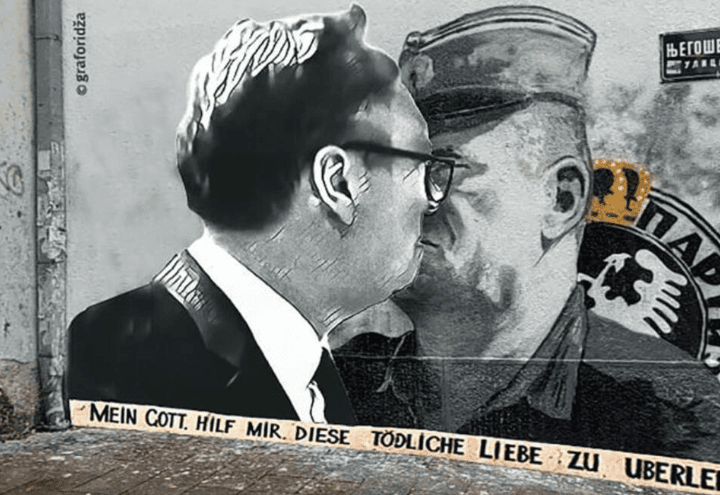 The two faces of Serbia
 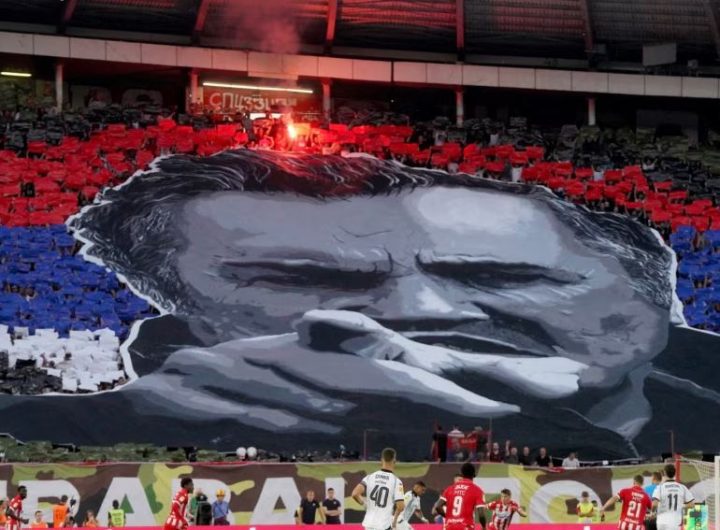 The connections between politics, clubs and fans: Glorifying Mladic without reactions and sanctions
  SAS veterans train Russians in camps in Serbia and Bulgaria to fight in Ukraine
  "The time has come for tougher measures": Picula calls for an end to EU tolerance towards Serbia and Vučić
  Serbia glorified Mladic, Vucic is victimized after EU reaction
  Serbs from the front in Ukraine with threatening messages for Kosovo (Video)