
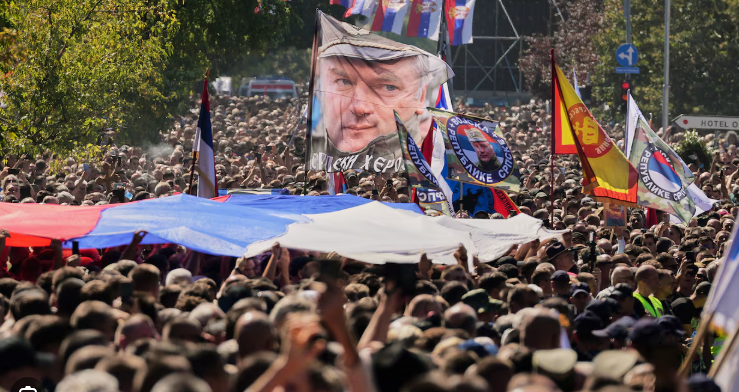
The glorification of war criminals, as well as the funeral of convicted war criminal Ratko Mladic, who was convicted of genocide, war crimes and crimes against humanity by an international tribunal, with elements of state honors in Serbia, raises a serious question about how ready the state is to accept European values and translate them into concrete actions – which is, declaratively, the strategic goal of official Belgrade.
However, this is also a serious test for the European institutions, as they must now show whether they are truly willing to defend European values when they are directly challenged and whether there will be concrete consequences for violating them.
The European Commission (EC), whose president has a proven close relationship with Serbian President Aleksandar Vučić, initially did not appreciate the fact that Ratko Mladić's funeral was held in Belgrade with state honors.
Brussels radically changed its tone a day later, when the leaders of European institutions issued a joint statement on the funeral.
European Commission President Ursula von der Leyen and European Council President Antonio Costa said in a joint statement that “views from yesterday's funeral of Ratko Mladic.
"The elements of official support, as well as the presence of some senior Serbian officials at the funeral, are deeply regrettable. They show a failure to confront a dark chapter in recent European history and are contrary to the values on which Serbia's path towards the European Union is based," said Von der Leyen and Costa.
John O'Brennan, professor of European politics at Maynooth University and director of the university's Centre for European and Eurasian Studies, believes Brussels needs to go a step further.
"Although Commissioner Kos (Marta) issued a strong statement and cancelled her upcoming visit to Serbia, the truly strong EU response should have been a complete suspension of Serbia's accession process to the European Union. The only language that people like (Serbian President) Vučić respect or understand is the language of strength, without darkness and timidity," Professor O'Brennan told Radio Free Europe.
"Recent days have brought back to life some of the worst horrors of the 1990s, and no EU candidate country should have acted in the way Serbia has," O'Brennan said.
Social media was also flooded with comments from political actors in Brussels, and among the most vocal were members of the European Parliament, who announced that they would demand the removal or suspension of financial aid to Serbia.
However, the question remains open as to how far the European Union is prepared to go, in the case of Serbia, to implement its oft-repeated position that “there is no place in the EU for the glorification of war criminals and the denial of genocide.”
'Time for Serbia to face the consequences'
O'Brennan believes that too often the European Commission and some EU member states have been willing to turn a blind eye to abuses in Serbia, largely because they saw Belgrade as the key to geopolitical stability in the Balkans. There was an assessment that the country, if left outside the European Union, could become a potential source of instability and chaos.
"Now is the time for Serbia to face the consequences. This should mean imposing serious material sanctions on the regime in Belgrade. You cannot be a candidate for EU membership and at the same time glorify war criminals. Imagine Germany organizing state funerals for Heinrich Himmler or Hermann Göring years after the end of World War II," O'Brennan said.
Michael Leigh, former director for enlargement at the European Commission and now a senior fellow at the Brussels-based think tank Bruegel, warns that the behavior and messaging of the Serbian leadership are not without consequences for the country's European path.
"Such events are not without consequences. Serbia is far below its potential when it comes to EU rapprochement, largely because such attitudes remain widespread in the country. Its progress towards EU membership would be much faster if Serbian leaders demonstrated, through their actions, not just words, a commitment to democracy, the rule of law, minority rights and good neighborly relations," Lee told Radio Free Europe.
Will there be consequences for the European integration process?
Croatian Prime Minister Andrej Plenković stated on September 7 that the glorification of war criminal Ratko Mladić is fundamentally incompatible with the values on which European integration is based.
"Anyone who gives state honors to a convicted war criminal does not understand what the European Union stands for and does not share the same values of democracy, the rule of law, respect for human rights and European solidarity," Plenkovic said during a speech at the Cernobbio forum in Italy.
Croatia, as a full member of the EU, has the right to veto any decision related to enlargement.
Michael Lee also questions the willingness of Serbian authorities to translate the values of the European project into concrete political action, warning that without progress in dealing with the past and regional reconciliation, there can be no serious progress towards membership. He sends the same message to politicians from the region who have expressed regret over Mladic's death.
"The Serbian government's commitment to the values on which the European Union was founded has not yet been confirmed by concrete actions. Unfortunately, several leaders of other Western Balkan countries have expressed condolences on the occasion of Mladic's death. This shows that the region still needs to make significant progress in the process of reconciliation and respect for fundamental values before it is ready for EU membership," Li assessed.
Professor O'Brennan emphasizes that honoring Mladic through state elements at the funeral raises serious questions about Serbia's right to EU membership.
"Unlike Germany, Serbia has never experienced a moment of moral confrontation with the guilt of war crimes, nor has it had a counterpart to German Chancellor Willy Brandt, who knelt in Poland and apologized for German crimes. Belgrade has never truly faced the legacy of ethno-nationalism and genocide committed by people like Mladic and Milosevic," says the Irish professor and expert on issues in the Western Balkans region.
"Instead, Serbian leaders continue to lie, obscure the facts and threaten their neighbors. Meanwhile, they are getting closer to Moscow and using the European Union as an easy target. That is why it is time to end the farce of Serbia's possible EU membership. You cannot be in the EU and at the same time continue to worship at the altar of genocidal ultranationalism," he assesses.
However, regardless of whether the funeral of convicted war criminal Ratko Mladic will be treated as an event with state honors or not, Serbia remains where it was in terms of European integration – in a virtually frozen accession negotiation process.
The reasons for this are, first and foremost, the situation in the country, especially when it comes to the rule of law, but also the lack of compliance with EU foreign policy and sanctions, especially against Russia.
Therefore, the possible consequences of the events surrounding Mladic's funeral may be of a material or diplomatic nature rather than a direct change in the status of the negotiation process.
Two final moments that will show if there will be consequences
The possible visit of the President of the European Commission to Serbia as part of a Balkan tour and the money that Serbia could potentially receive from the Western Balkans Growth Plan are two moments in which it may become clearer how prepared Brussels is to show that Serbia will bear the consequences for glorifying war criminals.
Ursula von der Leyen is scheduled to make her regular annual tour of the region in early October and, according to EC officials, for the first time "the possibility of bypassing Serbia is not being ruled out."
Admittedly, this would be an extremely extreme step. Although the likelihood of this happening is low, the recent joint announcement by Von der Leyen and Antoni Costa could be a hint at such a decision.
If she comes to Belgrade, Von der Leyen may choose, as a Pyrrhic victory, to avoid meeting the Serbian president in front of the cameras, as well as not holding a press conference. However, the authorities could undoubtedly use her arrival to present it as a confirmation of support for Serbia's European perspective and the current government.
There is already a precedent for avoiding a press conference. Last year, Von der Leyen did not appear before the media during her visits to Kosovo and North Macedonia, justifying the decision with the election campaign in both countries.
If the prevailing opinion is that it is not appropriate to visit Serbia at this time, there is a backup option: for the EC President not to go to Bosnia and Herzegovina either, which would mitigate the political consequences of a possible cancellation of the visit to Belgrade.
Unofficial sources within the European Commission confirmed to Radio Free Europe that a visit to Bosnia and Herzegovina is also questionable (provided Serbia is not part of the plan).
The money allocated to Serbia could also be an indicator of the direction Brussels is taking. Financial resources from the European Growth Plan for the Western Balkans are largely conditional on good neighborly relations and regional cooperation.
New payments to countries in the region are expected later this fall.
Whether and how much Serbia will receive from this package in the second half of the year will be another indicator of Brussels' readiness to react to the events that took place between August 27 and September 7.
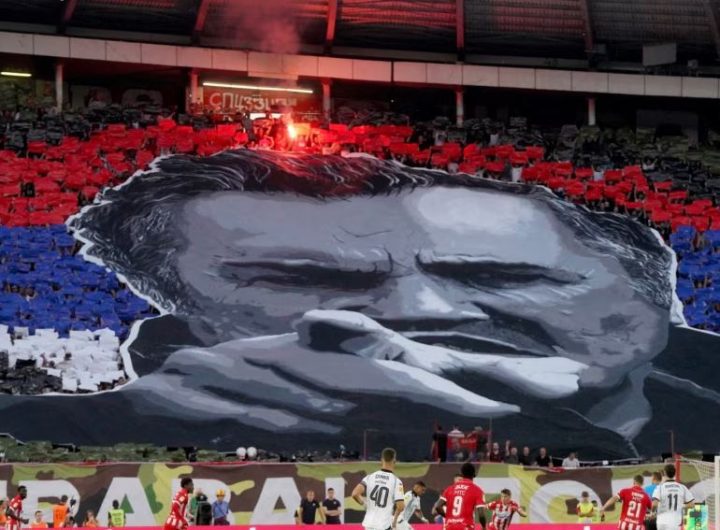 The connections between politics, clubs and fans: Glorifying Mladic without reactions and sanctions
 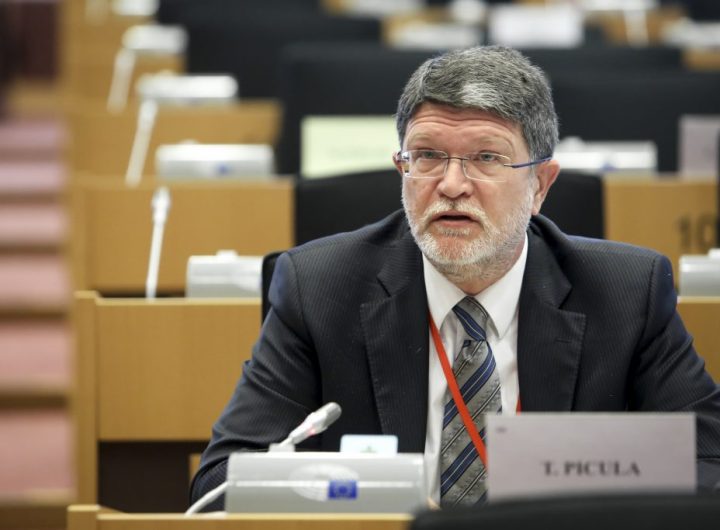 "The time has come for tougher measures": Picula calls for an end to EU tolerance towards Serbia and Vučić
 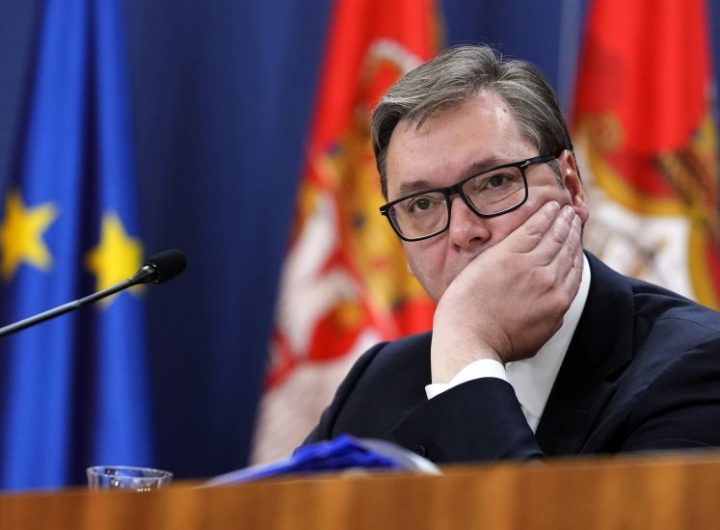 Serbia glorified Mladic, Vucic is victimized after EU reaction
  Serbs from the front in Ukraine with threatening messages for Kosovo (Video)
  Alarm from former US ambassador: The West must urgently change its strategy towards Serbia
  Bosnia expels two Serbian diplomats over Mladic glorification