
The Leningrad region in Russia is located about 600 kilometers from the nearest point in Ukraine.
But on April 15, the governor of this region declared that region a “frontline.” Part of his explanation was this: from January to March, according to him, a total of 243 Ukrainian drones were shot down over this region.
However, not all drones have been shot down.
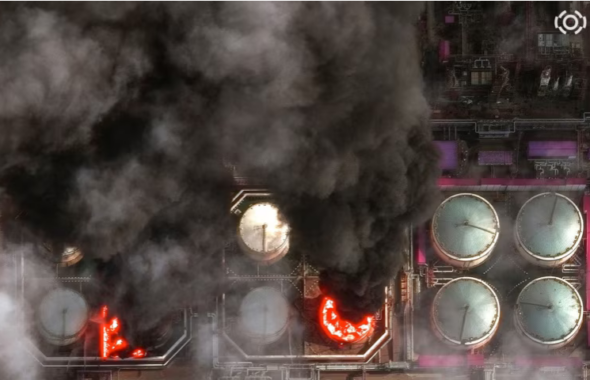
From export terminals in the Gulf of Finland to refineries inland, oil facilities in the region surrounding St. Petersburg – the hometown of Russian President Vladimir Putin – have been among the hardest hit in the growing wave of Ukrainian attacks on Russian hydrocarbon production, storage and export infrastructure.
The attacks, which often strike hundreds of kilometers or even further from the front lines, have changed the dynamics of Russia's war against Ukraine, now in its fifth year since Putin ordered a full-scale invasion of the neighboring country in February 2022.
To what extent they could change the course of the war is still unclear. But the attacks – mostly by drones, but also by missiles, and targeting military installations such as air defense systems, military airports and weapons factories – are coming at a time when Russia is facing difficulties on the battlefield, advancing at a very slow pace and at a high cost in killed and wounded soldiers.
They have made it difficult for Russia to benefit from the sharp rise in oil prices – a key source of funding for its war against Ukraine – that has resulted from the US and Israel's war on Iran and Tehran's restriction of traffic in the Strait of Hormuz.
The sight of black smoke rising from Russian oil facilities has suddenly become almost commonplace. The attacks have brought Moscow's war against Ukraine closer to Russian citizens, for example in the Black Sea port of Tuapse, where residents have reported oil droplets falling from the sky during a series of attacks in recent weeks.
They have also prompted Putin to scale back plans for the May 9 military parade in Red Square, which marks the victory over Nazi Germany in World War II. The Victory Day parade is expected to be held without the display of heavy weapons, such as tanks and intercontinental ballistic missiles, for the first time in almost 20 years. Smaller parades in some cities have been canceled.
According to French open-source researcher Clement Molin, Ukraine launched about 1.000 drones towards Russia in August 2024, 3.000 in July 2025, and 7.000 in March – for the first time more than Russia has launched towards Ukraine.
That number, based in part on Russian Defense Ministry data, fell slightly in April. But in any case, assessing the effects is a matter of quality as much as quantity, in part because Moscow's claims about the number of drones its military has shot down are not credible.
"I would be cautious about drawing too strong conclusions from the raw numbers alone... However, the broader trend is real," John Helin, co-founder of the research organization Black Bird Group, told Radio Free Europe.
"Ukraine has clearly expanded its long-range drone strike capability, and Russia now faces the challenge of defending a much larger area in its rear from regular Ukrainian attacks."
The figures “suggest a change in scale, but the success of the Ukrainian long-range campaign should be assessed more by the effects,” Helin said, such as “what was hit, how often, how deep inside Russia, whether the attacks forced Russia to deploy air defenses, whether they disrupted logistics, reduced refinery output, or incurred real economic and military costs.”
"In these respects, it is clear that the Ukrainian long-range campaign is becoming increasingly effective," he said.
Ukraine struck Russian oil infrastructure at least 21 times in April, including nine attacks on processing facilities, which helped push Russia's crude oil processing volume to its lowest level since 2009, according to Bloomberg News.
On the battlefield and in airstrikes carried out by both countries, drones have become an extremely important factor in the deadliest war in Europe since 1945. Both sides are trying to build, buy and improve them as quickly as they can.
"Today, our Ukrainian drones have fundamentally changed the way war is waged," President Volodymyr Zelensky said at a demonstration in April, on the occasion of Ukraine's Arms Worker's Day, where he presented more than 30 types of drones.
Ukraine's new Defense Minister, Mykhaylo Fedorov, said in late April that Kiev has purchased more drones in the first three months of his term than in all of last year.
"We are now seeing the moment when Russia's air defense capabilities are much smaller than the increase in Ukrainian drone production," Oleksandr Karpyuk, a soldier with the 59th Assault Brigade of the Ukrainian Unmanned Systems Forces, known by his military nickname Serge Marco, told Radio Free Europe.
Targeting Russian air defense systems is a key element of Ukraine's strategy, soldiers, officials and military analysts suggest – either by damaging or destroying them with direct attacks, or by neutralizing them by sending a few drones in their direction, to keep them busy and prevent them from defending targets from missiles and other attacks.
If Russian systems shoot down dozens or hundreds of drones, those systems will be exhausted, opening the sky for further attacks, Karpyuk said: “First come the drones, then come the missiles. They disable the air defense systems – and that means that a few Flamingos, with 1.000-kilogram warheads, can hit [the targets] easily.”
Ukraine has been promoting its Flamingo cruise missiles. It used some of them on May 5, Zelensky said, including in an attack on a factory in Cheboksary, about 1.200 kilometers from Ukraine, that produces navigation components for the Russian military. The regional governor said at least two people were killed and more than 30 were wounded.
Ukraine's Unmanned Systems Forces destroyed 41 Russian air defense units in March, according to the service's commander, Robert Brovdi, increasing the pace after destroying 54 units over the previous three months.
Analysts warn that such claims are difficult to verify. Oryx, a group that monitors losses of military equipment during the war, counted 18 destroyed or damaged Russian surface-to-air air defense systems and seven radars in March.
Whatever the numbers, destroying or disabling air defense systems could help Ukrainian forces on the frontline repel Russian advances and achieve their own breakthroughs.
This also "opens a window for deep strikes, medium-range strikes and effective strikes. We are seeing them in the Leningrad region and along the Black Sea coast," Oleksiy Bezuhliy, spokesman for the 413th Special Forces Regiment of Unmanned Systems, told Radio Free Europe, referring to the recent wave of Ukrainian attacks on Russian oil facilities.
Russia's large land area increases its vulnerability to "air defense suppression attacks" from Ukraine, according to University of Oslo researcher Fabian Hoffmann, because the loss of a single system could mean that an entire area is no longer under air defense cover.
The focus on protecting Putin, the government, and Moscow could leave distant energy and military facilities, or forces near the front, more exposed – a factor that has come to the fore ahead of the May 9 parade in Moscow, a high-profile annual event in which Putin attends from a tribune near Lenin's Mausoleum.
“Russia’s apparent reluctance to shift capabilities away from the narrow ring of air and missile defenses around Moscow – likely due to fears that the realities of war would come closer to the regime’s doorstep – exacerbates the problem,” Hoffmann wrote.
In a blog post on April 12, he wrote that "the campaign of attacks alone does not ensure Ukraine's victory in the war, nor does it eliminate Russia's economic potential."
However, he added, the cumulative effects of the restrictions it imposes "are real and significantly impact Russia's budget and planning, even if they fail to collapse its capacity to wage war."/REL
 Indictment filed against former police officer Bojan Jevtic – suspected of espionage and illegal possession of weapons
  "Death Zone" - How is Russia luring Africans to fight in Ukraine?
  Saudi Arabia and Kuwait open bases for US, resume operation in Strait of Hormuz
  EU increases pressure on Serbia, but without clear decision on sanctions
  Kremlin bans foreign media from covering May 9 parade in Moscow
  Belarus: Between Washington and Moscow