
The bombing campaign by the United States and Israel has devastated much of Iran's infrastructure and industries, disrupting domestic production and driving up the prices of basic food products.
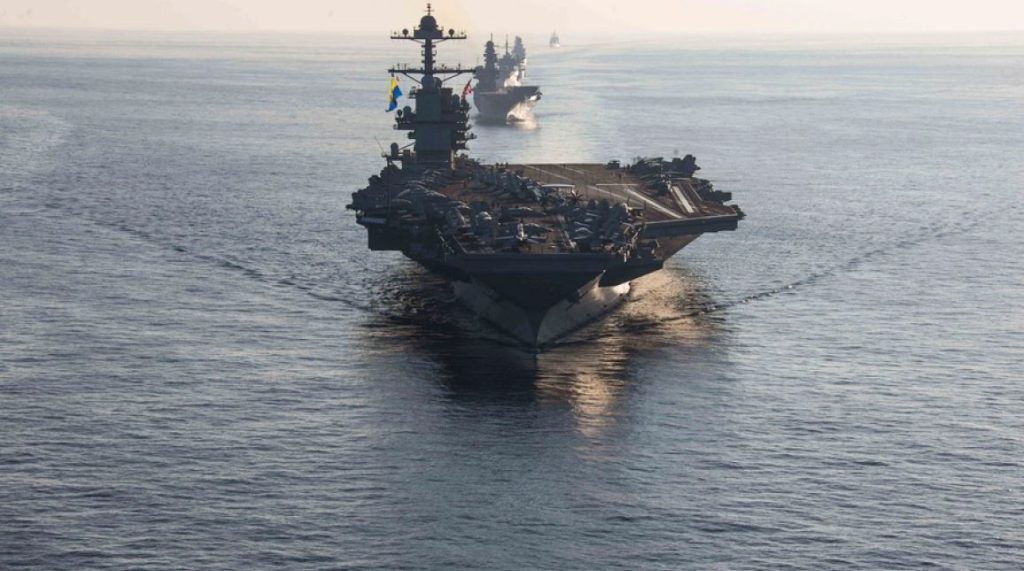
A US naval blockade has increased economic pressure on Iran, hindering its trade through the Strait of Hormuz, a vital sea route that has been virtually closed since the war began on February 28.
As a result, Tehran has turned to alternative routes, transporting goods by truck from neighboring Pakistan and Turkey, as well as sending cargo from ally Russia via the Caspian Sea.
Iran is also considering sending oil by rail to China, which is an important trading partner of the Islamic republic.
Steve H. Hanke, a professor of economics at Johns Hopkins University in Baltimore, said alternative routes could help Iran supply itself with consumer goods, food and industrial materials. But they “cannot replace a container-based maritime economy.”
"Truck transportation is more expensive and the Caspian Sea's capacity is limited by ports and fleets," said Hanke, a former economic adviser to US President Ronald Reagan's administration.
"Higher import costs and higher inflation for tradable goods are expected, but not the economic collapse that some have predicted," he stressed.
Iran's alternative trade routes
With the Strait of Hormuz closed, Iranian imports and exports are now flowing through border crossings with Turkey and Pakistan, as well as a shipping route to China through Central Asia. Iran is also using its own port of Bandar Anzali, on the Caspian Sea.
Trump declared in late April that "Iran's entire oil infrastructure would be destroyed" because the US blockade was preventing Tehran from exporting oil, the country's main economic resource.
But experts are skeptical that blocking the Strait of Hormuz will force Iran to surrender or sign a peace deal on American terms.
For their part, Iranian officials have stated that the US embargo has not affected the country's ability to secure basic goods and food, citing strong domestic production and alternative import routes.
"Despite the US naval blockade, we have no problem supplying basic goods and food because, due to the size of the country, it is possible to import from different borders," Agriculture Minister Gholamreza Nouri said on April 21.
Rosemary Kelanic, director of the Middle East Program at the Washington-based Defense Priorities Institute, said Iran's geography has softened the impact of the US naval blockade.
Iran, a country of about 90 million people, has almost 6.000 kilometers of land borders with seven countries, as well as a 700-kilometer coastline along the Caspian Sea, connecting it to Central Asia and Russia.
"Measures such as trucking goods from neighboring countries could offset disruptions caused by the blockade. Although the compensation may not be complete, trade volumes may be lower, transit costs somewhat higher, and the type of goods may change," she said.
"But there are many ways a war economy can replace goods with similar alternatives," she highlighted.
"The opportunities for the Iranians to improvise around Trump's blockade are endless, because the country has thousands of kilometers of land borders to exploit," Kelanic added.
Under international law, blockades that impede the flow of food and medicine are prohibited. It is not clear whether the United States is blocking civilian shipments to Iran unintentionally or as part of its policy. Radio Free Europe/Radio Liberty has sought comment from the White House on this.
Land routes
Iranian lawmaker Ebrahim Najafi said last month that the country was using land routes with Pakistan, Turkey, Armenia and Azerbaijan, as well as the Caspian Sea, to import goods.
Pakistan opened its ports to cargo from third countries destined for Iran on April 25. This move created six land routes for transporting goods from the ports of Gwadar, Karachi, and Port Qasim to the Iranian border.
These routes will be used primarily for the import of rice, meat, and infant formula.
Since the imposition of the US blockade on April 13, around 3.000 containers destined for Iran have remained stranded at Pakistani ports.
Meanwhile, the Kapikoy-Razi border crossing connects Iran with Turkey. By linking West Asia with Europe, this transit corridor facilitates major trade. It is not clear whether Iran has increased imports through this corridor since the blockade was imposed.
Russia has reactivated shipments through the Caspian Sea to Bandar Anzali, an Iranian port on the world's largest landlocked sea.
Bandar Anzali was hit by Israeli airstrikes on March 18, causing damage. At the time, Israel said it had struck targets at an Iranian port and naval base where dozens of military vessels, including missile boats and patrol boats, were located.
Media reports have suggested that Moscow and Tehran are using the Caspian Sea to smuggle oil and sanctioned weapons. But Iran and Russia also trade food products through this route. Grain trade between Iran and Russia was halted immediately after the Israeli attack, but has since resumed.
Kpler, a cargo and shipping analytics company, said about a dozen ships from Russia, Kazakhstan and Turkmenistan carrying grain, corn and sunflower oil have arrived at Iranian Caspian ports since mid-April.
Oil by rail
In addition to securing new import routes, Iran is also looking for ways to export goods, especially oil.
The US blockade has significantly disrupted Iran's seaborne oil exports, but has not stopped them completely. Some tankers bound for Iran have managed to bypass the blockade, according to cargo tracking group Vortexa and shipping company Lloyd's List.
Experts said the Islamic republic should be able to withstand the blockade for another two months, referring to up to 130 million barrels of Iranian oil already at sea before the blockade took effect.
However, Iran is turning to alternatives, including exporting oil by rail to China, which buys about 90 percent of Iranian oil, according to Hamid Hosseini, spokesman for Iran's oil exporters' union.
The railway infrastructure connects Iran with the Chinese cities of Yiwu and Xi'an. The Kazakhstan-Turkmenistan-Iran corridor opened in 2014 and was expanded in 2025 by the 10.400-kilometer Chinese railway link.
"Rail can transport strategically important volumes, but in the short term it cannot replace large-scale sea tankers," said Hanke of Johns Hopkins University.
“Its value is partly logistical and partly political: it operates entirely outside any waterway that a Western navy can patrol, and entirely outside the dollar payment system, as China has been paying for Iranian oil in yuan since 2012.”
Kelanic said that transporting oil by sea is more efficient, but there are ways for Iran to ship oil by land to circumvent the US embargo.
"Iran could also transport oil by truck on highways, as Iraq has done, avoiding the Strait of Hormuz through land transport in Syria to the Mediterranean Sea," she said.
"In the short term, volumes will be smaller, limited by the availability of tanker trucks. But host countries or third countries could provide additional trucks, perhaps as a political favor to Iran, or simply because it would be in their interest to increase access to oil in a tight market."/REL
 Indictment filed against former police officer Bojan Jevtic – suspected of espionage and illegal possession of weapons
  "Death Zone" - How is Russia luring Africans to fight in Ukraine?
  Saudi Arabia and Kuwait open bases for US, resume operation in Strait of Hormuz
  EU increases pressure on Serbia, but without clear decision on sanctions
  Kremlin bans foreign media from covering May 9 parade in Moscow
  Belarus: Between Washington and Moscow