

This report traces how Russia supports its war in Ukraine by recruiting foreign nationals, many of them deceived or coerced, through a global network of social media advertisements, intermediaries, and readily available websites.
It focuses on a recent investigation by the European External Action Service (EEAS), which uncovered a coordinated digital infrastructure behind this recruitment campaign.
The Kremlin has faced challenges recruiting personnel for its war against Ukraine. With around 30,000 casualties a month. (opens in a new tab) , many Russians are reluctant to fight. During Russia’s partial mobilization in 2022, hundreds of thousands of citizens – officially (opens in a new tab) 261,000 and up to 700,000 according to other sources (opens in a new tab) – deserted, prompting authorities to suspend the measure (opens in a new tab) Since then, the military has relied mainly on volunteers, criminals pardoned in exchange for fighting, and foreign recruits.
A system has been set up to lure individuals from around the world to enlist in the Russian military, with over 28,000 foreigners from 135 countries. (opens in new tab) involved by the end of 2025. The EEAS investigation identified part of this digital channel, tracing thousands of advertisements and dozens of websites to several organizations and recruiters.
Tracking Russia's digital recruitment backbone
Investigators found numerous recruitment ads for the Russian armed forces on Meta, WhatsApp and at least 35 websites in up to 40 languages, such as Indonesian, Thai, Malay, Arabic, Wolof, French and Spanish. Together, these indicate a recruitment network aimed at engaging potential recruits worldwide, while concealing the true sponsors and, in many cases, the nature of the work being promoted.
By monitoring sponsored ads on Facebook, the investigation uncovered a coordinated campaign spanning four continents. African audiences were first targeted in June 2026, with a focus on Latin American users (including diaspora communities in Italy, Spain, Poland, Romania, and Bulgaria) by July, before expanding to Southeast Asia by the end of the month. At the time of writing, 85 paid ads targeting Russian military personnel had appeared on Meta platforms and had been reported by the company. Currently, 78 of these are no longer accessible.

The ads used at least four tactics to evade scrutiny: First, AI-generated recruitment posters disguised as general job postings that revealed their military nature only after being clicked. Second, French- and Spanish-language ads that took users to third-party landing pages hosted on an app-building platform to collect contact details. Third, the use of newly registered, available domains that redirect to real recruitment pages, a known technique to avoid tracking the final website (a method reminiscent of Doppelganger). (opens in a new tab) Finally, fake but sophisticated Facebook pages posing as legitimate employment agencies to give the whole operation a layer of credibility.
Tracking domains back to a command structure
The investigation traced dozens of recruitment websites to a small group of groups hiding behind them. At least 35 websites were identified, spanning up to 40 languages with domains dedicated to Brazil, Serbia, and the DRC. Behind this infrastructure lie four recruitment brands: Military Staff Agency, Work in Russia, IRC Russian Bear, and Work Team Agency. The first three are linked through shared WhatsApp contact details to a single Russian-registered organization, “Central Headquarters,” which is co-located with a volunteer battalion training center in Bashkortostan, Russia.
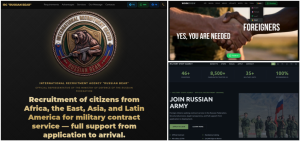
The open-source research also linked a Task Force Agency domain to Roman Saponkov, a Russian military blogger already under Ukrainian sanctions for his role in supporting the invasion, with a documented history of ties to the Wagner Group. While a full attribution of the network to Russia is still pending, these signals transform a story about anonymous websites into a story about assets and figures operating within a state-linked recruitment pipeline.
Volunteers, mercenaries and victims of fraud
The digital network uncovered by the EEAS is only part of the story. Recruits range from willing volunteers to people lured by high salaries or tricked into traveling to Russia. Former military personnel and war veterans from Asia, Africa, Latin America, and the Middle East join willingly, including former Syrian fighters lured by high salaries from recruiters with ties to Russia. The Kremlin exploits poverty and desperation for geopolitical gain, contradicting its claims of supporting the emancipation of the Global South. A recent report by the Center for Human Rights Research calls this a “predatory global recruitment infrastructure” that exploits economically vulnerable citizens.
Many had no intention of joining the Russian army at all. Thousands believed they were signing up to work as plumbers, warehouse packers, security guards, or other roles in Russia, or, at best, in logistics or construction away from the front.
A Guardian (opens in a new tab) The report highlights a Nepalese man, 'Nandaram Pun', who was promised a job in Germany, told to travel via Russia and instead was forced into the army and sent to fight in Bakhmut.
From social media ads to a military contract
The EEAS investigation identified a coordinated and centralized campaign against Meta. Recruitment(opens in a new tab)also takes place on TikTok(opens in a new tab), YouTube(opens in a new tab), Facebook(opens in a new tab), Discord and gaming apps(opens in a new tab). Once contact is made, intermediaries such as influencers(opens in a new tab), middlemen or women(opens in a new tab), travel agencies or specially created companies(opens in a new tab)coordinate the logistics of the trip, often charging significant fees that are offset by promised high salaries of up to $3,000. Upon arrival in Russia, recruits have their passports taken away.(opens in a new tab), and they are forced to sign a contract with the Russian military, usually in Russian, a language they do not understand, before beginning up to two weeks of military training at places like the Avangard Academy.(opens in a new tab)near Moscow, before deployment to Ukraine.
When recruitment turns into human trafficking
The fraudulent nature of this scheme has led many scholars and legal experts to conclude that it is tantamount to human trafficking. A recent report by the International Federation for Human Rights finds that, legally, Russia is responsible for violations in this area, and third states may also be responsible for failing to prevent trafficking, prosecute perpetrators, and repatriate victims.
Several Ukrainian initiatives aim to counter these tactics. (Opens in a new tab) The project encourages members of the Russian armed forces to desert or surrender. Another effort, 'Stop Russian Recruiters' (Opens in a new tab), focuses on exposing predatory recruitment activities. This website exposes those involved in such fraudulent practices globally, offers advice to the public on how to find missing relatives in Russia, and aims to help them escape or surrender safely to Ukrainian forces.
Governments oppose
This has caused strong reactions in the recruits' countries of origin. Nepal has banned its citizens from traveling to Russia or Ukraine and demanded that Moscow return its nationals. In India, the controversy has prompted high-level diplomatic efforts to repatriate all Indians from the front lines.
As the pipeline from East Asia dwindles, attention is increasingly shifting to Africa.(opens in new tab)and Latin America(opens in new tab)An INPACT(opens in new tab)investigation found that at least 1,417 African citizens signed contracts with the Russian military between January 2023 and September 2025, most likely an undercount, as Kenya’s National Intelligence Service…(opens in new tab)has identified over 1,000 of its own nationals as recruits. Cuba, along with Colombia(opens in new tab), is a major source for recruitment in Latin America, with Ukrainian military intelligence estimating 10,000 to 15,000 Cubans fighting in Russia’s ranks, with more than 1,000 identified by name. Other countries are also implicated. Families of hundreds of defrauded Peruvians(opens in a new tab) have also protested outside Peru's Ministry of Foreign Affairs and the Russian Embassy in Lima, demanding the safe return of their relatives.
A recruitment pipeline under pressure
As the Russian death toll continues to rise(opens in a new tab)and bonuses(opens in a new tab)shrink amid growing economic woes, recruitment numbers are falling(opens in a new tab)In February, backlash to Russia’s schemes prompted the Kremlin to ban the recruitment of citizens from 43 “friendly” countries(opens in a new tab), including China, India, Brazil, Turkey, Cuba, Iran and Venezuela. This exposes a growing contradiction: Moscow presents itself as a partner of the Global South while exploiting economic hardship and sending duped foreign workers into a war they may never have agreed to fight. As evidence(opens in a new tab) emerges(opens in a new tab), governments intervene and recruitment networks are exposed, the dangers of dealing with Russian recruiters are becoming harder to hide.
 German authorities uncover secret weapons cache near Berlin linked to Russian spies
  Ukraine hits Russian refinery over 1,600 kilometers from border, Zelensky confirms attack
  EU: Ukraine must decide on elections itself, in accordance with the Constitution
  US vows to impose 'toughest sanctions' in history on Iran
  NATO exercises near Kaliningrad – US plays key role
  US sends another aircraft carrier to Middle East as concerns grow for USS Abraham Lincoln crew