
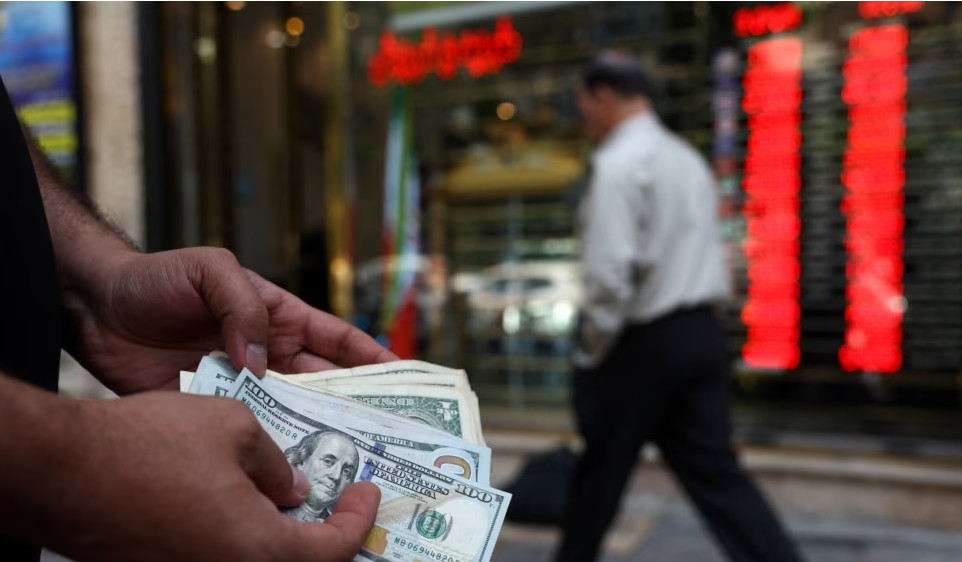
The Iranian currency has fallen to a historic low against the US dollar as Washington prepares a new wave of sanctions and intensifies economic pressure on Tehran after nearly six months of war.
The Iranian rial was trading at around 1.992 million rials to the US dollar on Monday on the unregulated market, according to Bloomberg News, citing data from monitoring site Bonbast. Another unofficial platform, TGJU, reported that the Iranian currency had crossed the symbolic threshold of 2 million rials to the dollar on Sunday.
The devaluation comes just days after US President Donald Trump announced a "crushing economic operation" against authorities in Tehran.
Meanwhile, US Treasury Secretary Scott Bessent is expected to announce new sanctions on Iran on Monday. In an article published in the Financial Times, Bessent warned of what he called an “economic D-Day.”
"At dawn begins an economic D-Day - the largest financial offensive ever undertaken against an adversary," Bessent wrote.
According to him, Washington's objective is to strike all economic avenues that enable the financial survival of the Iranian regime.
"Our goal is to cut off every vital economic avenue that sustains the tyrannical regime, until Tehran is left alone," the US Treasury Secretary said.
The Iranian currency is facing significant pressure as the US tries to further isolate the country's economy. Washington is also putting pressure on Iran's few trading partners, while the US measures have hit key ports in the Persian Gulf and oil exports.
Last week, the governor of Iran's Central Bank, Abdolnaser Hemmati, admitted that Iranian crude oil exports have "practically stopped."
Additional blows to the Iranian economy have also come from the United Arab Emirates, one of Tehran's main trading partners, which last week announced the suspension of all financial transactions with Iran until further notice.
According to Iran's leading financial newspaper Donya-e Eqtesad, the rial's decline has been driven by the disruption of foreign exchange transfers and a decline in exports, while at the same time demand for imports and expectations of higher inflation have increased.
The record currency decline is expected to further increase pressure on Iranian citizens, making imports more expensive and worsening purchasing power at a time when the country's economy is facing one of the worst shocks in recent years.
The GeoPost
 Cyberattack on a power plant in Britain, suspicions of hackers linked to Iran
  Finland to produce drones for Ukraine and Europe
  Even when they leave Russia, Putin makes it difficult for Russians to renounce citizenship
  The US introduces the AIM-424 Malice, a missile with a range of over 463 km
  The US is planning further economic tightening on Iran, having imposed sanctions on Tehran since 1979.
  Trump says Iran not ready to make 'right deal'