
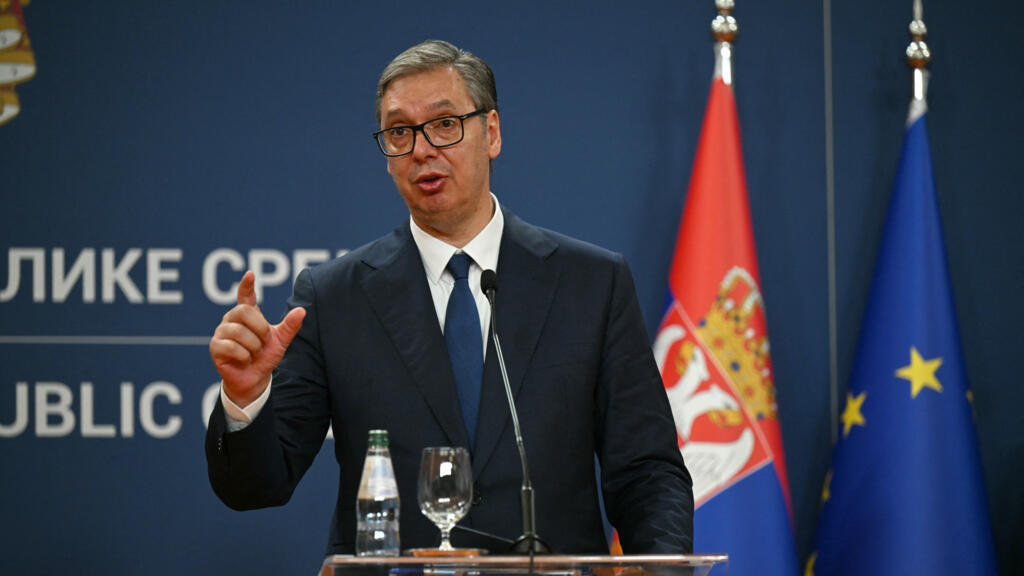
Serbian President Aleksandar Vučić is changing his narrative about the verdict of former Kosovo President Hashim Thaçi and other former leaders of the Kosovo Liberation Army, just days before the Special Court in The Hague announces its verdict.
Initially, Vučić claimed that he had received information from Serbian services that Thaçi would largely be acquitted of the charges and that the sentence, if there was one, would cover the time he had spent in detention.
Now, after his visit to Paris, the Serbian president is presenting a different version.
He says he has received "different signals" from what he had heard before and that Thaçi could face a severe sentence.
"15 days ago I received information that he would be sentenced to a measure that covers the time of detention; I received this from our services. Now, when I was in Paris and talking with several European and world leaders, I received several different signals. In four days we will see who is right," Vučić declared.
But it is precisely this change in version that makes the Serbian president's statement more of a political game with expectations about the decision, rather than verifiable information about what the Court will decide.
The court has not yet spoken.
The main problem with this method of communication is that the court decision has not yet been made public.
Vučić's claims are not accompanied by any evidence that could verify whether Serbian services actually have information on the content of the verdict or whether the alleged "signals" in Paris are related to the Court's decision.
Thus, he is using unconfirmed sources, initially Serbian services, and then conversations with European and international leaders to create the impression that Belgrade has prior knowledge of a decision that has not yet been announced.
In this way, the trial becomes part of a political narrative: Vučić is not just waiting for the Court to speak, but is trying to influence in advance how the public perceives the decision.
A statement that fits any outcome
This is where the most obvious element of narrative manipulation lies.
Vučić is not just predicting one outcome, he is putting before the public two different versions of the future.
In one, Thaçi is expected to receive a sentence that covers the time spent in detention.
In the other, he could face a severe punishment.
By keeping both options open, the Serbian president protects himself from the possibility that his prediction may turn out to be wrong.
If the verdict matches the first version, it can be referred to Serbian services.
If it matches the second, it can claim that the information received in Paris was accurate.
If neither of them fully agrees with the decision, he can still argue that he was only talking about "signals" and not about reliable information.
And this is precisely what serves the Serbian president's political narrative, to create the impression that Belgrade has access to information that others do not have and that Serbia is able to know in advance what the outcome of an international judicial process will be.
The verdict for Hashim Thaçi, Kadri Veseli, Jakup Krasniqi and Rexhep Selimi is expected to be announced on September 16 in The Hague.
The four former KLA leaders are accused of alleged war crimes and crimes against humanity, charges which they have denied.
The prosecution has requested long prison sentences, while the defense has requested the release of the accused.
Until the moment of the announcement of the verdict, any claim about its content remains unconfirmed.
The GeoPost
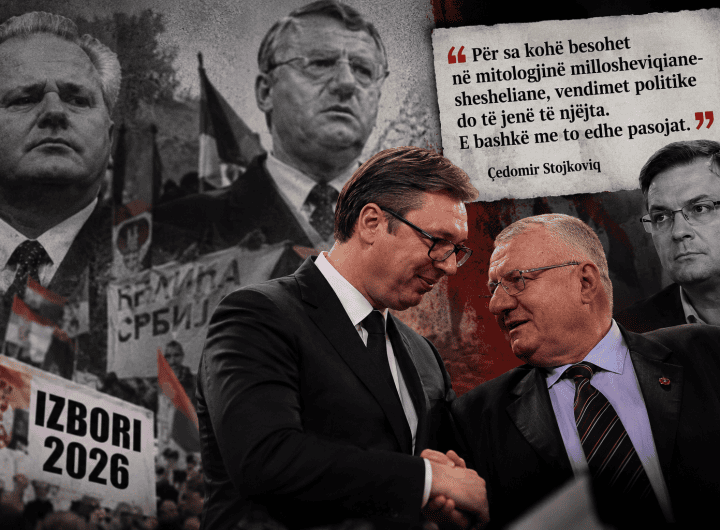 Vucic returns to Seselj, Stojkovic: Serbia still believes in Milosevic-Seselj mythology
 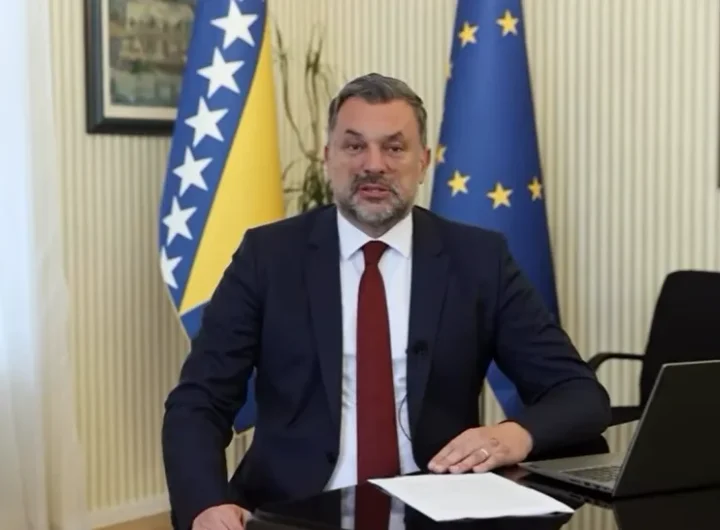 Konakovic warns West after Mladic tributes in Serbia: Act before it's too late
 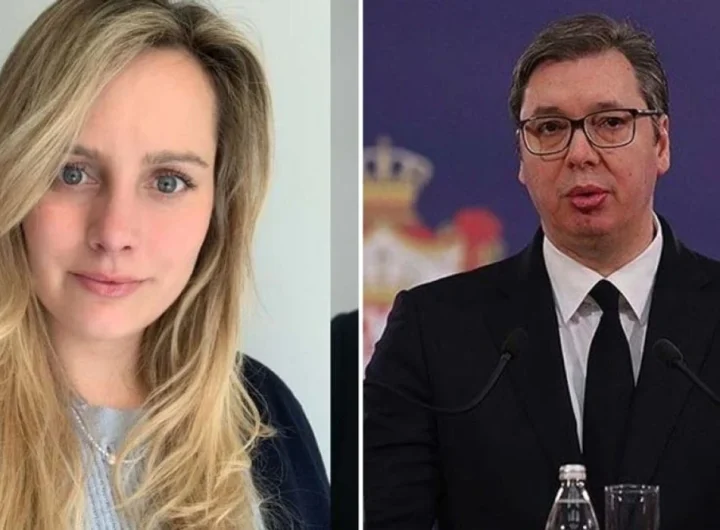 Stradner: Russia is giving Vucic "the regime's survival package", Russian intelligence will interfere in the elections in Serbia
 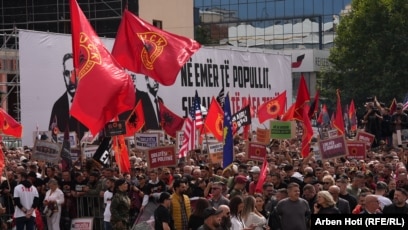 "March for Freedom" fills the squares in Pristina on the eve of the Special Court's verdict
  25 years after September 11, Kosovo in solidarity with the American people
  German expert: Serbia remains the main destabilizing factor in the Balkans, Vučić uses nationalism for power