
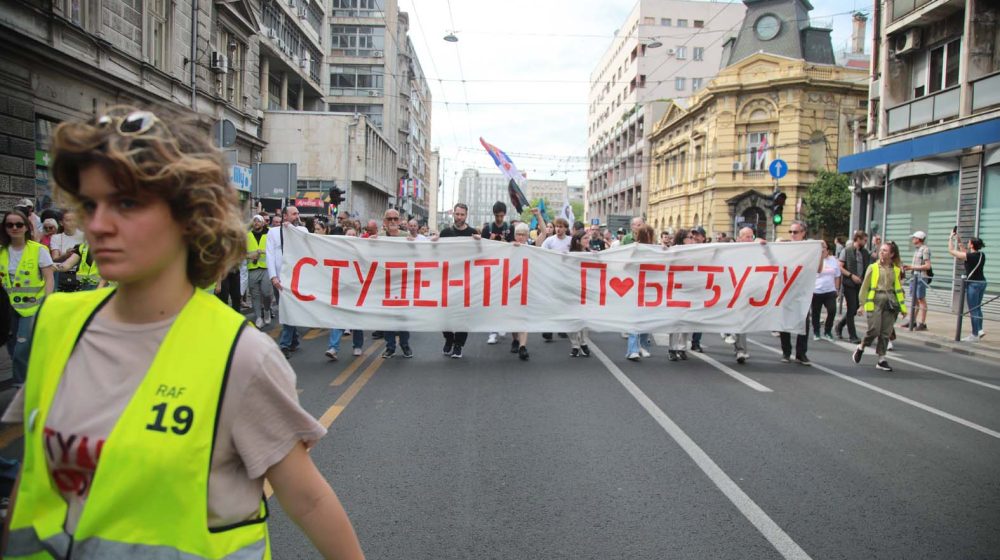
Serbian students, who have been protesting against President Aleksandar Vučić's regime for weeks, published a new memorandum on Sunday, which in terms of language and main theses resembles the infamous Memorandum of the Serbian Academy of Sciences and Arts (SANU) of 1986.
In the document, the students describe Kosovo as "an inalienable and integral part of the Republic of Serbia", emphasizing that this issue "cannot be negotiated".
The memorandum was adopted in Kragujevac, a city that the authors describe as "the first capital of modern Serbia and the center of Serbian state-building thought."
According to the document, preserving the "constitutional order of Serbia" in Kosovo represents "the foundation of the survival of the Serbian state" and, as it goes on to say, a "guarantee for a just peace in the region."
The memorandum also emphasizes that "Kosovo and Metohija are not simply a territory, but a component of the Serbian national identity," while also mentioning the Orthodox religious monuments in Prizren, Peja and Gracanica as part of the "Serbian spiritual and cultural heritage."
The students declare that the Kosovo issue cannot be resolved in isolation, but only through cooperation with the international community and relevant organizations, insisting that any solution must remain “within the framework of the Constitution of Serbia.”
The document concludes with the call that every citizen of Serbia has a "moral and historical obligation" to preserve Kosovo, while the commitment to this issue is described as a "fight for the honor, culture and future" of the Serbian people.
Similarities with the 1986 Memorandum
The memorandum published today has been seen as a derivative of the 1986 SANU document, which was later used by political elites in Serbia to legitimize nationalist and occupation policies in the former Yugoslavia.
The 1986 Memorandum became the ideological basis for Slobodan Milošević's rise to power (1987), while his theses – about "economic discrimination of Serbia", "oppression of Serbs in Croatia" and allegations of "genocide against Serbs in Kosovo" – presented Serbia as a victim.
In the decade that followed, Serbia was involved in four wars in the Balkans (Slovenia, Croatia, Bosnia, and Kosovo), which were accompanied by serious crimes, including the massacres in Vukovar, Srebrenica, and Kosovo.
The student memorandum, published at a time of protests against the current government in Belgrade, brings to mind the rhetoric that has historically served to mobilize nationalists around the issue of Kosovo.
Memorandum on Kosovo and Metohija.
We, the students of Serbia, gathered in Kragujevac, the first capital of modern Serbia and the center of Serbian state-building thought, aware of our personal and collective responsibility and historical debt to our ancestors and descendants, have adopted this Memorandum as an expression...
— Studenti_u_blokadi (@studentblokade) May 17, 2026
 USA Today: Kosovo, a success story in the Balkans
  Vucic opposes conviction of Patriarch Porfirije by a Slovenian court
  Srebrenica commemorates victims on 31st anniversary of genocide
  Seselj continues his denialist propaganda about Srebrenica
  Kosovo commemorates Srebrenica victims: Without truth, there is no justice or peace
  Albania and Montenegro will close other chapters in EU accession talks on Tuesday