
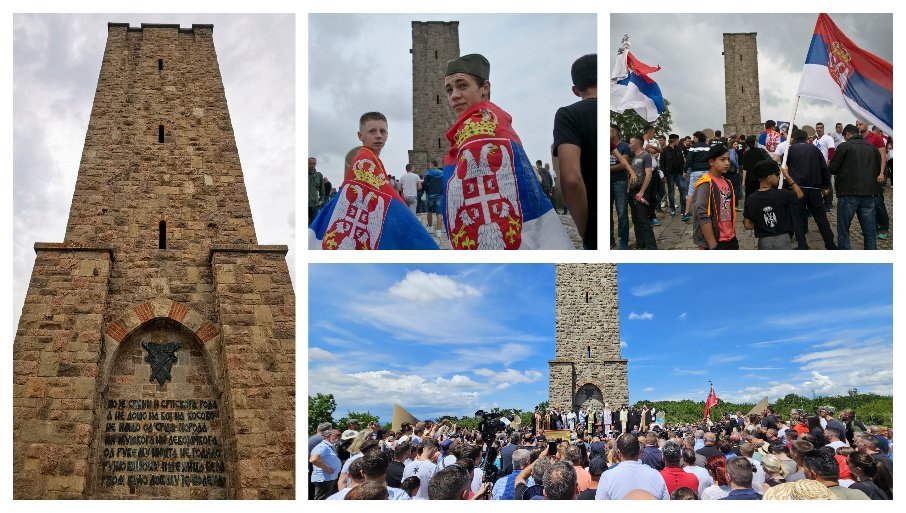
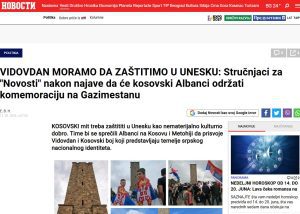
A claim published by a Serbian newspaper Evening News, according to which Kosovo Albanians are preparing to organize activities dedicated to the Battle of Kosovo on June 15 in Gazimestan, has provoked reactions in Serbia and has been used to promote initiatives to include Vidovdan in UNESCO's list of intangible cultural heritage.
In her article, News claims that the activity announced by the Municipality of Obiliq represents an attempt to “appropriate Serbian historical heritage”, while academics, historians and former Serbian officials present this as an additional argument for the international protection of Vidovdan as part of Serbian national identity.
The newspaper writes that "according to reports, the event is organized by the Municipality of Obiliq, led by Mayor Halit Thaçi, and that the date June 15 according to the Julian calendar coincides with June 28 according to the Gregorian calendar", implying that this is an activity directly related to the Serbian symbolism of Vidovdan.
However, this claim is presented without concrete evidence and without official documents that would prove that Kosovo institutions or the organizers of the event intend to mark or celebrate the Battle of Kosovo as part of Serbian historical heritage.
This has raised suspicions that this is a biased interpretation, which aims to create the impression of a "threat" to Serbian heritage in Kosovo and to mobilize public opinion in Serbia around a topic with a high emotional and political charge.
In the absence of verifiable evidence for the organization of an Albanian activity dedicated to the Battle of Kosovo, the claim published by Vecernje Novosti, shows that Serbian media continue to spread disinformation periodically to incite division and incite hatred.
Thus, there is no data or any announcement indicating that Kosovo institutions or Albanians are organizing manifestations to celebrate the Battle of Kosovo. On the contrary, the interpretation of this battle continues to be the subject of numerous historical and academic debates, while its political use remains one of the most important elements of Serbian nationalism.
Professor of international relations, Syle Ukshini, had previously said that the myth of the Battle of Kosovo has been transformed over the last two centuries into a political instrument for legitimizing Serbian territorial claims to Kosovo.
Ukshin emphasizes that the Battle of Kosovo in 1389 was not an exclusive clash between Serbs and Ottomans, as is often portrayed in the Serbian nationalist narrative. According to him, the coalition of Christian forces also included Hungarians, Croats, Bosniaks, and Albanians, which makes it problematic to interpret it as an exclusive symbol of Serbian identity.
"The Battle of Kosovo has been transformed into an expansionist ideology and for political purposes, where the hegemonic political aim of the state has been combined with the church narrative," Ukshini assessed.
He adds that the problem lies not in the historical commemoration of a medieval event, but in the way it has been politically instrumentalized.
"Vidovdan is not celebrated as a cultural or historical event, but is often transformed into a manifestation with chauvinistic content, where others are excluded and presented as historical opponents," he says.
That Gazimestan continues to be a politically charged space is also evidenced by the incidents of recent years.
On June 28, 2024, during the Vidovdan demonstrations, a group of Serbian motorcyclists attempting to enter Kosovo were involved in verbal incidents and insults against members of the Kosovo Police.
Kosovo Serbian journalist Radomir Dimić considers the Kosovo myth to be one of the main mechanisms through which Serbian nationalism has survived and reproduced for decades.
According to him, this myth was constructed with the aim of nurturing the idea of restoring a "Serbian empire" and justifying expansionist policies towards Kosovo.
"The myth of Kosovo is a political deception that attempts to transform a real territory into a metaphysical space. Albanians experience Kosovo as the place where they live, while Serbian nationalism continues to treat it as a mystical and historical project," Dimić had declared.
He believes that the rallies in Gazimestan and the symbolism that accompanies them represent a continuation of the ideology promoted during the Slobodan Milošević years, especially after his famous speech in Gazimestan on June 28, 1989, which is considered by many scholars to be one of the key moments of Serbian nationalist mobilization before the dissolution of Yugoslavia.
Meanwhile, contemporary studies by Western historians have called into question many of the fundamental elements of the traditional Serbian narrative on the Battle of Kosovo.
Austrian historian Oliver Jens Schmitt, a professor at the University of Vienna and one of the most renowned scholars of Balkan history, argues that relations between Serbs and the Ottoman Empire were much more complex than they appear in Serbian national mythology.
According to Schmitt, historical documents show that Serbian elites at certain periods collaborated closely with the Ottoman court, disproving the claim that the Serbs were the sole victims of the Ottoman occupation, while other Balkan peoples were presented as collaborators.
These academic findings directly challenge the narrative that presents the Battle of Kosovo as a simple conflict between “Christian Serbs” and “Muslim Ottomans.”
Historians estimate that the myth of Kosovo was gradually built over the centuries and then transformed into a political instrument.
The military defeat was reinterpreted as a "moral victory," while Prince Lazar was elevated to the status of a holy figure.
In the 20th century, especially during the Milošević period, this symbolism was used to justify Serbia's political claims towards Kosovo.
Precisely for this reason, the current debate around UNESCO and Vidovdan is seen by many not as an issue of cultural heritage, but as a continuation of efforts to use history as a political instrument in relation to Kosovo.
In this context, claims of Albanian activities dedicated to the Battle of Kosovo are seen more as part of a mobilizing narrative of the Serbian nationalist media than as a reflection of a concrete reality on the ground.
For critics of this approach, the problem lies not in the preservation of cultural heritage, but in the instrumentalization of history for political and identity purposes in a region that continues to be burdened with the consequences of past conflicts.
The GeoPost
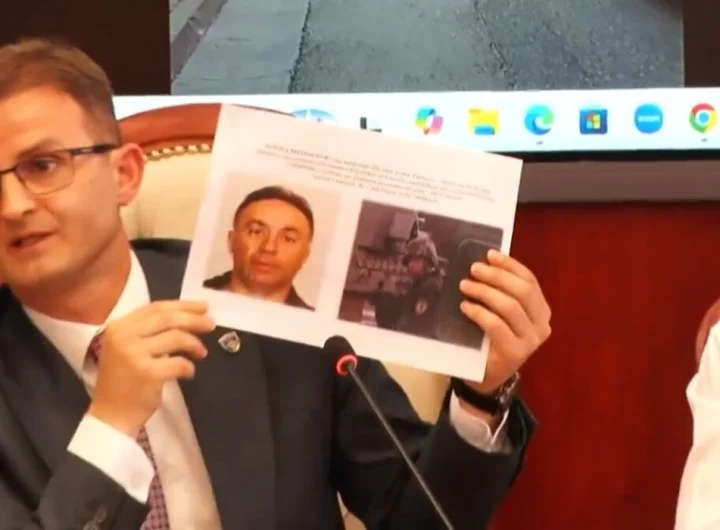 The five arrested for war crimes were involved in the Recak massacre.
 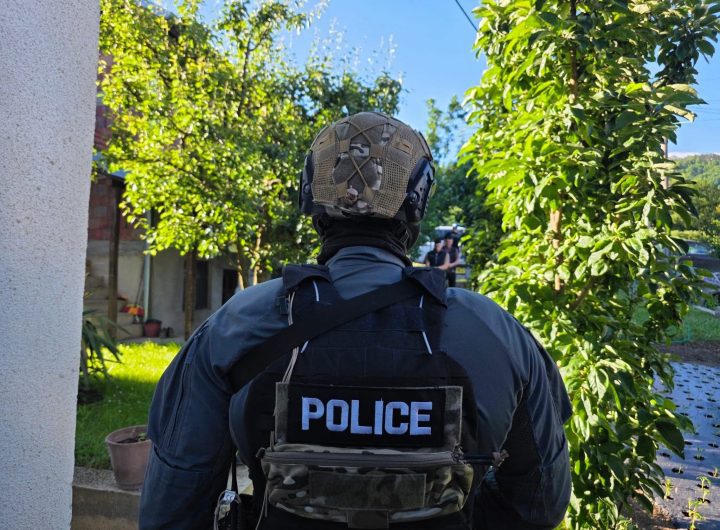 Five people arrested in the operation to investigate war crimes in the “Reçaku II” case
 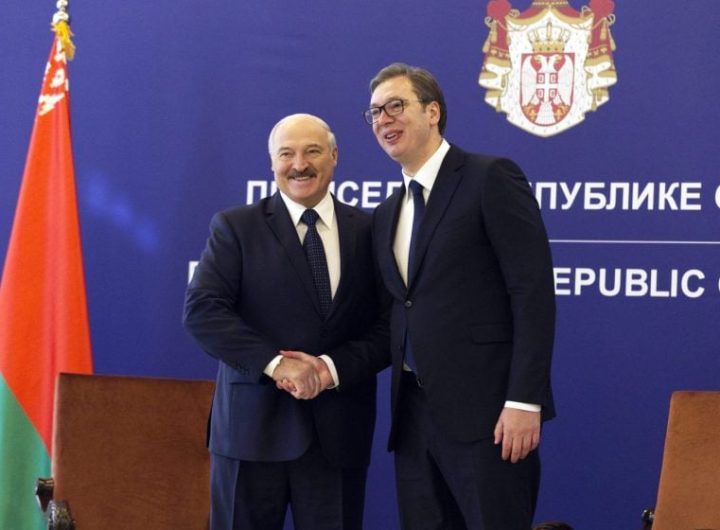 Will Vučić suffer the fate of Lukashenko if the EU does not recognize his elections?
 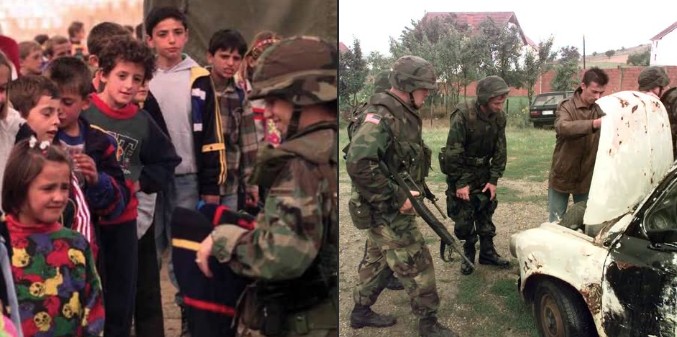 "US Army Center of Military History" commemorates NATO's intervention in Kosovo and the deployment of KFOR in 1999
  Montenegro airport scandal – criminals and former Serbian police officers on the same mission
 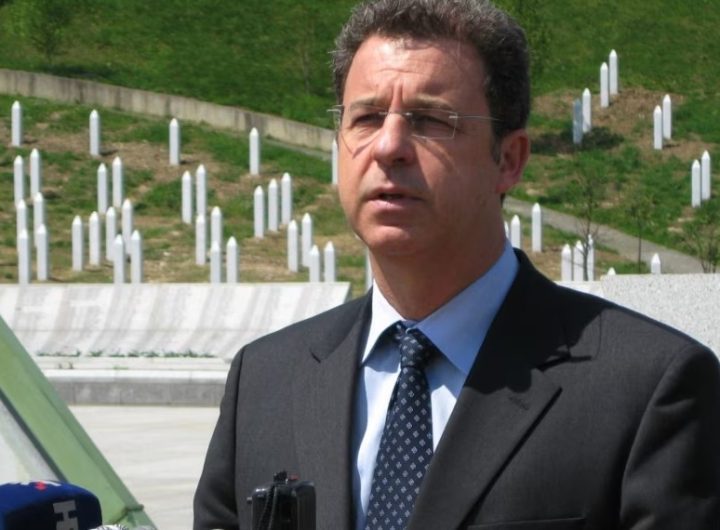 UN Prosecutor: Over 2,000 War Crimes Suspects Still Uninvestigated in Former Yugoslavia