
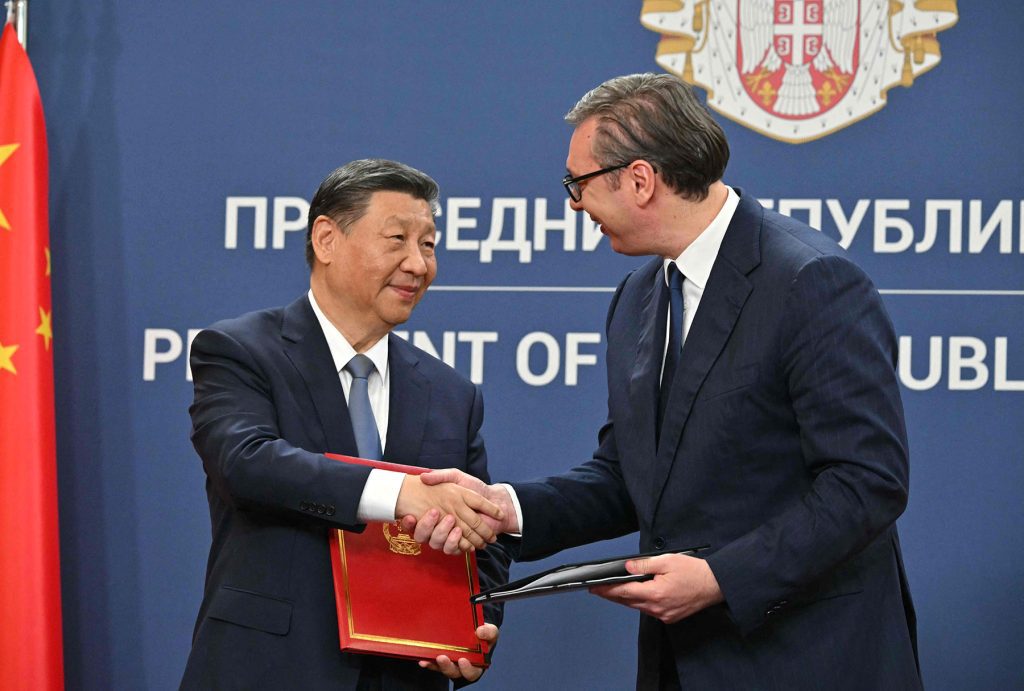
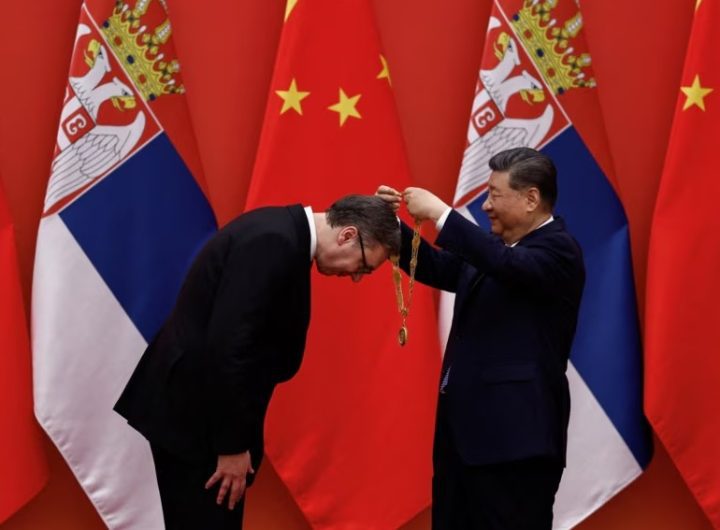
Chinese President Xi Jinping (L) and Serbian President Aleksandar Vucic (R) shake hands after signing bilateral documents during a meeting in Belgrade, on May 8, 2024. Chinese President Xi Jinping will hold talks with his Serbian counterpart in Belgrade on May 8, 2024, as Beijing seeks to deepen its political and economic ties with friendlier countries in Europe. (Photo by Elvis Barukcic / AFP)
"Serbia is a big kitchen from which we supply all of Europe," is the message of the founder of the Chinese company "Minth", which produces spare parts for vehicles.
It is one of a number of companies with which Serbian President Aleksandar Vučić signed new agreements during his visit to China in late May.
The announcements come at a time when European Union (EU) countries are considering new measures to further protect their markets and jobs due to the rapid growth of investment and imports from China.
One of the proposed solutions is a law, widely called "Made in Europe", which would limit China's access to EU markets in some segments.
Beijing called the measures announced by Brussels discriminatory and announced the possibility of a reciprocal response.
While for the authorities in Belgrade, Chinese investments mean new jobs and economic growth, the Serbian Chamber of Commerce estimates that the new EU measures could also affect the Serbian economy.
What does the European Union propose?
In early March, the European Commission proposed new measures to stimulate industry in EU countries, which the European Parliament will vote on soon.
Formulated in the Industrial Accelerator Law – “Made in Europe”, the measures should “strengthen European manufacturing, ensure clean technology and encourage greater employment of citizens of EU countries”.
According to the bill, the measures will also affect imports of steel, cement, aluminum and the automotive industry, with the possibility of expanding the list.
Foreign investments that control more than 40 percent of global production capacity in the fields of electric vehicles, batteries or solar energy will be targeted.
The law should also prevent unfair competition, because Chinese manufacturers, using subsidies from their state, enter the European market at significantly lower prices than their competitors.
EU Commissioners met on May 29 to discuss all the problems and proposed measures.
After the meeting, they announced that "the current state of trade and investment relations with China is not sustainable."
Whether and when the new measures will begin to be implemented will be known in mid-June, when the EU institutions will issue a statement on the matter.
Brussels says that talks will also be held with China in the meantime and that "the European Union remains one of the most open markets in the world."
China is the EU's third largest trading partner, after the United States and the United Kingdom.
This trade is not equal because the European Union constantly runs a deficit.
Why might Serbia feel the EU's measures?
Billions of euros of Chinese investment have been flowing into Serbia for more than a decade.
In addition to participating in infrastructure projects and exploiting minerals, China is also investing in opening factories from which it can more easily sell goods from the Serbian market to the European Union.
Serbia has a Stabilization and Association Agreement with the EU, which regulates the free trade regime and allows Serbian businessmen duty-free exports of almost all industrial and agricultural products.
Chinese products from factories in Serbia will have the label "Made in Serbia" and will then be easier and cheaper to find in the EU.
"It's all a screwdriver industry," says economic journalist Miša Brkić, explaining that factories in Serbia only assemble elements made in China.
The new rules that the EU plans to introduce to protect its market from the Chinese one could also be felt in Serbia, believes Bojan Stanić, Assistant Director of the Sector for Strategic Analysis, Services and Internationalization of the Serbian Chamber of Commerce.
"The fact is that our cooperation with China is being significantly limited through various protectionist measures," Stanić believes.
He recalls that Serbia is already suffering the consequences of previously introduced European Union measures regarding steel.
"Because of the reduction in quotas for duty-free steel exports and the increase in customs duties if the quota is exceeded," he explains.
In 2019, the European Union introduced quotas for steel imports from non-EU countries for the first time in response to the United States' decision to impose import tariffs on steel and aluminum.
Since then, they have been amended and expanded several times, and now Brussels is tightening them further.
The allowed amount of duty-free imports was reduced by 47 percent, while customs duties doubled.
“We (Serbia) have that pressure because the Smederevo Steel Factory is operating at a loss and is financed by the parent company from China – HBIS Group,” says Stanić.
HBIS Group purchased the Smederevo Steel Plant in 2016 for 46 million euros, while the Serbian Government assumed the steel plant's debts.
HBIS is one of the largest steel producers in the world with many factories in China.
What else does China export to Europe via Serbia?
Several Chinese companies operate in Serbia that produce spare parts for cars, which are then exported to the European market.
Among them is the Minth factory, which has facilities in two cities – Šabac and Loznica.
At the end of May, during the official visit of the Serbian delegation to China led by President Aleksandar Vučić, the founder of the Minth company, Chin Ronghua, said that Serbia is the headquarters from which their products enter the entire European market.
According to Ronghu, Serbia is a "big kitchen" for plants in EU countries.
Economic journalist Miša Brkić does not rule out the possibility that Serbia's role will change following the new EU measures.
"The question is, when the 'Made in Europe' law is adopted, what will be the taxes on imported products, regardless of whether they are produced in Serbia or China. So, Europe will be protected in any case," believes Brkić.
According to data from the Statistical Office of the Republic of Serbia, the European Union is Serbia's main export market, with around 58 percent of total foreign trade.
Among the most important export products in 2025 were electrical equipment, cables, automobiles and vehicle parts, copper and copper products, steel, industrial machinery, and rubber products.
How is Serbia's trade with China?
As in the case of the European Union, Serbia is also in deficit.
Imports from China to Serbia have been many times higher than the value of exports to that country for years.
Although there is growth, it is still far from being able to capture the benefits that China has through trade with Serbia.
"We are constantly and drastically increasing the deficit with China. On the other hand, our exported products do not have a great value," explains Bojan Stanić, Assistant Director of the Sector for Strategic Analysis, Services and Internationalization of the Serbian Chamber of Commerce.
The Serbia-China Free Trade Agreement, which the two countries began implementing in July 2024, did not contribute to better figures, although Serbian authorities had expected this.
Brussels does not look favorably on the Agreement.
With the start of its implementation, the European Union announced that Serbia could conclude trade agreements with other countries, provided that they do not conflict with the Stabilization and Association Agreement and until it itself becomes a member of the Union.
Because, in the EU accession process, Serbia, they say, has pledged to withdraw from all bilateral free trade agreements signed so far, as a new member of the Union.
Possible consequences
Serbian President Aleksandar Vučić said during a recent visit to China that additional Chinese investments worth 945 million euros are arriving in Serbia.
Brkić believes that future issues should also be seen in a global context and the potential consequences should be assessed in advance.
He cites the example of joint agreements with Russia, due to which Serbia, dependent on Russian gas and oil, is now suffering the consequences.
"Even if we implement agreements with China, Serbia, as a country that wants EU membership and cooperation with the West, never knows what situation it will find itself in in the future due to global circumstances," believes Brkić.
The Serbian government did not respond to Radio Free Europe's questions about whether they are considering the possible consequences of the EU's measures against China and whether they are anticipating potential problems due to China's role in all key projects in the country.
Are there solutions for expanding the China market?
Bojan Stanić from the Chamber of Commerce believes that Europe and Serbia will have difficulty freeing themselves from economic dependence on China.
"Europe remains largely dependent on imports of materials, raw materials, products, machinery, telecommunications and other equipment, as well as automobiles. As a result, the European economy is losing competitiveness in the domestic market. The surplus that China has achieved with the world has increased," he explains, adding that thanks to this surplus, China can continue to finance subsidies for companies, loans to other countries and direct investments.
Stanić adds that it is difficult to compete in an uneven market where diversification will result in higher prices for end customers.
When it comes to Serbia, Stanić believes that in deals with China that are negotiated through interstate agreements, greater inclusion of Serbian micro-companies in the supply chain should be insisted on.
All major Chinese investments and deals in Serbia are negotiated at the highest state level. Chinese companies are engaged in the implementation of these projects, often involving Chinese workers, and the deals are paid for with loans in China.
Details of the agreement are being declared secret and Brussels has also warned about the lack of transparency in these agreements.
In its relations with China, the European Union is trying to further strengthen its own interests.
As part of the new "Made in Europe" Law, it is proposed that foreign investors must provide at least 50 percent of jobs for citizens of European Union countries.
The draft law also requires that joint investments with investors outside the EU be limited to a maximum of 49 percent foreign ownership.
This, the proponents declare, will keep decision-making power under EU control.
The GeoPost
 Indictment against six Serbs for barricades in the north
  US warnings after Dodik meetings: There should be no delays in disconnecting from Russian gas
  Margetić publishes documents about "Sarajevo Safari" again, Vučić is mentioned
  Lawyer Ninic: Tivat case exposes criminalized political networks in Serbia under Vucic's leadership
  Vučić, Beijing's political pawn in the Balkans
  Police raid two locations in Zubin Potok, four weapons confiscated after threat against Minister Sveçla