

Recent changes at the top of Serbia’s Security Information Agency (BIA) are not a routine rotation, but a calculated move that underscores President Aleksandar Vučić’s efforts to maintain absolute control over the country’s intelligence services.
Marko Parezanović, for years one of the most influential figures within the BIA and among Vučić’s most trusted associates, has been removed from his post as Head of Operations and reassigned to an advisory role with minimal authority. He has been replaced by Nikola Vasiljević, former head of the BIA’s Novi Sad office and a former security adviser to Prime Minister Miloš Vučević.
This reshuffle comes at a politically sensitive moment. Serbia is facing mounting international pressure to curb Russian influence over its economy, particularly in the energy sector, following the ownership crisis surrounding Serbia’s Oil Industry (NIS), in which Russia holds significant stakes. Parezanović, known for his close ties to Russian intelligence services and his openly expressed Russophilia, appears to have become a liability in this context.
The recent arrest—and swift release—of Russian intelligence officer Vyacheslav Kalinin in Belgrade was widely interpreted as a signal that the Serbian regime, while carefully avoiding any direct confrontation with the Kremlin, is attempting to project a gradual and symbolic distancing from Moscow.
Sources within the security services say that Parezanović’s removal does not constitute a harsh punishment, but rather a mutually agreed retreat. With extensive operational experience and a keen sense of political timing, he appears to have opted to step into the background in order to avoid future risks.
Parezanović’s career spans close ties with the old socialist structures, through the period of Democratic Party rule, to the full confidence of Vučić himself—making him a classic “man for all seasons.” However, in the current phase of delicate balancing between East and West, his profile no longer fits the regime’s evolving strategy.
Although Vučić has publicly criticized the BIA’s leadership for “insufficient engagement” and has hinted that parts of the agency may be sympathetic to the opposition, such remarks are widely seen as warnings designed to reinforce absolute loyalty rather than as genuine attempts at institutional reform. In practice, the BIA remains one of the central pillars of Vučić’s power.
Since Vučić and the Serbian Progressive Party (SNS) came to power in 2012, the BIA has been repeatedly accused by international organizations—including Amnesty International, Freedom House and Human Rights Watch—of systemic abuses. Amnesty’s latest report, “A Digital Prison: Surveillance and the Suppression of Civil Society in Serbia,” documents the use of advanced spyware by the BIA and the police, including Israel’s Pegasus and the domestically developed NoviSpy, to infect the phones of journalists, activists and opposition figures.
The agency has also been accused of infiltrating anti-government protests, including those following the 2024 Novi Sad tragedy, carrying out arbitrary arrests, and disseminating disinformation through pro-regime media. There are serious allegations linking senior BIA officials to organized crime groups, including that of Veljko Belivuk, which is suspected of carrying out intimidation and acts of violence on behalf of the regime.
Parezanović himself has been mentioned in correspondence linked to the criminal network of Darko Šarić as someone who “can fix everything,” raising grave concerns about the entanglement of state security structures with organized crime.
These practices have drawn sharp criticism from the European Union and the United States, which describe Serbia as a “hybrid democracy” sliding into authoritarianism, where security institutions serve to protect Vučić’s personal grip on power rather than the constitutional order.
The latest changes within the BIA may be intended to “clean up” the regime’s image in the eyes of Western partners. However, as long as Vučić retains firm control over the intelligence services, the BIA is likely to remain his primary instrument for carrying out the regime’s “dirty work.”/TheGeopost.
 Belgrade interferes again in Kosovo elections: Jobs in parallel institutions offered in exchange for votes
  Information warfare: How PSYOPS shapes National Security and NATO Alliances
  Support from Novi Pazar for students irritates Vučić’s regime
 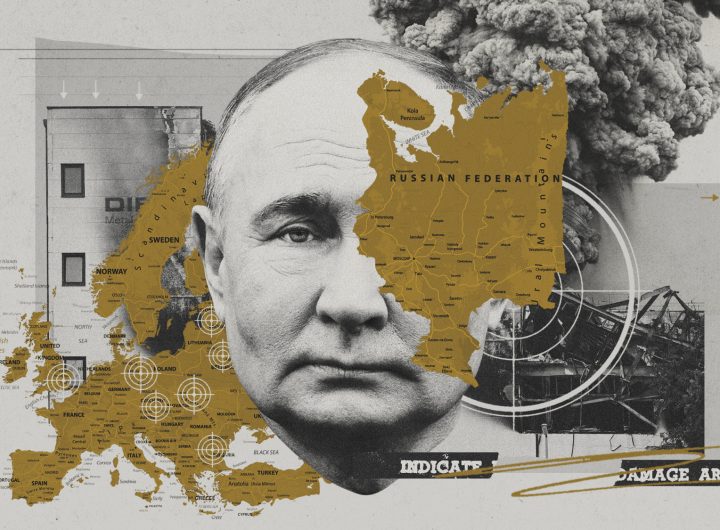 Andonov: The balkans are Moscow’s hybrid weapon against the EU and NATO
  U.S. enacts Western Balkans Democracy law with strong criticism of Serbia
  The bankruptcy of Vučić’s domestic and foreign policy