
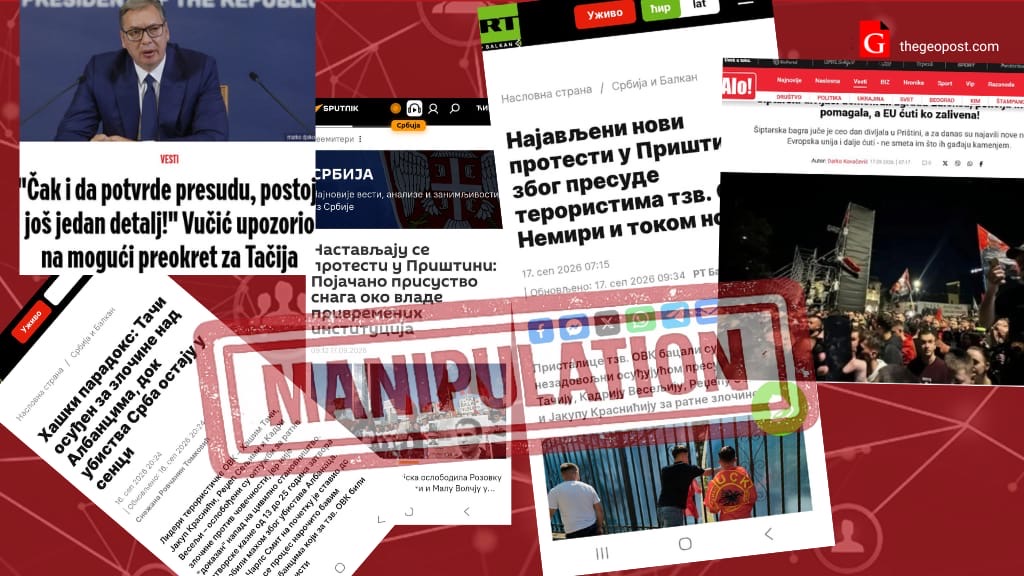
The Hague Tribunal's verdict against the former KLA leaders caused a strong revolt in Kosovo, where public opinion experienced the decision as an injustice against people who are representatives of the liberation struggle. Thousands of citizens have taken to the streets in recent days in support of Hashim Thaçi, Kadri Veseli, Jakup Krasniqi and Rexhep Selimi, while after the verdict was announced, protests continued in Pristina.
However, the way some Serbian media reported on these developments shows a huge difference between the reason for which the protests were held and the image conveyed to the public in Serbia.
While some reports talk about dissatisfaction with the verdict, others shift the focus almost entirely to incidents, stones, police and insulting messages, while the most extreme tabloid headlines present the protests as "collective savagery of Albanians."
The verdict of September 16 caused strong reactions in Pristina and throughout Kosovo. Thaçi was sentenced to 25 years in prison, Jakup Krasniqi to 25, Kadri Veseli to 18, and Rexhep Selimi to 13 years for war crimes.
The verdict sparked protests in Pristina and The Hague, while supporters of the former KLA leaders publicly condemned the decision as unjust.
It is precisely the sense of injustice that is the key to understanding what happened on the streets of Pristina.
People didn't protest because they wanted to clash with the police or EULEX. The protest was a reaction to the verdict.
There were incidents during the rallies and they should be clearly presented. But the way some media outlets in Serbia chose to present them raised the question of whether they were reporting on a specific protest or whether the protest was being used for a broader political and ethnic message.
Analysis
RT Balkan: the verdict through the history of Serbian victims
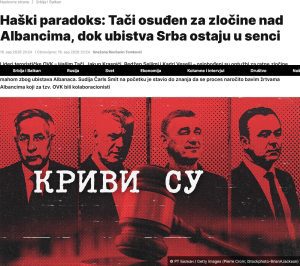
The RT Balkan portal published a text with the title "The Hague Paradox: Thaçi is convicted of crimes against Albanians, while the murders of Serbs remain in the shadows."
The text discusses in detail the alleged crimes for which former KLA leaders were convicted, but the main angle of the article is the issue of the position of Serbian and non-Albanian victims.
RT Balkan specifically emphasizes that among the victims were Serbs and other non-Albanians, presents data on murders and other crimes, and criticizes what the author sees as the overshadowing of Serbian victims in the public narrative about the war in Kosovo.
Instead of initially explaining that a part of public opinion in Kosovo experienced the verdict as an injustice and that it was precisely for this reason that they took to the streets, the reader is offered a narrative that the Serbian victims have once again remained in the shadows.
This creates a completely different perception of the event.
Večernje novosti: “the new savagery of Albanians”
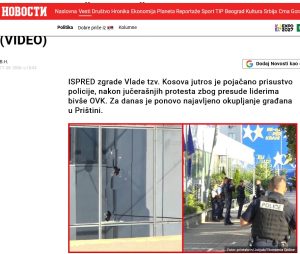
Večernje novosti took an even harsher approach.
The portal warned of the protests with the headline:
"TENSIONS IN THE FAKE STATE: Kurti's police on alert, new anger among Albanians is expected due to the verdict against KLA criminals."
The title itself determines how the reader should view the event.
Kosovo is called a "fake state", while the expected protest is not described as a new gathering of citizens dissatisfied with the verdict, but as "the savagery of Albanians".
Such a title puts the reason for the protest in the background.
The verdict, which public opinion in Kosovo experienced as an injustice, becomes only a pretext for a narrative about the alleged "savagery".
RTS and Tanjug: protests through the prism of incidents
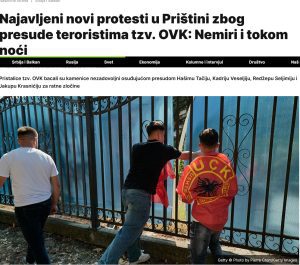
RTS and Tanjug presented the developments somewhat differently. Their reports mentioned citizen gatherings, KLA and Albanian flags, increased police presence, stones, pyrotechnics, and incidents in front of EULEX and the Kosovo Government.
However, RTS also reflects the political background of the protest.
Reports say that the protesters were demanding a reaction from Kosovo institutions and that they were expressing their dissatisfaction due to the verdict, which they consider unjust. There were also calls for the protest to continue without attacks on the police and institutions.
For this reason, RTS reporting is more complex than most tabloid texts.
However, when the police, stones, and "riots" are put in the foreground, there is a risk of losing sight of the most important question:
Why did citizens take to the streets?
The answer is – because of the verdict.
Sputnik: from political protest to security mirror
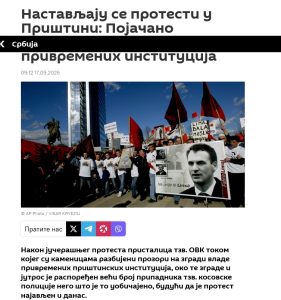
Sputnik in its reporting highlighted the increased police presence around the Kosovo Government building, the gathering of protesters, stones, pyrotechnic devices, and the incident near EULEX.
In this way, the protest is presented primarily as a security event.
The text devotes much more space to what was happening around the institutions than to the emotions and political reason for which citizens gathered.
Such an approach changes the perspective.
When one initially reads that the police have increased their presence, that stones were used, and that there was an incident near EULEX, the protest begins to look like a threat to security.
RTV: offensive messages become a central topic
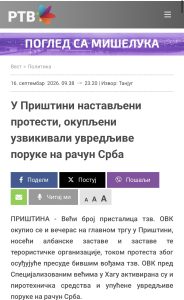
RTV, broadcasting Tanjug's information, published a text with the title "Protests continued in Pristina, the crowd chanted insulting messages addressed to Serbs."
The text mentions flags, pyrotechnics, a gathering of KLA supporters, and offensive messages against Serbs.
Incidents near EULEX and the Kosovo Government are also mentioned, including the throwing of stones and bottles and the breaking of windows.
These events should definitely be reported. But when offensive messages against Serbs are singled out as one of the main determinants of the entire protest, the focus is once again shifted from its fundamental reason.
The protest was not organized because of anti-Serb messages. It was organized because of the verdict.
This is a distinction of great importance for understanding the event.
Alo: from reporting to open ethnic stigmatization
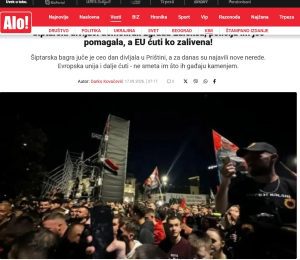
The most prominent example is the Alo portal.
He published a text with the title:
"The Albanian savages destroyed the EULEX building, the police even helped them, while the EU is silent as if nailed to the wall!"
The title itself clearly indicates the chosen framework.
Instead of "protesters", "participants in the protest" or "citizens dissatisfied with the verdict", the expressions "Serbian savages" are used.
The text also includes the phrase "Shqiptare gang", while it states that protesters threw stones and bottles at EULEX and that facilities were damaged.
Even more importantly, the text itself confirms that people gathered because of dissatisfaction with the verdicts against former KLA leaders.
/The Geopost/
 Bosnia and Herzegovina bans entry to Milan Radoić: National security threat declared due to terrorist attack in Banjska
 Student List, new in name but with old attitudes towards Kosovo
 Serbian nationalist melody in Brussels against Kosovo, Marta Kos and the shadow of UDB
 Fetoshi: Vučić's 'warning' despair
 Former BIA inspector: Serbian secret service should have known about Banjska, for Vučić the action enabled his survival in power
 Challenges after Vučić: Five tasks on which Serbia's democratic future depends