
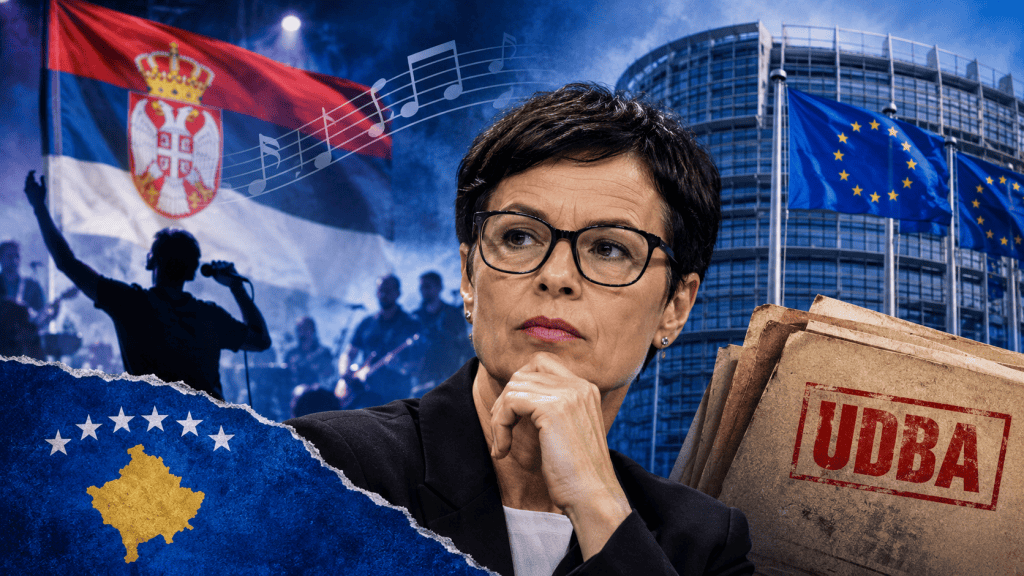
An event intended to promote European unity, cooperation and reconciliation in the Western Balkans ended up being dominated by a scandal that brought back into focus the complicated relations between Kosovo, Serbia and the European Union.
The performance of the Serbian nationalist tune “Oj Kosovo, Kosovo” at a concert organized as part of the EU Enlargement Forum in Brussels was not just a musical gaffe. It was a politically charged incident that exposed Brussels’ lack of institutional sensitivity to the history and political reality of Kosovo.
The irony is even greater when it is known that the song is related to the period of the rise of Serbian nationalism in the late 80s, when Slobodan Milosevic's regime used Kosovo as an instrument of political and territorial mobilization.
At a forum where the European future of the region was discussed, Kosovo was represented through a melody that carries a narrative contrary to the principles of sovereignty, good neighborliness, and reconciliation that the European Union itself promotes.
Reactions, including those of Albanian Prime Minister Edi Rama, the rapporteur for Kosovo in the European Parliament, Riho Terras, and civil society representatives, caused the incident to almost overshadow the main topics of the forum.
But, beyond the song itself, attention was focused on Enlargement Commissioner Marta Kos, who expressed regret for the musical selection, emphasizing that it does not represent the position of the European Commission.
However, this clarification did not close the questions about institutional responsibility. In an event organized within the framework of European institutions, it is hard to believe that there was no mechanism for verifying the content of the program.
Marta Kos, the UDBA files and the shadow of the secret services in Belgrade
The inclusion of Marta Kos's name in this debate takes on another dimension when attention is drawn to previous reports about her past and allegations of collaboration with the Yugoslav secret service UDBA.
The issue became a topic of political debate in Slovenia after the publication of the book "Komisarka", by author Igor Omerza, who claims to have obtained archival documents proving that Kos had collaborated with the Yugoslav State Security Service (SDV), known as UDBA.
According to Omerza's claims, she was initially registered as a source of information under the codename "Tara", while later, while working as a journalist at Deutsche Welle in Cologne, she was used under the codename "Blanka".
Among the most sensitive allegations is that Kos had passed on information about colleagues and the personnel structure in the Deutsche Welle editorial office to the Yugoslav secret service.
Kos has denied these accusations, calling them disinformation. However, the issue did not end with controversy in Slovenia, as the European Parliament also became involved in the debate.
What makes this story particularly sensitive for Kosovo is the destination of some of the documentation of the former Yugoslav secret service.
After the dissolution of Yugoslavia, part of the archives of its services ended up in Belgrade, where the documentation was administered by Serbian security structures. Part of the historical files are located in the archives of Serbian institutions, including documentation related to the Security and Information Agency (BIA).
This raised questions in the European Parliament about whether Serbian authorities might have information at their disposal that could potentially be used to pressure the European Commissioner.
Slovenian MEP Milan Zver has raised concerns about the possibility that such documents could be used to make Kos vulnerable to external influence, citing the risk of information flowing to Russia, due to the close relations between Moscow and Belgrade.
At a hearing of the European Parliament's Foreign Affairs Committee on 20 April 2026, Kos was asked about these allegations, but did not give a direct answer on whether she had collaborated with UDBA. She referred to the vetting process she had undergone before her appointment to the European Commission.
However, the fact that some of the former Yugoslav secret service's documentation is located in Belgrade creates a legitimate institutional security issue for the European Union. This is particularly important when it comes to a commissioner who has a direct impact on Serbia's European integration process.
Serbia, between European rhetoric and nationalist politics
This is precisely where one of the greatest contradictions of European policy in the Balkans lies.
Under the leadership of Aleksandar Vučić, Serbia continues to maintain close relations with Russia, reject sanctions against Moscow, and keep alive a political discourse that disputes Kosovo's statehood.
Moreover, Belgrade has still not sufficiently taken responsibility for the armed attack in Banjska, while the normalization process with Kosovo continues to be far from full implementation of the agreements.
These problems have also been highlighted in European Commission reports and European Parliament resolutions. However, Serbia continues to maintain its candidate country status and its diplomatic space in Brussels.
Here the problem of the European approach appears: the desire to keep Serbia within the EU orbit often clashes with the need to hold Belgrade concretely accountable for its actions in the region.
In this context, reports about the UDBA files and the possibility that their documentation is in the hands of Serbian structures cannot be ignored, especially when it comes to an official who oversees the enlargement process and relations with Belgrade.
Marta Kos and the dilemma of European credibility
Admittedly, Kos has repeatedly criticized Serbian authorities for their lack of reforms, relations with Moscow, and glorification of war criminals. In September, she canceled a visit to Serbia after the tributes to Ratko Mladic.
But this does not exclude its political responsibility for the standards applied in the enlargement process.
Kosovo still does not have candidate country status and continues to face political obstacles on its path to the EU, while Serbia, despite its policy towards Kosovo and proximity to Russia, remains part of membership negotiations.
In this context, the incident with the Serbian nationalist song in Brussels is not simply an organizational error. It raises the question of whether European institutions are sufficiently attentive to the narratives that Serbia uses against Kosovo.
And, also, the problem is that a commissioner overseeing Belgrade's European path faces serious questions about the files of the former Yugoslav secret service located in Serbia, while her institution organizes an event where a nationalist melody that disputes Kosovo is performed.
Brussels cannot demand reconciliation from Kosovo and Serbia while failing to guarantee that its own institutional activities do not become a platform for nationalist narratives of the past.
Reconciliation is not built by relativizing history, but by confronting it.
The GeoPost
 Dodik's turn their backs on Vučić after losing the elections, now they are joining the Student List in Serbia
 Bakic in the Serbian Parliament accuses the former government of links to organized crime, mentions Radoicic, Veselinovic and Belivuk
 Student List continues Vučić's narrative on Kosovo, opposes draft law on cultural heritage
 Albania brings back reservists
 Joseph's warning: Vučić's apparatus could undermine Serbia's stability
 Kandic nominates Kamber for the post of Deputy Speaker of the Serbian Parliament