

In the early hours of the last day of February, the moment of truth began for the theocratic regime of the mullahs in Tehran. The undemocratically constructed structure, chronically prone to the use of terrorist methods and the constant export of violent influence to the Persian Gulf region, has for four and a half decades been considered an impregnable fortress that almost everyone avoided in a wide circle.
Article by Dragan Sormaz for The Geopost
However, the ambitious program for the development of ballistic missiles with ever-increasing ranges, coupled with the feverish enrichment of uranium almost to the limit necessary for the production of nuclear weapons, this time left little choice for the American and Israeli leadership.
In all likelihood, the timing of the attack was self-imposed by a carelessly organized meeting of the Iranian state and military leadership, which created an opportunity that should not be missed. With a precise strike by Israeli forces, supported by the committed American military capabilities, in the first minutes of the war Iran was practically left without direction in the operation called “Epic Wrath”. According to the statement of the American leader, the main objectives of the intervention of the coalition forces are the elimination of the Iranian nuclear program, the destruction of Tehran’s ability to produce and further develop its ballistic missile program, as well as the overthrow of the theocratic regime in Tehran.
Given that the technologically superior aviation of the United States and Israel has already taken control of Iranian airspace in the first 24 hours, it is clear that achieving the first two objectives is now only a matter of time and perseverance on the part of the Trump administration. The biggest dilemma at the moment remains the third objective, as overthrowing the regime requires active support from opposition forces within Iran itself.
This indicates that the issue of future order and power in Iran will depend primarily on the success of the intelligence services' preparations in recruiting and organizing internal anti-regime elements, who at a certain point may establish some kind of cooperation both with ethnic and religious minority movements within Iran itself (Kurds, Azeris, Sunnis), and with those parts of the regime that, in order to preserve their privileges, would be ready for a more pragmatic and reformist approach in creating future solutions.
In an attempt to respond to the existential challenge it faced, the Iranian regime's forces responded with indiscriminate missile and drone attacks on US bases and installations throughout the region. However, these attacks were not surgically accurate, so the residents of Dubai, Abu Dhabi, Manama, Doha, and other cities in the region faced strikes on civilian and economic facilities, further isolating the Tehran regime and worsening relations with all its neighbors.
In parallel with the decline in the capacity to continue missile and drone attacks on neighboring countries and Israel, the Iranian Revolutionary Guard forces announced the closure of the Strait of Hormuz to the passage of military and civilian transport ships, jeopardizing the circulation of approximately 20% of the world's oil trade. Financial markets reacted almost immediately to this disruption, but despite a certain increase in prices (oil around $90 per barrel and gas around €60 per MWh), all economic calculations show that this is a much smaller shock compared to what occurred in 2022 after the start of the Russian aggression against Ukraine (when oil reached $120, while gas reached €300).
Also, all indicators suggest that the blockade of the strait will not last long and that it is a matter of days before the US naval and air forces will fully ensure freedom of navigation in this important trade route. China and almost all major Asian countries are also interested in such an outcome, which have already begun to exert pressure on Tehran to stop this extremely harmful and unprofitable practice even for Iran's own security interests.
As in previous crises, in Syria and Venezuela, this time too it was proven that it is extremely dangerous to be an enemy of the United States and a vassal of Russia and China. In critical situations, when the moment of truth comes, Russia and China usually leave their allies in the lurch, without any real help, contenting themselves with lukewarm statements of condemnation and cynical moralizing about “violation of international law” and other mantras from the propaganda arsenal of these hardened systems.
The world is once again facing reality – conflicts, even when they are not caused by themselves, are resolved by great powers, while today there is only one global superpower in the world: the United States of America! Try to remember – which conflict has the United Nations resolved?! Sometimes?! Until now, the UN has served mainly as a discussion forum for peoples and occasionally as a distributor of humanitarian aid in crisis-stricken areas!
Instead of drawing the right lessons from these circumstances, which show more clearly than ever that the security and prospects of the entire Western Balkan region can only be guaranteed through membership in the EU and NATO, the Serbian regime and the public under its control continue to persistently try to turn Serbia into a Balkan Iran, leaving a mark on the foreheads of current and future generations of Serbian citizens.
By publicly presenting himself as neutral towards the war in the Persian Gulf, Aleksandar Vučić did not miss the opportunity to indirectly blame the United States for that war, but also to send a message to his supporters that Serbia will invest even more money in armaments to deter any potential attacker. The very fact that after the start of the general aggression of the Vladimir Putin regime against Ukraine, Vučić did not feel the need to strengthen Serbia's defenses clearly shows that the now open radical sees the only danger to Serbia in the democratic West.
His media, once again, warns of the decline of Europe, although from the regions involved in the war, much more gas and oil are bought by India and China, which themselves have a weaker potential to protect themselves from such attacks. A few years ago, I had a clash with Aleksandar Vučić, as a deputy, when I commented on his warning for the Fonet agency about the purchase of the S-400 system from Russia. At that time, I said: “The S-400 is not smeared on bread! Serbia needs a fair foreign policy for defense; NATO membership is the best missile we can buy!” At 02:00 in the morning, like a vampire, he called me to discuss this. Even today, his insistence on buying Chinese military technology is nonsense. These systems have not managed to scratch a single American or Israeli aircraft! Serbia would lose an airstrike in one day, for three reasons: massive corruption in the army and state, NATO's information about us, and technical backwardness.
This paranoid fear, to which almost all dictators in the world are prone, stems from the obvious difference in values and the contempt that Vučić and his ilk feel for democracy, as well as for human rights and freedoms in general.
Such an approach clearly leads Serbia towards isolation and distance from all those countries that are vital to it as economic and political partners. It also distances Serbia from the position of a partner in maintaining peace and stability in the region, but also from participating in the creation of the security and political architecture in the Western Balkans.
Although it is clear that Serbia has neither the power nor the potential to spread destruction in the manner and on the scale that the Iranian regime has done in the Middle East, the very idea of the country's isolation and lack of participation in regional and European mainstreams condemns Serbia to complete failure and calls into question its long-term survival as a state.
What is even more worrying than the destructive and vassal policy of Aleksandar Vučić’s government towards dictatorial regimes is the inability of the so-called student opposition to formulate a clear pro-European and modernist political program to get out of the impasse that Serbia has been led into by Vučić. The main anti-American and anti-EU impulse in mobilizing the masses has become the dominant feature of the Serbian opposition, putting the citizens of Serbia in front of a choice between two almost identical political structures, without any real difference in values or essence. The relationship of the United States of America and the European Union towards Serbia is determined precisely by this fact – with whom can they talk if there is no alternative to the politics in power on the political scene?! They are not interested in “names”; they are interested in politics, in the relationship to the Euro-Atlantic world and in the will of the political elites for Serbia to take its place in that world.
While Aleksandar Vučić tries to keep Serbian public opinion and his voters in a state of high tension in order to consolidate his power before the rapidly approaching elections, he is simultaneously secretly sending ammunition to Israel. Although supporting Israel is a rational and beneficial choice for Serbia in terms of foreign policy and security, the fact that this only positive aspect of Serbian foreign policy is being carried out in secret clearly demonstrates Vučić’s double game.
Through cooperation with Israel, for purely opportunistic reasons and not values, Aleksandar Vučić is trying to secure the understanding of Washington and Western capitals, in order to continue to govern within Serbia by violating all democratic procedures and turning the country into an isolated island of corruption, where the crime and abuses of the regime remain completely unpunished. This will not happen, because he, as a hypocrite, is already being watched by the United Arab Emirates, Azerbaijan… Israel and the United States of America do not need to get tired of a little ammunition and forgive him his great sins. After all, standing next to Donald Trump in the White House, he signed the Washington Agreement and pledged to: energy diversification, the end of the dialogue with Kosovo… and to move the embassy to Jerusalem! He has NOT done any of this!
What Vučić, despite his desperate efforts, will not be able to change is the fact that his regime and the values on which it is based will never find lasting support in the West and will never become acceptable. That is why that regime will have to implode, because otherwise Serbia cannot survive.
As in the case of Iran, the fate of Aleksandar Vučić's regime will not depend on his propaganda, but on the reality that relentlessly overtakes every authoritarian system. Regimes that build their stability on isolation, fear, and manipulation through foreign policy balancing inevitably face their limitations in the end. Serbia, unlike Iran, does not have the luxury of geopolitical autarky nor the resources that would allow it to survive long-term in political and economic isolation. Therefore, the moment of truth for Serbia will come much sooner than Vučić expects. When that happens, the only question will be whether citizens will have enough political maturity and courage to choose a European future over another cycle of national self-isolation.
The Geopost
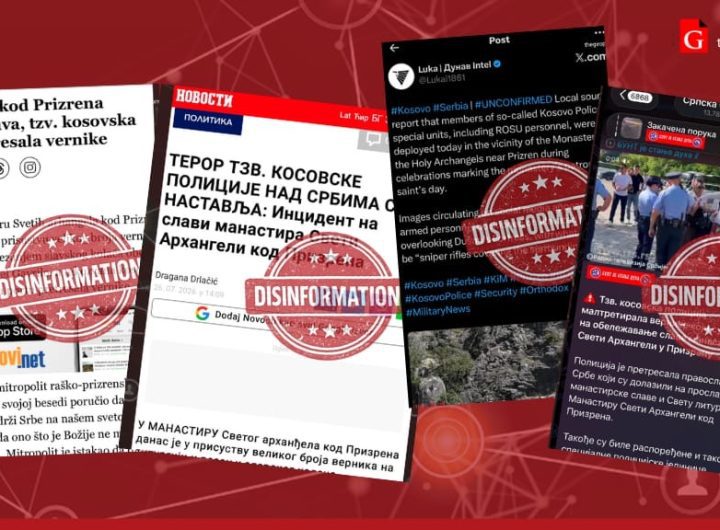 Facts refute Belgrade's narratives: How the security check at the Monastery near Prizren was misinformed by Serbian media
  Vučić's Aesthetics of Evil: When Crime Becomes a State Value
  Paunović's statement: Not a gaffe, but a reflection of Belgrade's policy towards Kosovo
  Europol and the new anti-terrorism algorithm
 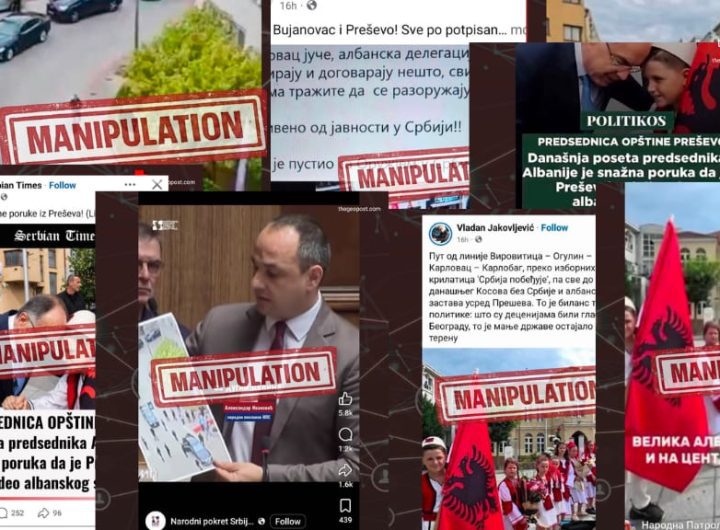 How the Albanian President's visit to Presheva and Bujanovac turned into a narrative of "invasion" and "Greater Albania"
  "Mafia State": Why Today's Serbia Resembles Palermo of the 70s