

The influence of Russian state-owned foreign media on public opinion in Western democracies is already well-known – regardless of its political qualification. There are well-documented analyses, e.g. from the US, France and Germany. The European Parliament has repeatedly called on member states to adopt strategies against “hostile propaganda” from Moscow, The Geopost reports.
A study by the Friedrich Nauman Foundation proves that the situation in the Balkan peninsula is completely different. Russian media material is very welcome in this region, which often receives propaganda content through Serbian-language media.
“The political elite, whether in the largest and most important Balkan country, Serbia, or in the Serbian half of Bosnia and Herzegovina, traditionally maintains close ties with Russia. Since the political elite – above all President Aleksandar Vučić – almost completely controls the media landscape, media offers from Russia are very welcome. Because Serbian print and electronic media suffer from chronic underfunding, the free information provided by Russia gains even more importance,” writes the study’s author, Dr. Thomas Brey.
The study says that Sputnik and Russia Today are becoming the main sources of information on events in regional and global geopolitics. And this information often does not correspond to the truth. Analyzing Sputnik's reports, the report finds that journalistic norms and ethics are rarely respected there - on the contrary, bias and tendency prevail.
"The matrix at Sputnik is clear. It does not follow classical journalism – for example, news and commentary are not separated. Sources are treated superficially, much more carelessly and, above all, with one objective in mind. Therefore, the aim is not to provide exhaustive information, but to promote and achieve political objectives," the report says.
According to the document, journalists at Sputnik do not think about their work from the reader/user's perspective, but instead follow a one-sided path in terms of content from the top down. "Figuratively speaking, the exclamation mark is the preferred punctuation mark. Western media try (at least ideally) to ask questions independently, not to overlook or distort anything. Their preferred punctuation mark is the question mark," the study says, comparing Sputnik with Western media.
The main elements of Sputnik’s composition, according to the document, include selective reporting instead of comprehensive reporting; it is not the event that matters, but the target country and, because of this, are inflated to an extent that does not correspond to reality; sources in reports are either irrelevant to an issue being covered, biased or disproportionately weighted; focus on individual events instead of important issues that are placed in the wrong context or described without context; identification of common Russian-Serbian ground or the path to alleged brotherhood; moralization of issues – Russia and Serbia self-victimize; explanation of Russian foreign policy around the world in order to create understanding and approval; “proof” that Russian weapons technology is far more advanced than military technology in the West; glorification of Putin’s person as an ideal leader and role model for senior Serbian (and foreign) politicians; supporting the Serbian and pro-Russian political elite in the region, weakening the opposition; "proof" that Western democracies are doomed to fail; the "superiority" of Russian politics and economics over the West; influencing the countries of the former Yugoslavia by sowing discord and emphasizing differences, such as Serbs against Croats, Albanians, Montenegrins...
The aim of Sputnik propaganda, according to the report, is also to prevent the Balkans from becoming part of Euro-Atlantic structures. The EU is presented in an exclusively negative light to prevent Serbia and Montenegro from moving forward with membership negotiations, and to discourage North Macedonia from making the reforms needed to start those negotiations.
Russia’s media power in this part of the Balkans, according to the study, ensures that the EU and the US often lose this battle. Although the EU is the largest donor and investor in Serbia (accounting for 67 percent of all foreign investment), a large part of the population believes that Russia and China are in leading positions in this area. Although Serbia conducts the vast majority of its trade (62 percent) with the EU, many Serbs believe that Russia is the country’s closest economic partner. Serbia, meanwhile, is one of the top three countries in the world to benefit from money transfers from Brussels, receiving around 300 million euros in non-repayable aid every year. Although the EU is trying to help Serbia build democracy with billions of euros, polls show that most Serbs prefer a Russian-style dictatorial form of government – a “strong leader.”
The polls conducted as part of the study show that Serbia's position between the two poles – Russia and the EU – is, however, more on the side of Moscow. Nearly 85 percent of Serbs surveyed believe that their country does not have the international status it actually deserves. Meanwhile, 70 percent attribute part of the blame for this to the EU, because it is contrary to Serbia's interests. About 71 percent see NATO as a threat to European security. In a parallel survey in several countries, only Russian citizens were stronger in this opinion.
Xhelal Neziri - contributor to The Geopost from North Macedonia
 Clickbait in RT Balkan headline: Graffiti writing is presented as "bullying", although there is no investigation into the author
 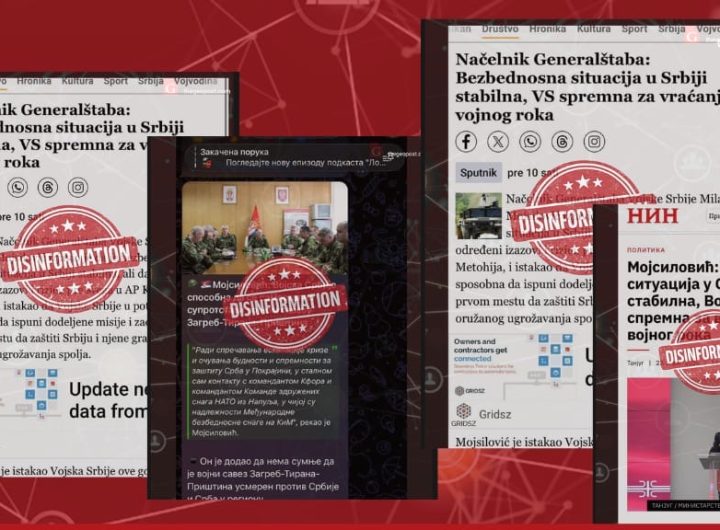 Mojsilovic misinforms about the agreement between Kosovo, Croatia and Albania
 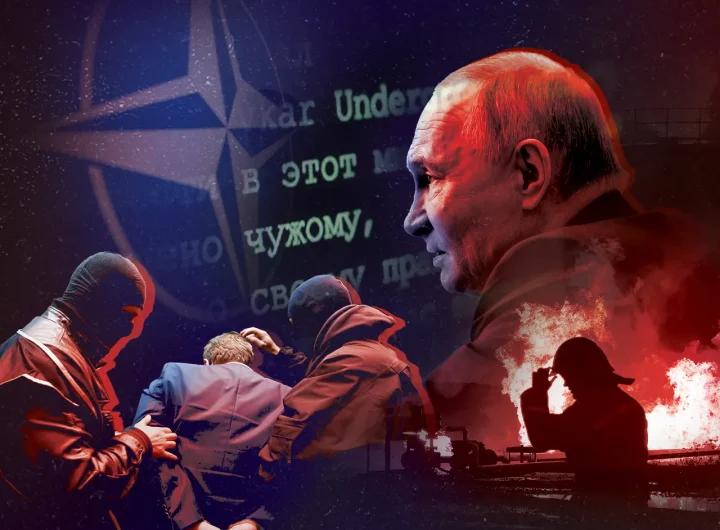 CEPA report: Russia is waging a "shadow war" in Europe, the risk of escalation increases
  Portal Novosti spreads propaganda: Media agreement declared a "pact against Serbs"
  Serbian media manipulates about American KFOR soldiers: From interest in Orthodoxy to acceptance of religion
  Momcilo Gajic, the leader of the Serbian group that caused unrest in Europe on the orders of Russian intelligence, takes refuge in Moscow