
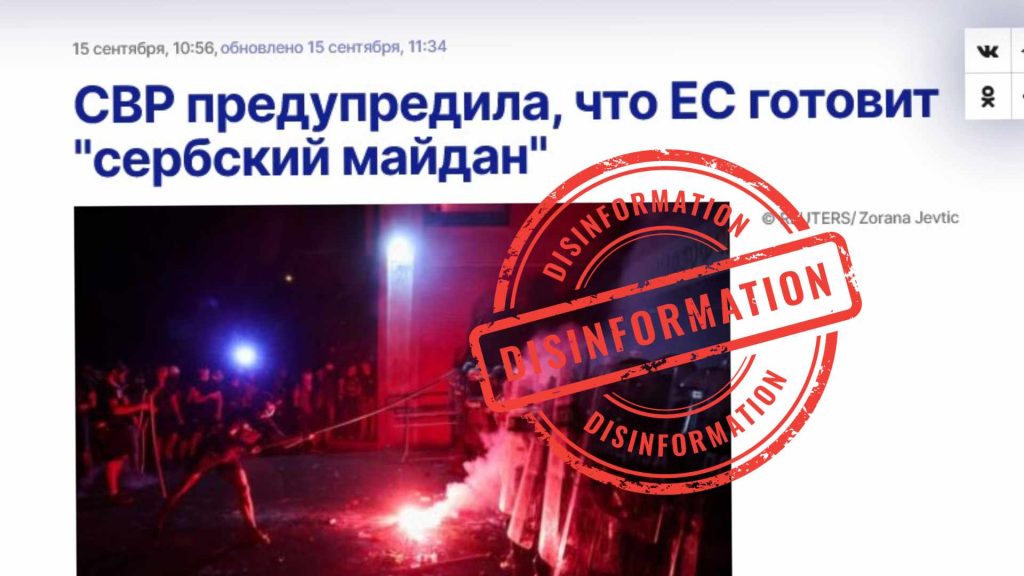
Russia's Foreign Intelligence Service (SVR) has misinformed that the European Union is behind the "riots in Serbia" in which young people are participating and that the anniversary of the fall of the tent on November 1 will be used to end the "Serbian Maidan".
The SVR made these claims in an announcement on its official website, n1 writes.
The SVR has claimed, among other things, that young people "are moving from peaceful protests to 'revolutionary' methods of war and violence."
The intelligence agency responsible for espionage activities outside Russia has also added that the tried and tested scenario of a "color revolution" in Serbia is not yielding the expected results and that the main reason for this is patriotic sentiments and the influence of the Serbian Orthodox Church.
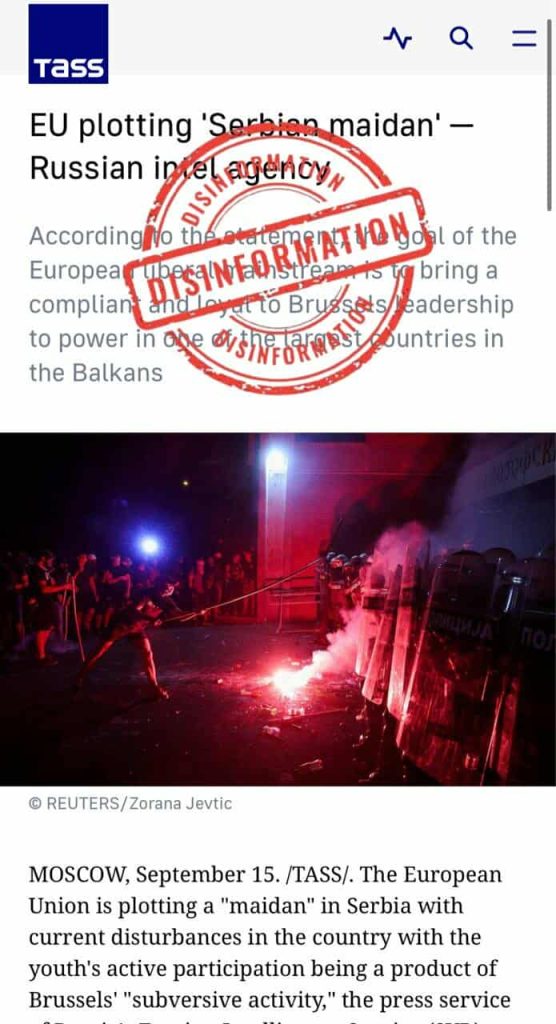
What did the SVR say?
“The current unrest in Serbia, with the active participation of young people, is largely a product of the subversive activities of the European Union and the member states of that alliance. The aim of the European liberal mainstream is to bring to power in this largest Balkan country a leadership obediently loyal to Brussels.”
Analyze:
The claims by Russia's Foreign Intelligence Service (SVR) that the European Union is behind the "unrest in Serbia" are not new.
Russia has used similar strategies in other countries to discredit civic protests by portraying them as manipulated by the West, to strengthen the anti-EU and anti-NATO narrative, and to keep Serbia, which is not fully oriented towards the West, closer.
EU calls a Russian propaganda claims that the West instigated protests in Serbia
Such claims are part of hybrid warfare that includes propaganda, disinformation, and political influence.
On the other hand, it is known that there is no evidence that the EU has been involved in any way in the protests in Serbia; on the contrary, it (the EU) has been critical of the violence, supporting dialogue and reforms.
Protests in Serbia began in November last year, initially to demand responsibility for the collapse of a train station canopy in Novi Sad, Serbia, and continued for months as a sign of dissatisfaction with Aleksandar Vučić's government.
Conclusion:
This SVR statement is a typical example of Russian state disinformation, aimed at legitimizing Moscow's narrative that Russia protects the "sovereignty" of friendly countries from Western interference. /The Geopost/
 Portal Novosti spreads propaganda: Media agreement declared a "pact against Serbs"
  Serbian media manipulates about American KFOR soldiers: From interest in Orthodoxy to acceptance of religion
  Russian Foreign Ministry Spreads Disinformation About NATO Intervention in 1999
  Propaganda from Moscow: Volodin blames the US and EU for the war in Ukraine
  Propaganda narrative from Moscow: Zakharova again misinforms about Kosovo
  Zakharova spreads disinformation about the incident in Cuba: Washington's aggressive provocation