
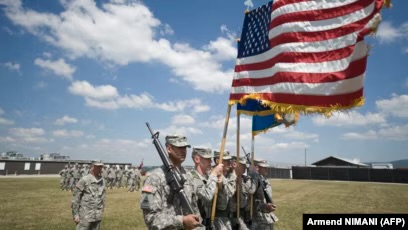
For more than two decades, the presence of American soldiers in Kosovo has been not only part of NATO's peacekeeping mission, but also one of the main guarantees of the country's security.
Now, as the United States reviews its military commitment in Europe and calls on European allies to take greater responsibility for the continent's defense, questions about the future of this presence have taken on new importance.
At the center of the changes is the NATO 3.0 concept, which aims for a new division of responsibilities between the two sides of the Atlantic.
Kosovo is not outside these developments.
The NATO mission, KFOR, present in the country since the end of the war in 1999, has begun a reorganization process. Of the thousands of American soldiers who served in Kosovo after the war, fewer than 600 remain today.
There is no confirmed decision to further reduce them.
However, changes in the structure of American forces and plans for the reorganization of KFOR have opened the discussion of whether the US role in Kosovo's security could change.
For Kosovo Prime Minister Albin Kurti, the future of the American presence must be based on a sustainable military commitment. He has called for Camp Bondsteel to be transformed into a permanent US base.
"Such a presence would serve as a guarantor of peace and security in Kosovo and the region and as a strategic base for NATO operations in Southeast Europe," Kurti said.
A change in Bondsteel, many question marks
On October 12, a change in the command structure of American forces in Kosovo occurred at Camp Bondsteel.
For the first time in more than a decade, active-duty US Army units took over the leadership of KFOR's Regional Command East from the Florida National Guard.
The change may seem technical, but it came at a time when Washington is reviewing its military presence in Europe.
National Guard members typically serve part-time outside of mobilization periods, while active duty units are composed of full-time service soldiers.
The US military justified the rotation with the availability of forces and the needs of the mission. However, it did not clarify whether this change is also accompanied by changes in the number of troops, their capacities or responsibilities in Kosovo.
REL requested clarification from the US Department of War on the nature of the rotation and possible plans for the American presence in Kosovo during 2026 and 2027, but did not receive a response.
Signals of change, however, came several months earlier.
In June, the US European Command confirmed to Radio Free Europe that the American contribution to KFOR would be subject to gradual adjustments, in accordance with a review led by NATO military structures.
Even then, no details were given about the nature or extent of the changes.
Now, NATO confirms that the reorganization of KFOR is in progress.
In a written response to Radio Free Europe, an Alliance official links it to the transition towards the NATO 3.0 concept.
"As the Alliance moves towards the NATO 3.0 concept, the KFOR reorganization process will enable the same strategic effect to be maintained, with more efficient use of resources and under continued European leadership," the response states.
NATO emphasizes that KFOR's mandate, as defined by the United Nations, remains unchanged, as does its commitment to the security of all communities in Kosovo and stability in the Western Balkans.
But it does not clarify whether the American rotation at Bondsteel is part of this reorganization.
Neither the Government nor the Ministry of Defense of Kosovo provided an answer, to which Radio Free Europe asked to clarify whether they have been informed of possible changes in the American contingent and whether they have received guarantees for the continuation of the US presence in KFOR.
From Washington, a new division of responsibilities
What is happening in Kosovo is just one part of a much broader review of the American military role in Europe.
For decades, the United States has provided a large portion of the forces, equipment, and capabilities on which the continent's defense depends.
But the US administration wants this burden to be shared differently.
In February, senior Pentagon official Elbridge Colby presented the vision of NATO 3.0: Europe would take primary responsibility for the continent's conventional defense, while the US would remain part of the Alliance, but with a redefined role.
Four months later, US Secretary of Defense Pete Hegseth announced a review of the deployment of US forces in Europe.
"To accomplish this, the War Department will review, over the next six months, the deployment of American forces and their military bases in Europe," Hegseth declared on June 18.
The review is not just about the number of soldiers the US can keep on the continent.
According to an analysis by the Center for Strategic and International Studies (CSIS), published in August, it also includes the location of forces and military capabilities that Washington will continue to offer to NATO.
REL learns from its sources that the results of this process could be made public around the end of November.
They may also provide more clarity on the Pentagon's plans in Kosovo.
Jim Townsend, former deputy assistant US secretary of defense, expects the US contingent in Kosovo to be part of the review.
According to him, decisions on KFOR will not be made in isolation from other US military priorities.
"Whatever the Alliance's decision, the American contribution will be determined in accordance with it. Because when NATO reviews the deployment of its forces, as is the case with KFOR, member countries can agree on a certain direction. Then, they determine what types of forces are needed to implement it," Townsend tells Radio Free Europe's Expose program.
Changes in the division of responsibilities between the US and Europe are not new. They have occurred continuously since the end of the Cold War.
But Townsend sees an important difference this time: American pressure on European allies could make the changes "faster" and "bigger."
Europe may have more responsibilities, but does it have the capacity?
Taking on greater responsibilities from Europe does not just mean increasing the number of soldiers.
For decades, NATO operations have relied on American capabilities that many European countries do not possess to the same extent.
Among them are: intelligence and surveillance, strategic transport, in-flight refueling, air defense, and long-range strike systems.
Some of these capabilities could be relocated or reduced, in line with new American priorities.
Townsend says European allies are considering ways to compensate for potential changes, but warns that equipment, specialized personnel and capabilities for joint operations are not provided in a short time.
"The US military has more military capabilities and equipment than European armies. Even when Europeans have similar equipment, they have it in smaller numbers. Filling these gaps takes time," he says.
However, the challenges of Europe's overall defense are not necessarily the same as those of the NATO mission in Kosovo.
KFOR is not a force deployed for conventional defense of NATO territory, but a peacekeeping mission, with a mandate to contribute to maintaining a secure environment and freedom of movement.
Its importance was also demonstrated during tensions in northern Kosovo, inhabited by a Serb majority, including the clashes of 2023, when KFOR members were also injured.
In the current security structure, the Kosovo Police is the first responder, EULEX the second, and KFOR the third.
The mission also has reserve forces that can be deployed in case the situation deteriorates.
Furthermore, the majority of KFOR troops now come from European countries and the mission is led by a European commander.
An analysis by the International Center for Defense and Security (ICDS), published in September, estimates that the Europeans can replace American capabilities in KFOR more easily than those the US provides for the overall defense of Europe.
But, this is only one side of the issue.
Not just how many soldiers, but what they represent
Even if European countries manage to replace part of the American contingent, this does not necessarily mean that the effect of KFOR's presence will remain the same.
For experts, the weight of American soldiers in Kosovo is not only related to their military capacities, but also to the political and strategic message conveyed by the US presence.
Michael O'Hanlon, a defense expert at the Brookings Institution in Washington, sees no major obstacle to the Europeans compensating for American combat capabilities in Kosovo.
His concern is different: what message would a large reduction, or complete departure, of American forces send?
"I'm not so concerned about combat capabilities. For me, it's important that a certain number of American soldiers remain in Kosovo. Maybe a few hundred would be enough to maintain the US commitment and presence, and to ensure that Serbia doesn't create the impression that the United States has lost interest in Kosovo," O'Hanlon tells Exposé.
Even the ICDS analysis warns that an American withdrawal could have political consequences.
According to her, such a development could affect the calculations of Serbian nationalist forces in Kosovo, while Russia could interpret it as a development in favor of its interests.
For retired American colonel Ray Wojcik, from the International Center for Defense and Security, the issue goes beyond Kosovo.
He believes that the greater US focus on the Pacific region should not come at the expense of the American presence in Europe.
"European leadership should not mean America's absence. That would be a mistake. If we significantly reduce our forces in Europe, including the Balkans, to focus on the Pacific, we risk losing our influence," Wojcik tells Radio Free Europe.
According to him, the US needs its allies and European security remains closely linked to global security.
Regarding the recent rotation at Bondsteel, Wojcik mentions several possible explanations: force reorganization, unit readiness, or the security situation.
But he cannot confirm which of them is, in fact, behind the American decision.
O'Hanlon sees no reason for alarm yet, although he warns that upcoming decisions in Washington require attention.
"We know that some officials in the Pentagon are trying to significantly reduce American engagement in Europe. We also know that the US president and vice president have ambivalent attitudes towards NATO in general," he says.
"So this is something that needs to be watched carefully. I'm not on high alert yet, but I think there needs to be vigilance, attention and, if necessary, opposition to these efforts," O'Hanlon adds.
From Germany and Italy, to Poland and Romania, about 80 American soldiers are deployed in Europe, according to data published during 2026.
They serve on a permanent or rotational basis and support the security of the continent.
Kosovo occupies little space on this map, but, as Wojcik warns, completely removing it could cost the region./REL
 "Fear is growing" - British MP demands reaction from London and Brussels on the situation in Serbia
 What do the residents of northern Kosovo expect from the elections in Serbia?
 Gendarmerie vehicles to disperse protests in front of the Serbian Presidency
 Serbian lawyer calls on Kosovo, Montenegro and Bosnia to investigate suspicions of vote buying by Vučić's party
 Vučić mobilizes voters from Kosovo for the SNS, 100 euros per vote and expenses paid
 Will he have Orban's fate? Reuters: Elections in Serbia, the biggest challenge for Vučić