
Serbia has not made key progress in the areas of rule of law, the fight against corruption, and media freedom, which remains a major obstacle to further progress in negotiations for membership in the European Union (EU).
This is stated in the latest European Commission document, which assesses Serbia's progress in chapters 23 and 24.
It is a document that is prepared between the two annual progress reports, which the European Commission publishes every autumn.
The European Union expresses serious concern about the increasing political pressure on the judiciary, the lack of results in prosecuting high-level corruption, the increasing attacks on journalists and the deteriorating electoral environment.
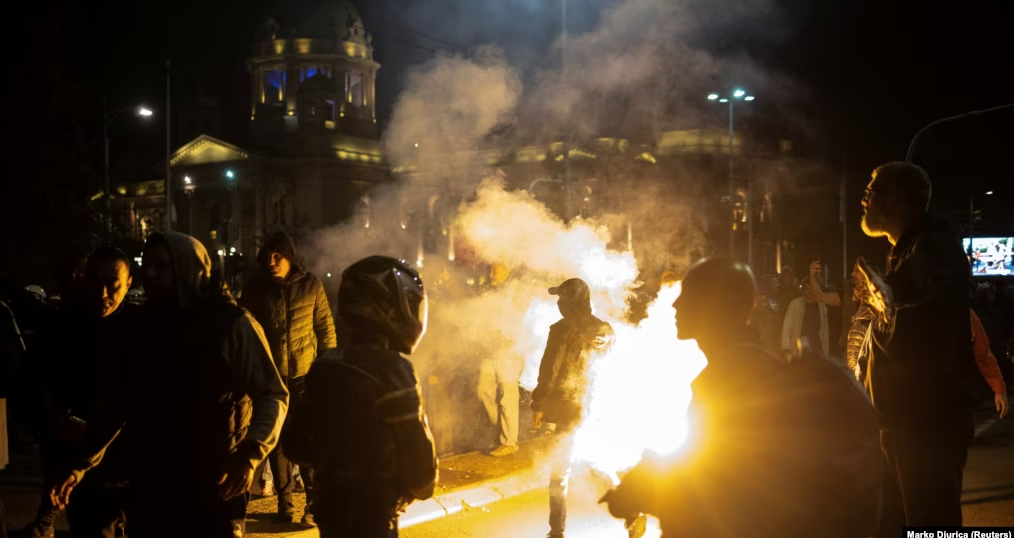
The document notes that student protests and demands for government accountability have characterized the past period, while at the same time violent incidents, pressure on civil society and the media, and limited progress in implementing reforms that are essential for continuing Serbia's European path have been recorded.
This is one of the most important documents for any country striving to advance in the European integration process, as it represents a key element in membership negotiations.
REL has had access to this document, which was the subject of discussion among diplomats from European Union member states earlier this week.
The reporting period was marked by tensions on the domestic scene.
The internal situation, according to the document, was marked by high tensions. It says that freedom of assembly was generally respected and protests were permitted, but the safety of participants was not always guaranteed and that several violent incidents against demonstrators and journalists were recorded. It is emphasized that only a few of the perpetrators have been prosecuted so far.
“Regarding allegations of excessive use of force by the police during the protests, the proceedings are still ongoing and so far no convictions have been achieved against the accused police officers. Pressure on civil society organizations and journalists has increased, including defamation campaigns directed against individuals and organizations defending the rule of law and the fight against corruption,” the document states.
He added that observers of the local elections in March this year witnessed violence in all but one of the municipalities visited. They noted, among other things, a number of irregularities, worsening campaign conditions, allegations of pressure on voters, vote buying and abuse of administrative resources and official positions for campaign purposes. They also noted the further intensification of the blurring of lines between the state, local authorities and the ruling party, as well as problems in the media environment.
Referring to reports from international observers, the document positively assesses the steps taken to improve the integrity of the voter register.
The negative impact of 'Mrdić's laws'
The European Commission's non-paper on the rule of law in Serbia concludes that excessive pressure on the judiciary and prosecution has "significantly increased", which raises serious concerns.
A separate section of the document is dedicated to the judicial laws adopted in January of this year, which are said to have been adopted under emergency procedure, without a transparent and inclusive consultation process.
The experts who participated in drafting the report assess that these changes negatively affect the functioning of the Organized Crime Prosecution Office (OCPO), weaken the autonomy of the prosecution and represent unnecessary interference in the handling of serious and organized crime cases.
“In addition, as previously stated, the withdrawal of police investigators from the operational groups formed in the TOK, which were established as an investigative mechanism in accordance with Article 11 of the Law on the Organization and Competence of State Bodies in Suppressing Organized Crime, Terrorism and Corruption, hinders ongoing investigations and reduces the efficiency of investigations conducted by the TOK,” the document states.
The report assesses that Serbia should act without delay on the recommendations of the Venice Commission, by repealing or substantially amending the decisions adopted in January 2026.
It is also stated that some provisions of the approved amendments are contrary to the goal of previous constitutional reforms, implemented as part of Serbia's accession process to the European Union, which is to strengthen the independence of the judiciary and the autonomy of the prosecution.
Significant increase in political pressure on the judiciary
The report on chapters 23 and 24 assesses that political pressure on the judiciary and the prosecution has increased significantly, including pressures related to criminal prosecutions of high public interest. As stated in the document, the competent institutions have taken limited measures to investigate such cases of interference and to determine responsibility for them.
It is emphasized that officials in Belgrade, including some representatives of the highest state institutions and MPs, continued to make inappropriate public comments regarding ongoing investigations and judicial proceedings, including the work of individual prosecutors and judges.
It is specified that these comments included criticism of court decisions, as well as threats to dismiss judges and prosecutors. The document notes that associations of judges and prosecutors have in some cases defended their colleagues, while the High Judicial Council and the High Prosecutorial Council have remained largely passive and have not fully fulfilled their role in responding to cases of undue influence, although this is provided for in their rules of procedure.
"Neither the National Assembly nor the Government have so far reacted to cases of inappropriate public comments by their members, despite the fact that such comments appear to be in violation of their codes of conduct," the document states.
No progress in large-scale corruption cases
The document concludes that no progress has been made in a number of large-scale corruption cases. In this context, it is said that investigations into possible corruption launched after the collapse of a tent at the Novi Sad Railway Station have not yet been completed.
It is added that the Organized Crime Prosecution reported insufficient cooperation from the police in terms of providing complete evidentiary documentation, and that cooperation between the prosecution and the police has deteriorated in recent months.
According to the report's assessments, TOK continues to face operational obstacles and attempts at undue influence, which further intensified during the reporting period.
The document also mentions the case of two prosecutors whose mandates were not extended, who worked on two cases of great public importance – the tent demolition case in Novi Sad and the case of the seizure of five tons of marijuana in Konjuh.
This, it is alleged, has negatively impacted ongoing investigations and judicial proceedings in cases of high-level corruption and organized crime.
The document assesses that the Law on Prevention of Corruption is generally well-established, but that there are significant shortcomings, especially when it comes to the control and verification of asset records. It also highlights that the implementation of the law does not apply to all high-ranking public officials who are particularly exposed to the risk of corruption.
It is noted that no additional measures have been taken following the amendments to the Public Procurement Law regarding sectors with high corruption risk.
"Many contracts are awarded outside the framework of standard public procurement legislation, through special laws intended for individual projects and interstate agreements used for large infrastructure projects, with provisions that give certain participants privileged access to tendering procedures," the document states.
It is added that such a practice is not in line with the acquis communautaire of the European Union.
“The risk of corruption due to the circumvention of public procurement procedures remains high,” the report states.
It also states that the Government has not implemented the long-standing recommendation of the European Commission to establish a constructive relationship with the Anti-Corruption Council, which functions as its advisory body. It is noted that the Council is not included in consultations on draft laws, while the Government does not implement its recommendations.
Increase in the number of attacks on journalists
The European Commission's document on monitoring Serbia's progress concludes in chapters 23 and 24 that there has been an increase in the number of attacks and cases of pressure on journalists, while the authorities have not consistently condemned such incidents. This includes physical attacks, some of which occurred in the presence of the police, who did not react.
It is noted that a small number of reported cases have resulted in final convictions. It is also said that cases of police use of force against journalists, obstruction of media workers from reporting on protests, and short-term detention of journalists have been recorded.
Female journalists are said to be particularly exposed to threats and attacks, especially online.
"Repeated verbal attacks by senior officials against journalists have continued and are having a chilling effect on freedom of expression," the document states.
It also states that the reporting period was marked by coordinated bot attacks on the accounts of independent media outlets and civil society organizations on social media. It is estimated that the documentary series broadcast on several television channels, including national channels, contributed to a smear campaign against several journalists, while the authorities did not publicly condemn its broadcast.
It is also noted that the members of the Council of the Regulatory Body for Electronic Media (REM) have not yet been appointed, therefore the audiovisual market remains without a regulatory body, especially when it comes to responding to violations of media legislation.
"Several television channels began broadcasting programs without the necessary licenses, including through the Telekom Srbija cable network. Public officials were invited to these channels, while at the same time receiving public funds," the document states.
The European Commission assesses that Serbia has not taken significant measures to combat foreign information manipulation and interference.
In this context, he states that RT Balkan, a Russian state-owned media under European Union sanctions, continues to broadcast programs in Serbian through the cable operator Telekom Srbija, which is majority-owned by the state, based on a license issued by the previous REM Council in 2024.
No improvement in war crimes prosecution
The document assesses that no progress has been made in the area of war crimes prosecution. It says that Serbia needs to take additional steps to accelerate the prosecution of war crimes cases and to resolve the large backlog of more than 1,731 cases before trial, which remains a serious cause for concern.
It is noted that cooperation between the Office of the War Crimes Prosecutor and the Office of the Prosecutor of the International Residual Mechanism for Criminal Tribunals has continued. Cooperation with Bosnia and Herzegovina has also continued, while there is almost no cooperation with Croatia and Kosovo.
The document emphasizes that the Serbian judiciary has not provided financial compensation to victims in any criminal proceedings for war crimes.
"The unresolved fate of missing persons from the conflicts of the 1990s remains one of the key issues to be resolved in the Western Balkans. Despite continued progress in identifying victims, 7,608 people remain missing as a result of the conflict," the rule of law report states.
 Britain, US and Australia on underwater drone project to deepen AUKUS defence partnership
  Russian media misinforms about the US Congressmen's Resolution supporting Kosovo's membership in NATO
  Attack on Russian targets, experts: AI drones are changing the war in Ukraine
  NATO prepares Baltic fortress to counter Putin
  The US is considering the possibility of reinstating sanctions against Dodik.
  What is the Russian Oreshnik missile and why do experts doubt its effectiveness?