

Kosovo is one of the few cases in the Western Balkans where China has almost no formal political entry point. Beijing does not recognize Kosovo’s independence, has no diplomatic relations with Pristina, has no major party-to-party channel, has no major infrastructure projects, and China’s strategic technology in Kosovo has not gained public acceptance at the state level. China also continues to view Kosovo through the prism of Serbia’s territorial integrity. This makes Kosovo look like an exception in China’s regional playbook.
Pristina has also largely avoided the debates over digital infrastructure and Huawei-related surveillance that have shaped discussions about China in Serbia and other European countries. Its foreign policy remains strongly aligned with the US, NATO and the EU, while public and institutional attitudes towards China remain skeptical.
However, Kosovo’s distance from China is not as great as it seems, and Beijing does not need an embassy in Pristina to exert its influence. China’s role in the country is evident in three ways: through Kosovo’s growing dependence on Chinese goods, through Beijing’s diplomatic support for Serbia, and through China’s deepening security partnership with Belgrade. This makes Kosovo an unusual case: China has not established significant political influence in Kosovo politically, but the country is still exposed to China economically and strategically.
A recent study by the Kosovar Center for Security Studies adds another layer to this picture. It argues that China’s activities in Kosovo are quiet – but not absent. Despite the lack of recognition and formal diplomatic relations, Beijing has sought alternative entry points through trade, business ties, cultural engagement and outreach at the municipal level. This reflects a broader Chinese practice of subnational diplomacy. Across Europe, Beijing has built ties with regions, cities, businesses, universities and cultural institutions below the level of central government policy. Similar patterns can be observed in Germany and the United Kingdom, where Chinese engagement with local authorities has included investment promotion, research cooperation, education, culture, sports and city-to-city partnerships.
In Kosovo, this approach has a specific political use. It allows Beijing to maintain its policy of non-recognition while still maintaining practical channels of engagement. Reported meetings between Chinese representatives and officials from the municipalities of Pristina and Ferizaj, as well as with representatives of the Kosovo Olympic Committee, illustrate how this approach works in practice. None of this is to say that China has penetrated Kosovo politically. But it does indicate that Beijing is testing low-risk access points below the level of formal diplomacy.
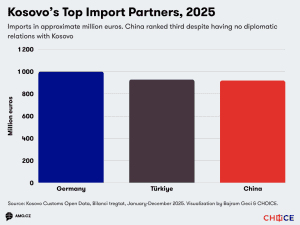
The most obvious change is economic. In 2025, Kosovo imported goods worth approximately 920 million euros from China, making China its third largest import partner after Germany and Turkey. Chinese goods accounted for about 13 percent of Kosovo’s total imports. The trend is striking because Kosovo’s imports from China have roughly doubled over the past four years. This shows that China now plays a larger role in Kosovo’s daily economic life. Chinese products are prominent in household consumption, electronics, machinery, construction materials, and low-cost technology. In a country that relies heavily on imports, this growing dependence is not politically neutral.
One likely factor behind this increase is not direct political influence from Beijing, but price pressures within Kosovo. Kosovo remains a low-income European economy, with a GDP per capita of around $7,000 in 2024. Combined with renewed inflationary pressures in 2025, cheaper Chinese goods have become increasingly attractive to consumers, retailers, and small businesses. The result is a form of bottom-up exposure, driven largely by the everyday search for affordable products in a price-sensitive market. This makes Kosovo different from many other CEE countries. In Serbia or Hungary, China’s influence is often discussed through infrastructure, high-level policy, investment deals, technology, or strategic partnerships. In Kosovo, the channel is narrower – Chinese influence flows from the bottom up, not the top down.
The risk is structural. Kosovo is becoming increasingly exposed to Chinese imports without having formal diplomatic relations with Beijing that could help manage problems during a crisis. If supply chains are disrupted, prices rise, or political tensions affect trade, Pristina has limited means for direct engagement. This is the paradox of Kosovo’s exposure to China: the relationship is politically closed but economically open.
The second channel is regional. Beijing most clearly affects Kosovo through Serbia. This does not mean that Beijing is responsible for Belgrade-Pristina relations. On the contrary, this reflects a simpler dynamic: China is strengthening Serbia, a state that most actively opposes Kosovo’s sovereignty and international position. This makes China important for Kosovo even without direct political engagement.
In July 2025, Chinese and Serbian military special operations forces conducted the joint training exercise “Peace Guardian 2025” in Hebei province. This military cooperation is not an isolated event. Serbia is also the first European operator of Chinese FK-3 air defense systems and CH-92A combat drones. It has also purchased Chinese CM-400AKG air-to-surface missiles, drawing criticism from Croatia and wider concerns about a regional arms race in the Balkans.
For Kosovo, these activities do not represent direct Chinese pressure, but they are reshaping the regional security environment. Chinese military technology is improving Serbia’s air defense, drone, and strike capabilities. Kosovo remains outside NATO, relies on KFOR (Kosovo Force) for deterrence, and faces a neighbor that continues to consider it part of its territory.
In this context, China’s support for Serbia is not a distant issue, because it shifts the regional balance around Kosovo without directly involving it. Kosovo’s position also creates a strategic exposure in the gray zone. It is protected by KFOR and is closely aligned with the West, but it is not a member of NATO and does not enjoy Article 5 guarantees. China and Serbia have also deepened legal-security cooperation, including an extradition treaty and previous joint police patrols. For Kosovo, this matters because Beijing’s partnership with Belgrade is expanding beyond trade and defense to internal security cooperation.
For Kosovo, however, the long-term concern is not only the current level of Chinese influence in Serbia, but also its future trajectory. Russia has traditionally been Belgrade’s most important strategic partner outside the West. However, if Serbia were to gradually distance itself from Moscow due to geopolitical pressure, economic incentives, or changing domestic priorities, Beijing would be well-positioned to fill at least some of that gap. China already offers Serbia investment, technology, diplomatic support, and increased security cooperation without the political conditionality typically associated with other partners—especially the EU. While China is unlikely to fully replace Russia, its influence could become more prominent as Serbia diversifies its external partnerships. For Kosovo, however, this reduction in Russian influence would not necessarily translate into a less challenging strategic environment.
China’s non-recognition of Kosovo is not just a diplomatic stance, but also a form of influence. Beijing’s stance supports Serbia’s claim to Kosovo, limits Kosovo’s space in international organizations, and aligns with China’s broader opposition to separatism. The Kosovo case fits into Beijing’s broader argument about sovereignty, territorial integrity, and the “One China” Principle. This gives Kosovo a place in China’s global narratives. Beijing can use Kosovo to criticize Western recognition policies, while simultaneously reinforcing its own positions on Taiwan, Hong Kong, Xinjiang, and Tibet.
For Pristina, this creates a narrow but persistent diplomatic obstacle. China’s position does not dominate Kosovo’s foreign policy, but it matters in international forums where Beijing carries weight. It also strengthens Serbia’s broader diplomatic campaign against Kosovo’s recognition and membership in international organizations. Kosovo is therefore in an unusual position. It is not politically penetrated by China, but remains constrained by its support for Serbia. It is not formally engaged by Beijing, but is influenced by Beijing’s partnership with Belgrade. Kosovo does not seek to balance between Washington, Brussels, and Beijing in the way that Belgrade does. Its strategic orientation remains strongly Western. However, this does not shield Kosovo from the consequences of China’s growing regional presence in the Western Balkans.
Therefore, Kosovo should treat China as an indirect strategic challenge – not as an absent actor. This does not require an anti-China policy, but rather clearer safeguards in areas where Kosovo is exposed: public procurement, sensitive technology, municipal expansion, business ties and strategic imports. Pristina should give municipalities and public institutions clearer guidance on how to deal with Chinese engagement, while simultaneously strengthening control over digital infrastructure, surveillance equipment, dual-use technology and companies operating through domestic or EU-registered intermediaries. The regional risk also requires attention. If Belgrade gradually reduces its dependence on Moscow, Beijing would be well-positioned to become an even more important non-Western partner for Serbia. Therefore, China’s problem for Kosovo is unusual but real: Beijing does not need to recognize Kosovo in order to shape the strategic environment around it./chinaobservers.
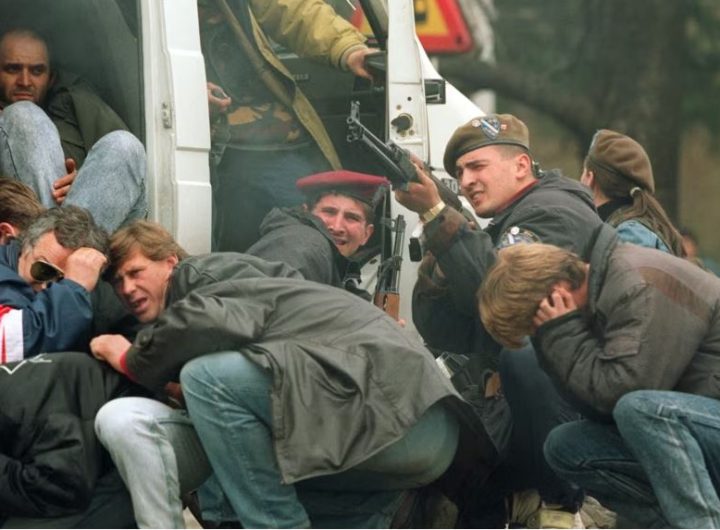 Over three decades after the war, American investigators obtain evidence of Serb crimes in Bosnia
 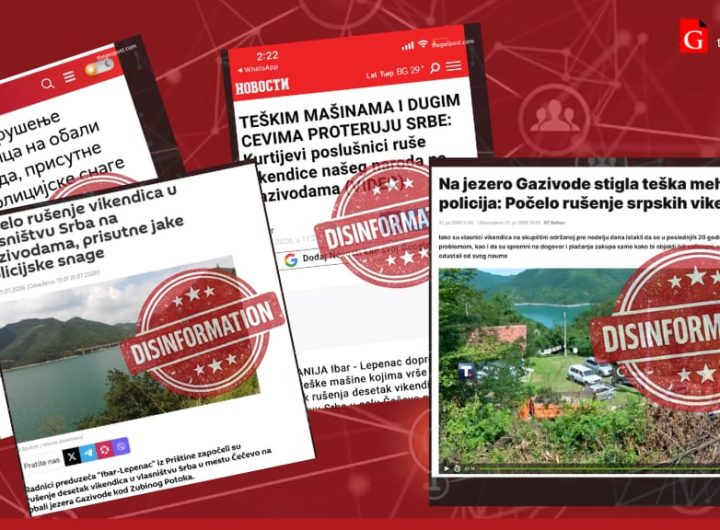 Serbian media misinforms about the demolition of illegal villas in Ujman, presenting the action as directed against Serbs
  Suspected Russian FSB hacker who traveled to Thailand faces 10 years in prison in the US
 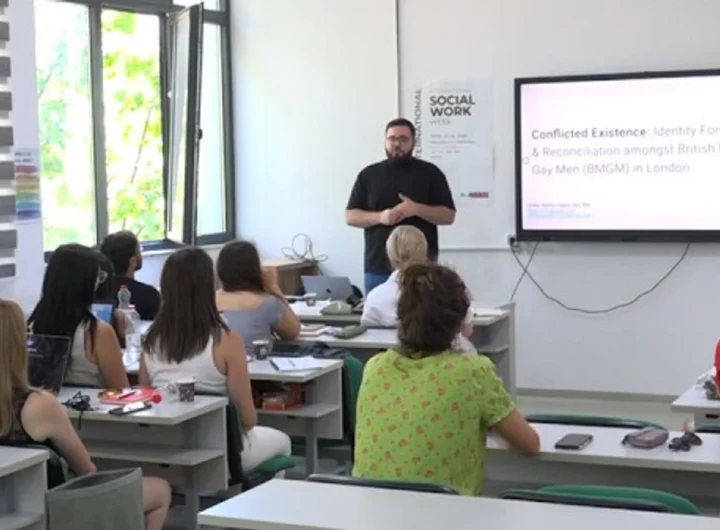 "I love coffee culture", "I got a free haircut", foreign students like Kosovo
  Russia targets Ukrainian crops with incendiary bombs to burn crops
  Crimea was Russia's fortress, now it's a weak point