
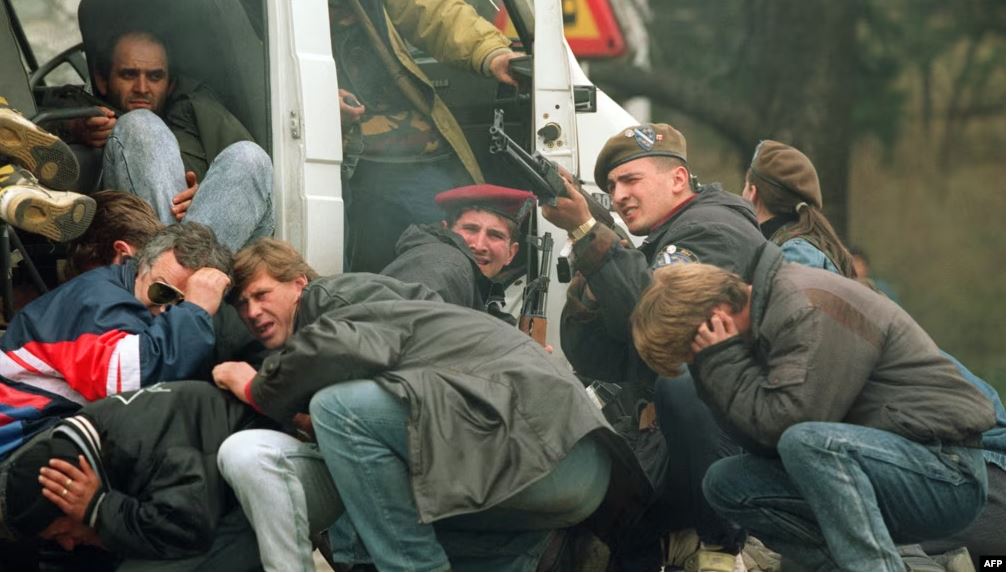
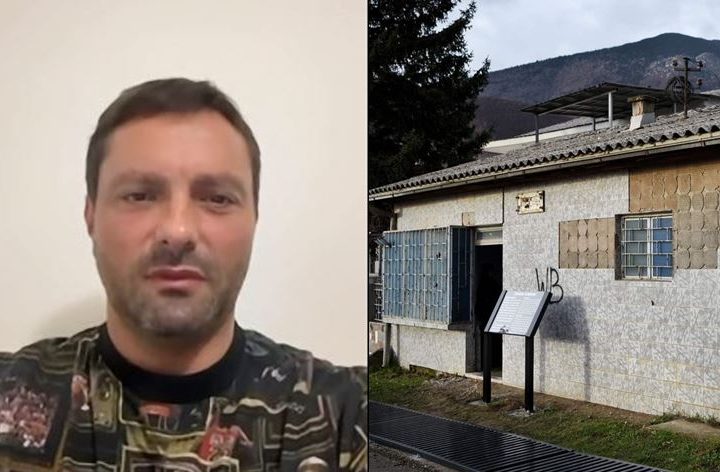
Thirty-three years after surviving imprisonment in the Derventa camps, Drago Knežević testified again about the events of 1992.
This time, he was questioned for several hours by American investigators, who arrived in Bosnia and Herzegovina in mid-July, to gather information as part of a possible investigation into war crimes committed in Derventa and into persons suspected of living in the United States today.
During questioning, Knežević says he understands who may be the focus of American investigators, but, due to the ongoing investigation, he does not want to provide more details.
"I was his 'patient,'" Knežević tells Radio Free Europe.
When asked what he means by this, he explains that it is about a person who, according to him, beat and mistreated him during his time in prison.
"He would beat me and torture me. He would give me a gun to kill myself and tell me: 'Now everything is over for you,'" Knežević recalls.
In the camps set up at the former headquarters of the Yugoslav People's Army in Derventa, in northern Bosnia and Herzegovina, Knežević says he spent the two hardest months of his life.
After that, he was held for another 15 days in detention in Slavonski Brod.
"I reached such a psychological state that I prayed to God to let me die. I couldn't stand the beatings anymore," he says.
How did the cooperation between Bosnia and Herzegovina and the USA come about?
The visit of American investigators to Bosnia and Herzegovina was organized in cooperation with the country's justice institutions.
Knežević says that two inspectors from the State Investigation and Protection Agency (SIPA) handed over invitations to eight former camp prisoners to give testimony before American investigators.
He says that during the interviews, which lasted several hours, investigators reviewed statements that the former prisoners had previously given to the Prosecutor's Office of Bosnia and Herzegovina, asking them for additional clarifications and details about persons who may be under investigation.
"They even asked me to describe what kind of boots a person wore in the camp. They are that detailed," says Knežević.
According to him, the interview with the first witness lasted about two and a half hours, and then he himself gave his testimony.
"It's about six investigators from the US and two SIPA inspectors," says Knežević.
Radio Free Europe/Radio Liberty requested comment from the US Department of Justice, but it refused to confirm or deny that any investigation was underway.
Bosnia and Herzegovina Prosecutor's Office Welcomes US Activities
The Prosecutor's Office of Bosnia and Herzegovina confirmed to Radio Free Europe that it has been cooperating with American justice institutions for years in war crimes cases involving persons who, after the war, continued to live in the United States.
"The Prosecutor's Office of Bosnia and Herzegovina welcomes the activities of our colleagues from the US in handling cases related to war crimes. We have good communication and cooperation with the US prosecutor's offices and justice institutions, especially in investigations related to persons who, after the war, continued their lives in the US, in their identification and criminal prosecution, as well as in their extradition to the judicial authorities of Bosnia and Herzegovina," the Prosecutor's Office's response states.
The prosecution added that, since these are matters being handled by American authorities, it cannot provide further details.
The visit of American investigators takes place at a time when the Prosecutor's Office of Bosnia and Herzegovina continues to have a large number of war crimes cases under review.
According to the Prosecutor's Office's report for 2025, at the end of the year, 162 cases were open against identified suspects, involving more than 2.000 people, as well as hundreds of other cases where the perpetrators have not yet been identified.
Extradition from the US and court decisions in Bosnia and Herzegovina
Although the US Department of Justice refused to confirm whether it is conducting a specific investigation into war crimes in Derventa, US authorities have, for years, been investigating war crimes suspects who emigrated to the United States after the conflict.
In cases where it is determined that a person has concealed involvement in war crimes, or has provided false information about their past when applying for a visa, permanent residence permit or US citizenship, proceedings may be initiated against them for the removal of citizenship, deportation or extradition to the country where criminal proceedings are taking place, or are expected to take place.
One of the most well-known cases of this collaboration, regarding war crimes in Derventa, is that of Azra Bašić, a former member of the Croatian Defense Council (HVO).
She was arrested in 2011 in the US state of Kentucky and then extradited to Bosnia and Herzegovina.
The court in Bosnia and Herzegovina sentenced Bašić in 2016 to 14 years in prison for war crimes against Serb civilians and prisoners of war in Derventa.
Also extradited from the United States to Bosnia and Herzegovina was Allmaz Nezirović, a former member of the Croatian Defense Council, who in 2020 was sentenced by final judgment to two years in prison for crimes against prisoners of war in Derventa.
Knežević is one of hundreds of people who were held prisoner in the Yugoslav People's Army camp and the Rabić camp in Derventa.
According to the final decisions of the Court of Bosnia and Herzegovina, civilians and prisoners of war, mainly of Serbian nationality, were illegally imprisoned, beaten and mistreated in these camps during 1992.
His testimony before American investigators is not the first.
Over the past three decades, Knežević testified several times in cases related to the crimes in Derventa, both before the Prosecutor's Office of Bosnia and Herzegovina and before the District Court in Doboj.
What happened in Derventa?
In the spring of 1992, Derventa was the scene of fighting between forces of the Yugoslav People's Army and Serbian military formations, on the one hand, and the Croatian Defense Council and units of the Croatian Army, on the other.
During the spring and summer of 1992, hundreds of civilians, mostly of Serbian nationality, were held prisoner in the Yugoslav People's Army camp and the Rabić camp, as well as in other improvised camp-like facilities.
In several final decisions, the Court of Bosnia and Herzegovina found that prisoners in these facilities were subjected to beatings, torture, humiliation, forced labor, and other forms of inhuman treatment.
Some of them did not survive their imprisonment, while many others, like Knežević, testified years after the war about the physical and psychological consequences of their experiences.
For some of the crimes committed in Derventa, the Court of Bosnia and Herzegovina issued final convictions, while several other processes are still ongoing both in this court and in the District Court in Doboj.
Two months in camp
Recalling the day he was captured, Drago Knežević says that only after entering the camp did he realize that he might not get out alive.
"When they captured me and brought me to the Yugoslav People's Army camp, I saw the letter 'U' on a guard's hat for the first time. Until then, I didn't even know who the Ustasa were. Until that moment, I was afraid."
"When I saw that sign, I thought: 'Now I've seen death.' In that moment, all fear passed. I said to myself: 'Everything is over,'" says Knežević.
He says that the interrogations and beatings began on the first night.
Before he was captured, he had been hiding for about ten days in the basement of the house of his friend, Ibro – a Bosnian with whom he had worked before the war.
According to Knežević, his friend fed him and helped him, in the hope that he would manage to escape.
But when he handed himself over to another acquaintance, believing that he would also help him, he ended up in the camp.
After two months in the Derventa camps, he was transferred to Slavonski Brod, where, according to him, the mistreatment continued.
"I broke my ribs. When I later went to the doctor, he told me that my ribs had pierced my pleura," Knežević recalls.
He was released only after several unsuccessful attempts at a prisoner exchange.
"For the first fifteen days after the exchange, I didn't believe I was free. I constantly thought someone was following me. I couldn't sleep. Even today, I dream that I'm being followed and taken prisoner again. I wake up shaking. Many former prisoners didn't live long after the war," says Knežević.
He remembers returning home just as clearly.
"When I arrived home, it was still before dawn. The children saw me, but they didn't dare come near me, I was so badly beaten. The boy was in first grade, while the girl was three or four years old. Only later did they realize I had returned," Knežević recalls.
"We cannot judge an entire people because of criminals"
More than three decades after the war, Knežević says some wounds never heal.
The arrival of American investigators, according to him, has given him – for the first time in many years – the feeling that his testimony may still have value and that justice can be served.
"There were crimes and I'm talking about what happened in Derventa. But we can't see an entire people through these criminals. Not all people are like that. Who forced him to do them? Nobody. Let him answer for what he did," says Knežević.
As he waits to see whether the investigation will lead to extraditions from the United States and indictments, he says he hopes for only one thing from justice:
"Those who committed these crimes, wherever they are today, must finally be held accountable."
 Simiqi turns the action against illegal construction into a narrative about "expelling Serbs"
  Once upon a time, there was a demand for a review of recognition for Kosovo, but the Czech Prime Minister softened his tone during his visit to Belgrade
  Fought for Russia in Ukraine, arrested in Bosnia and Herzegovina on suspicion of drugs and weapons
  New materials are published that raise doubts about the role of Serbian security structures in the 'Panda' case
  Belgrade continues with nationalist provocations, "Kosovo is Serbia" displayed in football stands
  Janjic: The statement about ethnic cleansing is more serious than Milosevic's policy - Vucic and Dacic think like Paunovic