
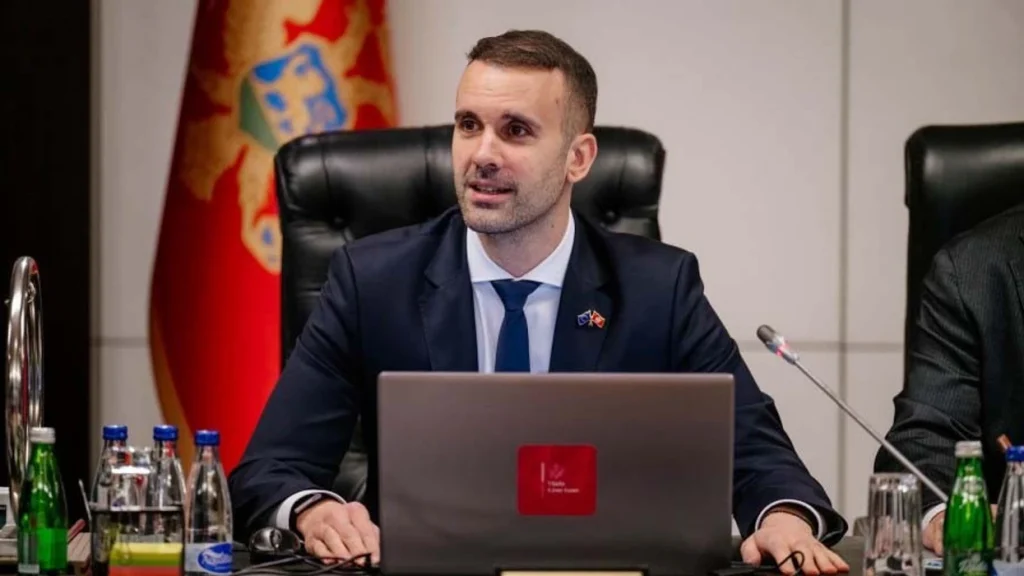
The Prime Minister of Montenegro, Milojko Spajic, continues to fail to clarify which two countries in the region are the ones that, according to him, are preparing hybrid activities to destabilize the country.
The Serbian agency "Beta" reports this Saturday that Spajic's silence has brought opposing interpretations and political reactions in Podgorica, Belgrade and Tirana. Montenegrin public television, RTCG, citing high-ranking sources in the executive branch, writes that Albania was not one of the countries the prime minister had in mind.
According to this report, Edi Rama requested clarification from the Montenegrin Government and was informed by Podgorica that the claim about Albania was not true. Albanian Foreign Minister, Ferit Hoxha, stated that Albania is not and cannot be part of any destabilizing scenario against Montenegro, a neighboring country, NATO ally and partner in the European integration process.
The controversy began after the newspaper “Vijesti”, citing four sources, reported that Spajic had meant Albania and Serbia. The newspaper “Dan” published a different version, mentioning Serbia and Croatia. Serbian President Aleksandar Vučić denied Belgrade’s involvement and said that Spajic could have had Croatia in mind.
Meanwhile, the Digital Forensic Center of Montenegro identifies Serbia as the main actor in hybrid threats, but says it has not identified similar influence from Albania or Croatia.
President Jakov Milatović has requested an urgent meeting of the Defense and Security Council, while Spajić is requesting that the National Security Council convene first.
Until an official clarification from the prime minister, the claim that it concerns Albania and Serbia remains only media reporting, not an official accusation.
Four springs, two countries and an unusual love
Prime Minister Milojko Spajic was not referring to Albania when he stated yesterday that the closing of new chapters in the negotiations between Montenegro and the European Union would be accompanied by coordinated hybrid activities, in which the official structures of the two countries in the region are involved. This was confirmed to the RTCG Portal by high-ranking sources in the executive branch.
However, this information makes the story more interesting than it seems at first glance, as over the last 24 hours, the political and media space of Montenegro has not only been discussing which two countries the prime minister was referring to.
Something else is being built before our eyes: from a piece of security information, a much broader political construct is being created, which speaks of the "undermining" of the government from within, of officials under external influence, of the possible collapse of the governing coalition, and of Serbia and Albania as the states allegedly behind this operation.
The problem is that at least a significant part of this construct is not true.
According to information that RTCG has received from sources within the government, Albania is not the country Spajiçi was referring to. As of today, reactions have also arrived from Albania, which deny these reports.
According to our information, after allegations emerged in public that Albania was one of the countries included in the prime minister's warning, Albanian Prime Minister Edi Rama requested explanations from the Montenegrin government about the origin of this information. Podgorica informed him that it was untrue.
So, the media "information" crossed the line and became a diplomatic issue.
And the source of this information was the newspaper "Vijesti".
Four sources who "know best"
"Vijesti" initially reported that Serbia and Albania were the countries Spajiçi had spoken about, claiming that the information had been confirmed by several sources. In today's article, the newspaper specified that it was four sources.
A day later, the newspaper "Dan" published a completely different version: Serbia and Croatia.
Of course, it can happen that journalistic sources provide different information. This is part of the profession. But for “Vijesti” there is a small problem: this is not the first time, in just a few days, that its anonymous sources “know” something that is not confirmed by those to whom the information is attributed.
Less than two weeks ago, an almost identical situation occurred.
On August 16, “Vijesti” published the results of a political poll, which it attributed to the “Spektrum Analitika” agency. Even then, the authenticity of the data, according to the newspaper, had been confirmed “by several sources.”
But "Spektrum Analitika" itself reacted very quickly.
The agency stated that it had not submitted the data to the media, had not approved its publication, did not stand behind the data presented in the article, and did not confirm its authenticity as the results of an official company survey.
She also emphasized that the published data did not represent final, methodologically verified results intended for publication.
So, in one case, "several sources" confirmed a survey that was not backed by the company to which it was attributed.
Two weeks later, four sources confirmed Albania, while senior government sources say it was not mentioned at all in the information the prime minister referred to.
In journalism, the anonymous source is a legitimate tool. But anonymity is not a magic wand that turns an allegation into fact. The more serious the allegation, the greater the need for verification.
Especially when the consequence is not a trivial journalistic error, but a diplomatic incident between two states.
What did Spajic really say?
The Prime Minister did not mention any country.
He did not even say that within the government there are ministers or deputy prime ministers who participate in hybrid activities against Montenegro.
His message was clear: there is "serious operational security information" that the announced closure of new negotiation chapters with the European Union will be accompanied by hybrid activities coordinated by the official structures of the two states in the region.
He also added that these activities aim to destabilize Montenegro, with the expected support of some political actors and part of the media scene within the country.
In the end, Spajic stated that destabilization efforts will not change the course nor stop Montenegro's European path.
Nowhere is there any mention of a minister working against the state. Nowhere is there any mention of a deputy prime minister being blackmailed with compromising materials. Nowhere is there any warning of the dissolution of the government.
All of this appeared later.
From two states to internal "traitors"
The writing of "Vijesti" follows exactly this path.
Referring to sources from the security sector, the newspaper speaks of a senior government official who is allegedly under the influence of persons linked to criminal structures, of compromising information they are suspected of possessing, and of a possible crisis within the ruling coalition.
It is one thing to report that the services are verifying certain information and quite another to build a political narrative on it, at the end of which the reader must conclude that the government is being overthrown from outside and inside.
In this way, countries, potential domestic perpetrators, and even the potential political outcome are identified.
Especially when the prime minister has not said anything like that.
But here the story gets even more interesting.
The unusual love between "Vijesti" and Vučić's business world
If in recent months we have read "Vijesti" only from a political point of view, Aleksandar Vučić seems almost like its natural opponent.
Belgrade is described as a source of political pressure, there is talk of Serbia's interference in Montenegro's internal affairs, Vučić's statements are analyzed almost daily, while politicians close to the Serbian president are treated as extensions of his politics.
All of this would be legitimate, because a media outlet has the right and obligation to critically examine any government.
But there is another, much less noisy, side to this relationship, which raises doubts about this entire approach.
It's about the business side.
On the pages of the same "Vijesti", on August 24, almost next to each other, promotional materials for the MTEL company and the ALTA bank appeared.
MTEL is not an ordinary private company from Serbia. Montenegrin MTEL is part of the Telekom Srbija group, a company in which the Republic of Serbia owns 58,11 percent of the shares.
Even more interesting is the case of ALTA bank.
Just two weeks ago, "Vijesti" published an article titled "Stop cooperating with the bank close to Vučić", describing ALTA bank in exactly this way.
So, these were the claims of "Vijesti" itself.
But on August 24, a promotional material for ALTA bank was published in "Vijesti".
None of this is illegal in itself. Nor does commercial cooperation automatically imply influence over editorial policy. It would be irresponsible to claim otherwise without evidence.
But it's hard not to notice the irony.
Vučić, apparently, is a problem when he appears in the political column, while the circle of business interests around him is very welcome in the "Business Marketing" column.
Vučić as a political threat and business partner
This question, in fact, is not new.
The question has previously been raised publicly how a media outlet, which for years has spoken highly critically about the political influence of the government in Belgrade, at the same time has no problem with commercial relations with companies that are part of the Serbian state system.
This question has also been raised by politicians whom "Vijesti" regularly and very harshly criticizes.
Albanian Chief Diplomat Ferit Hoxha denied the "Vijesti" report that Albania is involved in hybrid threats against Montenegro.
The answer is never particularly complicated: the media means that marketing has nothing to do with editorial policy. And that may be entirely true.
But then the same standard should apply to everyone.
If a business relationship with a company affiliated with a state does not indicate anything about the political relationship towards that state, then the business ties of other actors cannot automatically be presented as political evidence either.
But if economic ties are important when talking about Serbia's political influence in Montenegro, then the public also has the right to know the extent of the commercial relations of major Montenegrin media outlets with companies of the same system they criticize.
Not to reach a conclusion in advance, but precisely to avoid a predetermined conclusion.
An interesting moment
All this is happening at a time when Montenegro is entering the final phase of European integration.
In July, two more negotiating chapters, chapters 8 and 29, were provisionally closed, bringing the total number of provisionally closed chapters to 18.
In early September, the conditions could be created for the closure of the other four chapters. In other words, the European process, despite all the political tensions, is continuing.
Right now we have an interesting series of events.
Initially, a survey is published, the "authenticity" of which is confirmed by several anonymous sources, but then the agency to which it is attributed distances itself. Then the claim about Albania is published, again confirmed by anonymous sources, while completely different information arrives from the highest levels of executive power.
At the same time, the prime minister's message on security issues expands, without any basis, into a story about people within the government who could be working to bring it down.
And at the same time, the most politically critical voice towards Vučić has no problem advertising on his pages MTEL and a bank that he himself had described just a few days ago as "close to Vučić."
Maybe all of this is a coincidence. But in serious journalism, it is precisely the coincidences that are verified.
The most expensive commodity is independence.
The problem here is not MTEL or ALTA bank. A private media outlet needs to generate revenue and no reasonable person would criticize a newspaper for selling advertising space.
The problem arises when the media simultaneously places itself in the position of moral arbiter, measuring every contact, business relationship, or political proximity of others to Belgrade, while declaring its own commercial relationships completely irrelevant.
Then the question is no longer who advertises. The question is whether there is consistency in standards.
Because, if Vučić represents such a serious threat to Montenegro's political and media independence, as is suggested every day, then it would be interesting to know why the money of companies linked to his political and economic system is not considered a matter of transparency.
If this money has nothing to do with politics, then the same presumption of innocence should be generously applied to others.
Because the essence is precisely this: Vučić cannot be both a political poison and a marketing vitamin at the same time.
The European path is a reality, not a title
Montenegro has opened all 33 negotiation chapters and provisionally closed 18 of them. It remains the leading country in the European Union accession process.
Therefore, the political struggle today is not only taking place in the government, in parliament, or within parties. It is also taking place around the issue of who will explain to the public what is really happening.
If the incorrect information that Albania was the country the prime minister was referring to is published as reliable information, the consequence is not simply a false headline. The information has already reached Tirana and has created the need for clarification between the two governments.
If the prime minister's statement is then supplemented by anonymous allegations about officials who could destabilize the government from within, then a political scenario begins to be constructed from a piece of security information.
And if, moreover, all this happens in a media outlet that constantly warns about the political influence of Vučić's Serbia, while at the same time cooperating with companies of the Serbian state system and with a bank that itself describes itself as close to Vučić, then the question of transparency is not a tabloid provocation.
On the contrary.
It is precisely the question that "Vijesti", if it were about someone else, would probably be the first to raise.
And he has to raise it. Only this time he has to direct it at himself.
Because perhaps the greatest "irony" of this entire story does not lie in the fact that four anonymous sources failed to correctly identify the second state.
Much more interesting is the fact that the media, which has been warning Montenegro for years to guard against Vučić's political influence, seems to be much less concerned about cooperating with the economic system linked to the same power.
This connection may not in itself prove political influence. But it does prove something else: between publicly declared animosity and business interests, there is sometimes a much warmer relationship than the reader might think based on headlines alone.
Therefore, the next time "Vijesti"'s anonymous sources explain to citizens who from Belgrade is destabilizing Montenegro, perhaps it is not inappropriate to raise a completely journalistic question:
Who really finances the space from which these claims are made?/Top Channel
 Belgrade lawyer targeted by Serbian Interior Ministry: The reason is the connection between Vučić and Sarajevo Safari?
  Who is the only politician in the world who expressed condolences for the death of war criminal Ratko Mladic?
  Bild and The Telegraph write about possible scenarios of a Russian attack on NATO
  The issues that could determine what happens in the Iran war
  US and Venezuela sign historic oil deal
  Psychological support in war, NATO trains 1,000 Ukrainians