
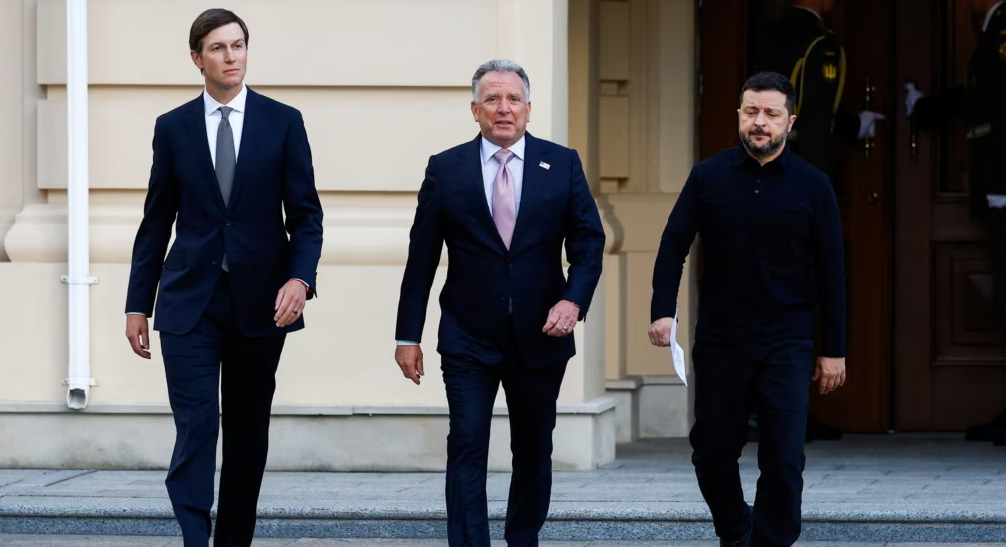
The White House has presented a framework plan for European security, along with security guarantees for Ukraine, as President Donald Trump's administration prepares for trilateral peace talks with Ukraine and Russia, to be held next week in Abu Dhabi.
US President Trump's envoy, Jared Kushner, presented the details of this initiative through a post on social media on November 5, following discussions in Brussels with Ukrainian, NATO and European officials.
The proposed framework includes permanent security consultations, crisis communication, greater military transparency, reciprocal measures to reduce the risks of escalation, and a long-term agreement on European security and stability.
Kushner said the initiative would respect the sovereignty and territorial integrity of each country, while no country would have the right to veto another country's security choices or alliances. He stressed that NATO would remain at the center of European collective defense.
The announcement came after a meeting at the White House on November 5 between Trump and Russian President Vladimir Putin's special envoy, Kirill Dmitriev. Trump said he believed a "great, great deal" could be reached quickly, suggesting it could include not just Ukraine but "all of Europe."
"It's going to be a great deal and it's going to involve more than Ukraine," Trump told reporters, predicting that "everybody's going to be happy."
Kushner said consultations would continue through the so-called Shell Bay format, which included Ukraine, NATO, the European Union and other European partners, while Russia would also participate in the peace negotiations.
Security concerns
The proposed link between security guarantees for Ukraine and a broader European security architecture has raised questions among Russia experts about the scope of this initiative and its impact on NATO.
Glen Howard, president of the Saratoga Foundation and a strategist on Russia, told REL that Kushner's announcement may be aimed at reassuring Ukraine and European allies that Washington is not abandoning their interests as it puts pressure on Russia ahead of negotiations.
But Howard said the reference to a broader European security architecture is particularly concerning.
He referred to statements made last week by Kremlin foreign policy adviser Yury Ushakov, who called for NATO to return to the position it had before 1997, before the alliance expanded into Eastern Europe and the Baltic states.
"Since when does Russia have the right to have a say in the future of NATO and the dismantling of its eastern flank?" Howard said, questioning what concessions Russia would offer in return.
He warned that even just putting NATO's position on the negotiating table could set a precedent for Russia and future US administrations.
Howard compared the potential approach to the 1938 Munich Agreement, which allowed Nazi Germany to annex part of Czechoslovakia in exchange for Adolf Hitler's promise to no longer make territorial claims. He also cited broader concerns about the Trump administration's stance on Russia, including comments by senior Pentagon official Elbridge Colby, who called on the Baltic states to tone down their anti-Russian rhetoric.
He also suggested that France and Britain's preparations for the possible deployment of peacekeeping forces in Ukraine, as well as discussions on rerouting gas through Ukraine, could be part of a broader strategy within the negotiations.
John Herbst, former US ambassador to Ukraine and senior director at the Atlantic Council's Eurasia Center, expressed little optimism about the upcoming talks.
He cited Russian Foreign Minister Sergei Lavrov's recent statement that Russia will not make any compromises, as well as reports of the appointment of Vladimir Medinsky to head the Russian delegation in Abu Dhabi. Medinsky has previously led Russian negotiating teams, but no progress was achieved in those meetings.
Herbst said European involvement could help maintain support for Ukraine and encourage Washington to take a stronger stance. However, he cautioned that European efforts to influence the US administration have had limited impact, compared with the Kremlin's ability to influence Trump.
He raised the question of why Washington was focusing on post-war security arrangements and de-escalation before securing a genuine commitment from Russia to end the fighting.
Herbst suggested that Russia's refusal to make concessions has pushed the Trump administration to seek progress in other areas, rather than exerting greater pressure on the Kremlin.
According to him, the challenge is to draft guarantees strong enough to reassure Ukrainian President Volodymyr Zelensky, but not so broad that Russia could reject an agreement.
"This is an impossible task," Herbst told Radio Free Europe, arguing that Russia does not want serious security guarantees for Ukraine, while Kiev needs them in order to survive as an independent state.
According to Herbst, a real breakthrough would be a clear commitment by Russia to end the fighting, which he considers unlikely. He said Putin still aims to take control of Ukraine and wants President Trump to convince Kiev to give up the parts of Donbas still under Ukrainian control.
Unable to conquer territory through military campaign, Putin could continue to attack Ukrainian cities and civilian infrastructure, with the aim of forcing Kiev to surrender, Herbst said.
Expectations from Abu Dhabi
Trilateral talks between the US, Ukraine and Russia are scheduled to take place on November 10 and 11 and, according to Kushner, they will be the first peace talks since February.
Mark Temnycky, a senior fellow at the Atlantic Council's Eurasia Center, told Radio Free Europe that he expects gradual progress, but not any major breakthrough.
According to him, the main obstacles remain territorial disputes and the security of Ukraine after the end of the war.
For security guarantees to be credible, Washington and European capitals must agree on how they will be implemented and who will finance Ukraine's reconstruction.
The World Bank Group, the European Commission, the United Nations, and the Government of Ukraine estimate that the country's reconstruction needs over the next decade amount to about $588 billion.
Temnycky warned that Washington cannot simply offer Ukraine EU membership as part of a deal. The decision on this issue lies with the 27 member states of the European bloc.
Two senior European diplomats in Washington told Radio Free Europe on November 5 that European leaders do not believe Russia is willing to make concessions regarding Ukraine or European security.
Parallel diplomatic efforts
The latest diplomatic activity coincides with several other initiatives aimed at creating momentum towards reaching an agreement.
On November 5, US First Lady Melania Trump hosted Russian and Ukrainian representatives at the White House to mark a six-day ceasefire she brokered in the Russian-occupied Ukrainian town of Oleshki in the Kherson region. During the ceasefire in late October, nearly 800 people were evacuated from the town.
"We chose humanity over war," said Melania Trump, calling on the parties to use this initiative to find common ground, based on concern for civilians.
Meanwhile, Zelensky has traveled to Spain for talks on strengthening Ukraine's air defenses and will hold meetings on the sidelines of the Ibero-American Summit. He said that prior to the negotiations in Abu Dhabi, he planned to have other contacts with US officials.
"We are coordinating with our partners to achieve concrete results on security issues and for further steps towards peace," Zelensky wrote on social media.
Trump's meeting with Dmitriev also drew attention, as the Russian envoy remains under US Treasury Department sanctions.
A US official told Radio Free Europe that this is not the first meeting between the two officials at the White House and dismissed claims that sanctions have prevented Dmitriev from traveling to the US. He said special permits have been issued to enable the visit. So far, no official decision to remove him from the US sanctions list has been announced./REL
 Montenegro closes two more chapters in EU accession process
 Putin confirms Russia-US-Ukraine meeting
 Ukraine hits Russian oil industry, 15 refineries out of service
 Kandic urges EU to react to distortion of facts about the war in Kosovo and the genocide in Srebrenica
 Detention for Serbian police officers suspected of mistreating students and other citizens
 How recruiting for Russia's war turned into big business