
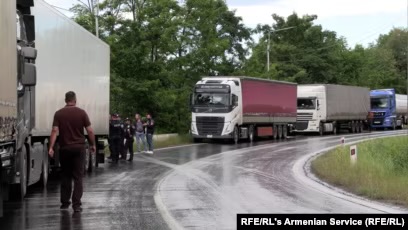
In a lush green valley in northern Armenia, near the border with Georgia, trucks lined a road that was still shiny from a recent downpour.
The stationary vehicles bore witness to a geopolitical battle in which Russia is trying to prevent Armenia from seeking closer ties with the West.
In statements to REL's Armenian service, drivers told stories of how they set off for Russia loaded with goods for export, only to turn back.
"They reviewed all our documents and saw the quality of our strawberries, the products grown by our farmers. But it was just a political decision," said Narek Yeginiyan, explaining that the fate of his 20-ton cargo is uncertain.
The other driver, Ara Isojan, returned with the same amount of peppers.
"They claimed they found a disease in our peppers that only affects tomatoes. They sent us to a parking lot where we had to pay all the related expenses. They sent us back after we spent the day there," he said.
Truck drivers are concerned about increased Russian restrictions. On June 2, the Russian agricultural inspection Rosselkhoznadzor announced measures regarding Armenian potatoes, eggplant, dried fruits and nuts.
This followed previous measures for other types of vegetables, fish products and mineral waters.
Official statements spoke of health and safety concerns, but the Kremlin made its true motives absolutely clear.
Armenians will go to the polls on June 7 in parliamentary elections that will determine the fundamental direction of the country's foreign policy. While Prime Minister Nikol Pashinyan has pushed the country toward the United States and the European Union, Russia has responded with a series of moves aimed at halting the turn toward the West.
This included threats that Armenia would be expelled from the Moscow-led Eurasian Economic Union (EAEU), warnings that it could have its preferential fuel supplies cut off, and numerous statements increasing pressure on Yerevan.
Speaking at a summit in Astana, Kazakhstan, on May 29, Russian President Vladimir Putin even suggested in a somber tone that Armenia should be wary of the fate of Ukraine.
“The crisis in Ukraine began with efforts to move towards EU membership,” he said, adding that Armenia would lose its market in Russia and other EAEU countries, lose cheap energy imports and face obstacles for its migrant workers going to Russia – whose remittances have been economically important for decades.
"These changes could lead to a loss of at least 14 percent of Armenia's GDP," Putin added.
EU to help?
Pashinyan has made it clear that he takes the reorganization of Armenia seriously.
In May, he rolled out the red carpet to welcome EU and other European leaders to a summit in Yerevan, including Ukrainian President Volodymyr Zelensky.
Pashinyan also froze Armenia's membership in the Russian-led security pact, the Collective Security Treaty Organization (CSTO).
Last year, his country passed a law that launched the EU accession process. Although this is a goal that would take many years to achieve, Brussels has been a strong advocate of Yerevan's pro-European agenda and is also looking to offer practical support.
This was emphasized on June 4, three days before the elections, in a phone conversation between Pashinyan and EU chief Ursula von der Leyen.
"Today I spoke with Prime Minister Nikol Pashinyan about the latest Russian restrictions targeting Armenia. This is nothing more than economic coercion and is unacceptable," she said in a statement after the conversation. "Moscow is using economic relations as a weapon for political pressure."
A plan is being prepared for what the EU calls Autonomous Trade Measures (ATM) that would provide preferential trade treatment for Armenian agricultural products.
However, there were doubts about the EU among truck drivers in Bagratashen's line.
"Will Spain allow us to sell tomatoes in Europe? Will Bulgaria allow us to sell peppers? Or will France allow us to sell brandy," asked a driver, who did not want to be identified.
There is still no clear answer to these questions – although sources in Brussels have suggested that the ATMs would be linked to seasonal goods. It is important to note that there are no details on the quantities involved.
Another issue is simply getting goods to market. The EU statement talks about newly opened routes through Turkey, as well as transporting products through Georgia, but these are long and expensive journeys.
However, there is a very difficult road ahead. A look at official statistics from recent years shows that trade with Russia is constantly growing and strongly exceeds trade with the EU.
'Geopolitical market'
Of course, Armenia has other trading partners. The United Arab Emirates, for example, is its largest export market, according to the Economic Complexity Observatory, and it buys mainly gold, jewelry, and diamonds from Armenia.
In a June 3 analysis, Caucasus expert Thomas de Waal, a senior fellow at Carnegie for Europe, said the entire region is striving for diversification in a new, multipolar reality.
“The idea that the region is bipolar, locked in a binary conflict between Russia and the West, is no longer valid today – except in the minds of strategists in the Kremlin. Instead, the South Caucasus is a geopolitical marketplace,” De Waal wrote.
"The European Union, China, the Gulf countries, India, Turkey and the United States are present here. In this crowded field, Russia is now one of many others," he added.
The United States is a concrete example. US President Donald Trump hosted Pashinyan and Azerbaijani President Ilham Aliyev at the White House last year to symbolically end decades of conflict, both open and ongoing.
A key part of the agreement is a trade corridor that runs through Armenian territory, connecting Azerbaijan with its enclave of Nakhchivan, while simultaneously opening a new east-west trade artery, bypassing Russia and Iran.
The path was called the Trump Administration’s Roadmap for International Peace and Prosperity (TRIPP), and the US president personally endorsed Pashinyan. “Nicole has my full and absolute support for re-election,” Trump wrote on social media on May 27.
US Secretary of State Marco Rubio, speaking at congressional hearings this week, noted that Russia seemed irritated.
"The Russians are not very happy with our engagement there. I think there are indications that they would like the current (prime minister) to lose the election as a result of this strengthening of relations with the United States," he told the Senate Foreign Relations Committee on June 2.
However, he added that "we are not asking them (Armenia) not to be friends with other countries."
Happy birthday from Putin
In Armenia itself, these debates were held as elections approached.
“They are being used as a platform against Russia,” Samvel Karapetyan, head of the main opposition party Strong Armenia, told reporters on May 27. “We could shout about better relations with the EU every day, but we would not be able to use these relations in any way.”
Karapetyan was arrested last year on charges of calling for an illegal seizure of power. At the time, Richard Giragosian, head of the Center for Regional Studies in Yerevan, said the arrest was “an action by the Armenian government to prevent Russian interference” in the election.
Karapetyan, a billionaire with dual Russian and Armenian citizenship, is currently under house arrest in Yerevan. He says the charges against him are politically motivated.
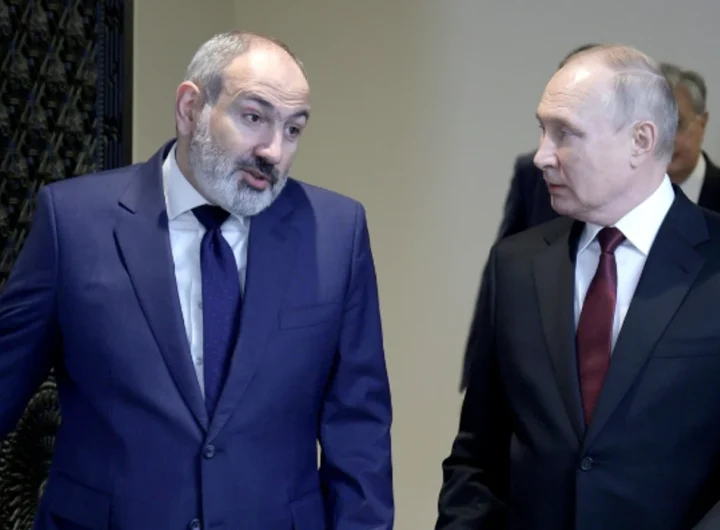
For his part, Pashinyan said he was not seeking a break with Moscow.
"I have really friendly relations with the president of the Russian Federation," he said at an election rally in May.
He recently said that Putin called him to wish him a happy birthday on June 1, and an official statement praised Putin for his "friendly tone."
 Council of Europe Commissioner expresses concern over handling of police violence case in Serbia
  United Kingdom updates travel advice for northern Kosovo
  EU considers sanctions against Russian patriarch, chess federation head, others
  Serbian arms dealer's firm earns millions under Vucic's rule despite US sanctions
  After victory in parliamentary elections, Armenian Prime Minister mocks Putin
  Finland, Norway, Latvia and Germany increase support for Ukraine, Zelensky calls for strengthening air defense