
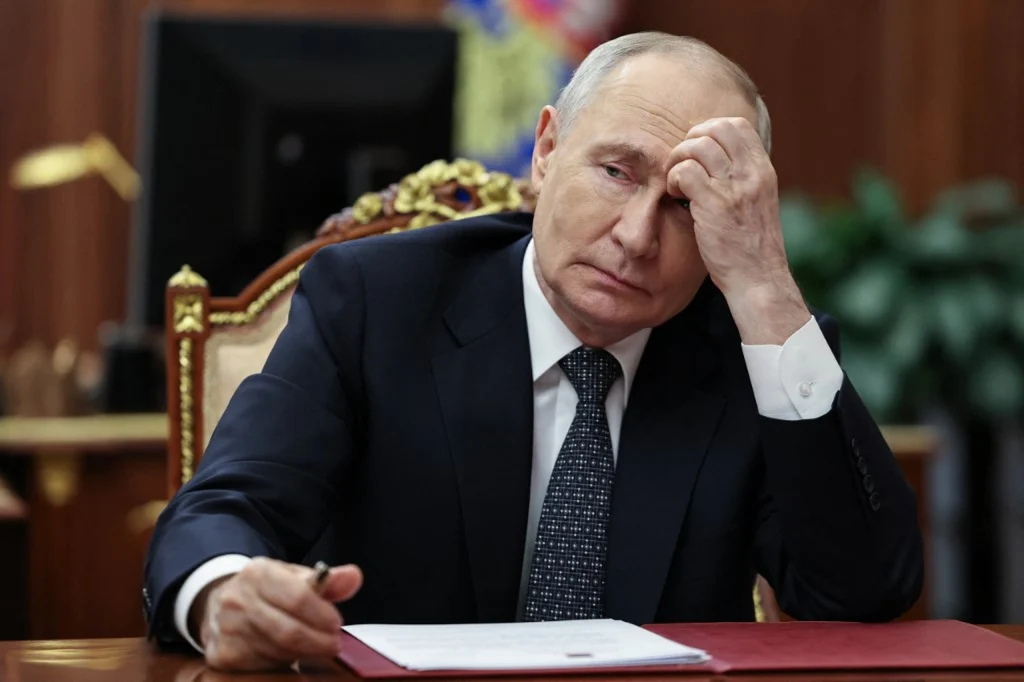
The Russian government has significantly cut the 2025 budgets for most of its priority domestic technology initiatives, diverting financial resources to support unprecedented military spending amid growing fiscal deficits.
A recent analysis by the Moscow-based Center for Macroeconomic Analysis and Short-Term Forecasting (CMASF) shows that funding for eight key “technological leadership” programs was cut by almost 38%. The revised federal budget allocates 201.9 billion rubles ($2.6 billion) to these sectors, down from the 324.4 billion rubles ($4.2 billion) originally planned.
The space technology sector experienced the most severe reduction, losing its entire planned budget of 10 billion rubles ($129 million).
Initiatives focused on domestic machine tools and industrial robotics – grouped under the national Production Tools and Automation project – saw funding drop by more than 75%, falling from a planned 52.2 billion rubles to 11.8 billion rubles ($152.2 million).
Budget cuts hit the Industrial Mobility and Transport program hard, which was cut to 102.2 billion rubles ($1.3 billion). Funding was similarly cut across the New Materials and Chemistry, Health Protection, Food Safety, and New Nuclear and Energy Technologies programs, it wrote. KyivPost.
Conversely, the state program to develop unmanned aerial vehicles (UAVs) was the only technological initiative to avoid cuts. It received 35.7 billion rubles ($460.5 million), a slightly higher allocation than the 32.7 billion rubles originally planned.
According to the CMASF, the wide-ranging cuts stem from implementation delays in the civil sector and a significant shortfall in federal revenues. Despite the implementation of new corporate, vehicle and progressive income taxes last year, state revenues fell short of targets by nearly 3 trillion rubles ($38.7 billion).
Meanwhile, defense spending remains strong, with the 2025 budget allocating 13.5 trillion rubles ($174.2 billion) for military spending. The expert group reported that fiscal pressure intensified in 2026, generating a deficit of 5.7 trillion rubles ($73.5 billion) in the first half of the year.
During the first quarter, military operations consumed approximately 50% of all federal spending and two-thirds of tax revenues.
"The execution of the 2025 federal budget shows how vulnerable complex investment projects remain when budget parameters are revised," concluded CMASF.
Structural impact on the civilian economy
The financial shift towards the defense sector has exacerbated structural imbalances throughout the civilian economy in general.
A June assessment by Ukraine's Foreign Intelligence Service showed that the Russian military-industrial complex has monopolized domestic labor, leaving civilian production sectors idle.
While official Russian statistics cite an average nominal salary of $1,460, bank transaction data puts the actual average salary closer to $900.
The SZRU assessment attributed this gap to inflated wages within the defense, raw materials, and financial sectors, which statistically obscure wage stagnation in industries that employ the bulk of the workforce, such as healthcare, education, and light manufacturing.
This loss of labor has directly degraded civilian business operations. The intelligence report cited the liquidation in June of domestic production facilities by Gloria Jeans, Russia’s largest clothing manufacturer and retailer. The company abandoned its assembly lines to rely entirely on imported clothing, stating that it could no longer staff its factories.
According to SZRU, finding industrial workers in Russia has become increasingly difficult, as the defense sector outstrips civilian enterprises in personnel bids using extensive state funds.
The GeoPost
 The war in Ukraine changed the security architecture in Europe, NATO returns to collective defense
  Zelensky says Russia is preparing to take in 30,000 more North Korean troops and expand mobilization
  At least 3,589 foreigners have died fighting for Russia, including Serbian citizens.
  Threatening message from Belgrade: Vučić in front of soldiers with dangerous rhetoric against Kosovo
  Belarusian factory producing components for Russian missiles catches fire
  Trump says Iran is 'much more serious' in talks