
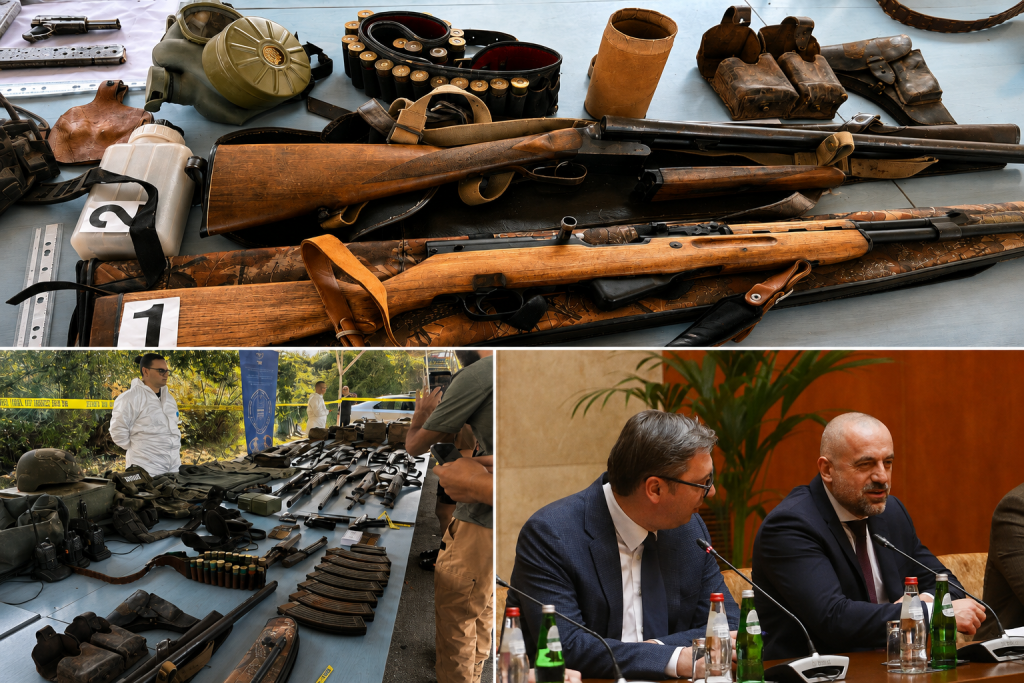
Northern Kosovo has not only been grappling with the phenomenon of illegal weapons possession for years. The continued discovery of heavy weapons, rocket launchers, grenades, explosives and thousands of rounds of ammunition in various locations raises a much bigger question – who has created, supplied and maintained these armed capabilities?
Following the Banjska attack and the investigations into Milan Radoić, evidence has emerged suggesting a connection between Serbian criminal and political structures in the north and logistical capacities linked to Serbia.
Kosovo Police data from just the last six years shows a pattern that extends beyond a group organization.
In 2020, three rocket launchers, two AK-47s, grenades, hundreds of cartridges, and other military equipment were discovered in Leposavic.
In 2021, hundreds of cartridges and weapons-related materials were found in Zvecan.
In 2023, a large arsenal of automatic weapons, rocket launchers, grenades, and thousands of rounds of ammunition was captured in Zvecan.
After the Banjska attack, in October of that same year, dozens of explosives, rocket launchers, and other military weapons were found at seven locations in the north.
In 2025 alone, 87 firearms, 4,200 rounds of ammunition, 21 hand grenades, and 11 rocket launchers were confiscated.
At least 100 firearms and over 8 cartridges were seized in North Mitrovica, Zubin Potok, Zvecan and Leposavic during 2026.
In Zubin Potok alone, during the operations of August 6–17, 72 weapons, 7 explosive devices, 7 grenades, and 4,831 rounds of ammunition were found.
In other cases, AK-47s, M48 rifles and over 1,500 rounds of ammunition were also seized.
In North Mitrovica, at least 4 weapons and over 800 rounds of ammunition were found, while in Zvecan, at least 3 weapons, over 400 rounds of ammunition and 3 grenades were found.
In Leposavic, one case resulted in 4 weapons and 128 cartridges.
The figure of 100 weapons and over 8 thousand cartridges is the minimum documented until August 20, 2026, as the Police have not yet published the final annual statistics by municipality.
Banjska as the point where the network surfaced
The attack of September 24, 2023 in Banjska is the most important point for understanding this mechanism.
Milan Radoićić, an influential political, business and criminal figure in the north and former vice-president of the Serbian List, claimed responsibility for organizing the attack.
He was questioned in Serbia, but was released and remains there. In 2024, Kosovo indicted 45 people in the Banjska case, while Radoićić is among the accused and remains outside Kosovo's jurisdiction.
Some of the weapons and ammunition used by Radoićić's group were manufactured in Serbia or had previously passed through the Serbian state system, including state armaments maintenance institutions.
Criminal network as intermediary
Radoicic's role is key because he is at the intersection of politics, business, local structures, and organized crime.
The European Parliament has described Radoicic as an influential figure in the north, an ally of Vucic and a person sanctioned by the US for involvement in organized crime. The same document notes that most of the weapons seized after Banjska were manufactured in Serbia and that some had passed through Serbian state maintenance centers.
Another European Parliament document states that the origin, type and quantity of weapons found in the group's possession raised serious suspicions of involvement by Serbian authorities, although Radoić stated that he had organized the attack himself and Belgrade denied state involvement.
So, if one looks at the network structure, the suspected scheme is more complicated than a direct state order.
Why is Vučić part of this picture?
The main question is how far the political connection goes.
Radoićić has had and continues to have documented relations with Vučić and with Serbian political structures operating in Kosovo.
At the same time, Vučić has publicly stated that Radoićić was a close ally, although he denies that Belgrade organized the Banjska attack.
Thus, the problem for Vučić is not only whether he personally gave the order for an operation. The political problem is the relationship with the actors operating in the north and the responsibility of the Serbian state to investigate and punish them.
While Kosovo has conducted judicial proceedings against Serbian criminals for Banjska, in Serbia the process against Radoićić has not ended with an indictment. So, Milan Radoićić continues to act freely, even supporting Vučić.
The European Parliament, in a 2025 resolution, expressed concern that Serbia had still not prosecuted the perpetrators of Banjska, specifically mentioning Radoicic.
Armament as an instrument of pressure
The arsenals discovered in the north have a characteristic that distinguishes them from the usual weapons of local crime.
These include AK-47s, M48s, rocket launchers, grenades, anti-personnel mines, explosives, mortars, thousands of rounds of ammunition, bulletproof vests, uniforms, radios, and tactical equipment.
The International Crisis Group, in its analysis of northern Kosovo, assessed that the type of weaponry brought to Banjska – including mines, explosives, rocket launchers, mortars and sniper rifles – could be suitable for a guerrilla campaign or for efforts to push Kosovo institutions out of Serb-majority areas.
If the weapons were randomly distributed, without repeating the pattern and without military-style equipment, the criminal explanation would be more convincing.
But, when warehouses, automatic weapons, rocket launchers, grenades and military equipment are constantly found in various areas of the north, while one of the main figures who emerges at the center of an armed operation is a person connected to the Serbian political elite, then the hypothesis of the political instrumentalization of criminal structures becomes much stronger.
This is also why Banjska should not be seen as an isolated episode. It can be seen as the moment when a system that had operated in the shadows for years appeared publicly and in armed form.
So under the rule of Aleksandar Vučić, Belgrade has maintained close political ties with powerful Serbian figures in the north, including Milan Radoićić, and that some weapons used in Banjska have documented links to Serbian production or the state system.
The lack of criminal prosecution of Radoić in Serbia and the lack of full cooperation in bringing the suspects to justice have fueled suspicions of institutional tolerance of this network.
The arming of Serbian groups in the north appears to have operated within an ecosystem where politics, criminal structures, and ties to Serbia intertwine.
The Banjska case constitutes the strongest public evidence that this ecosystem could develop into an organized capacity for violence. However, cooperation between intelligence and security institutions has resulted in the dismantling of such groups and the identification and crackdown on the individuals involved.
The GeoPost
 German authorities uncover secret weapons cache near Berlin linked to Russian spies
  Ukraine hits Russian refinery over 1,600 kilometers from border, Zelensky confirms attack
  RUSSIAN OCCUPATION WITHOUT ANY SOLDIERS: How did Serbia become a training ground for Putin's hybrid operations?
  EU: Ukraine must decide on elections itself, in accordance with the Constitution
  NATO: Any decision to reopen the Ibar bridge to vehicles must address the needs of all communities
  What does the Prosecution's file contain about BIA spy Jelena Djukanovic, sentenced to six years in prison?