
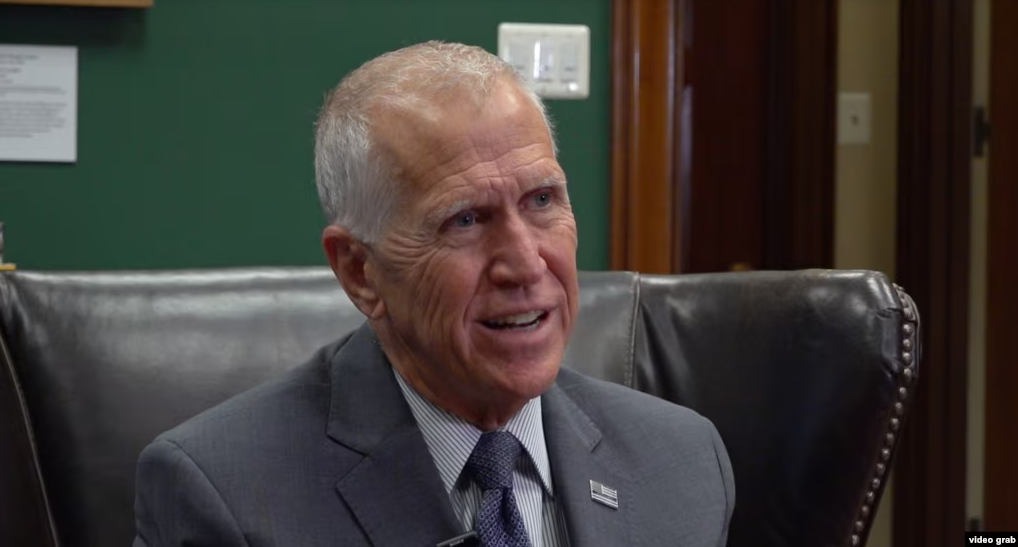
US Senator Thom Tillis, co-chair of the Senate NATO oversight group, has warned that the war in Ukraine and tensions in the Middle East should not be seen as isolated crises, saying they are part of a broader geopolitical clash between the "democratic world" and the "totalitarian world."
In an interview with Radio Free Europe on April 29, Tillis described the cooperation between Russia and Iran as a strategic military alliance, arguing that their partnership "has gone far beyond" a tactical agreement.
“No, I think it goes much deeper than that… it’s absolutely a strategic alliance and actually part of the old Axis of Evil,” Tillis said, citing Iran’s material support for Russia in Ukraine, including drone technology, as well as sharing information on targeting American and allied assets in the region.
The Republican senator from North Carolina said one of the main concerns is Iran's nuclear ambition, estimating that Tehran is "months, if not weeks" away from the ability to enrich uranium to weapons-grade levels, according to intelligence assessments.
He warned that a nuclear-capable Iran would destabilize the Middle East to levels "we have never seen before," adding that Moscow would benefit from such a development to increase instability in the region.
Tillis went further to suggest that, through collaboration with Iran and the use of proxies, Vladimir Putin is linked to the deaths of Americans.
"There is no doubt that the blood of American soldiers is on Vladimir Putin's hands," he said, comparing the Russian president to former Iranian commander Qassem Soleimani, killed by the US in 2020.
According to him, Putin aims to "eliminate US influence" from Europe and the Middle East, while Russia is also waging "hybrid warfare" in Moldova, the Balkans, and Eastern European countries.
Asked about the prospect of a frozen conflict in Ukraine, the US senator said such a scenario would be a "defeat" for the West and would reward Russian aggression.
"You can't redeem this... a draw is his victory," Tillis said, insisting that Putin "must lose very clearly."
Tillis assessed that sanctions on Russia and Iran are losing effectiveness, especially when they are not implemented in a coordinated manner. He criticized Europe for often being "a little behind," emphasizing that the long-term cost of tolerating the actions of Tehran and Moscow is greater than the short-term economic consequences of the sanctions.
In the part of the interview dedicated to the alliance, Tillis said that NATO remains a "wall of defense against totalitarianism," insisting that the West cannot do it alone.
He reiterated that allies must increase defense investments, arguing that failure to implement commitments has left behind, according to him, "two trillion unspent dollars" over the past decades.
Ultimately, Tillis said that a winning Western strategy requires stable, long-term agreements – for both Iran and Ukraine – that have broad political support and institutional ratification in the US, so that they do not change with the rotation of administrations.
The Geopost
 How Russia is helping Iran in its conflict with the US
  Sanctioned technologies, Russia relies on imports from China
  Ukrainian Air Force to be equipped with NATO-standard training simulators for F-16 fighter jets
  European Parliament calls for freezing of EU funds for Slovakia over rule of law concerns
  EU halts funds for Serbia, Kosovo takes a clearer pro-European line
  Sanctions and war hit Russia – Russian economy in crisis