
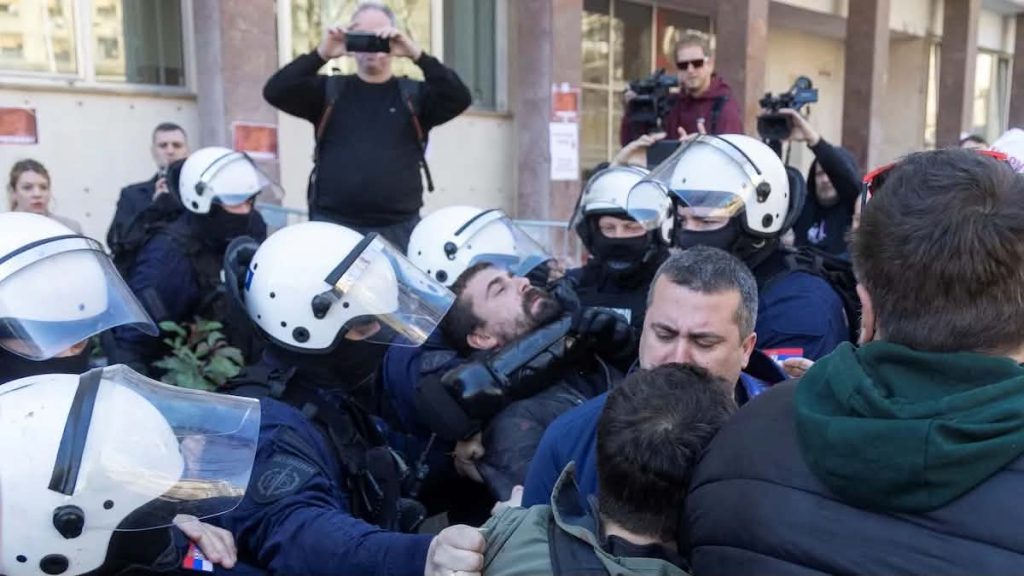
Serbia ranks 104th out of 180 countries in the 2026 Reporters Without Borders (RSF) World Press Freedom Index, ranking worse than any other country in the Western Balkans.
The latest assessment reinforces the picture of an increasingly hostile environment for critical journalism and independent media, in a climate where political pressure, attacks and smear campaigns have become part of everyday life.
According to Reporters Without Borders' profile on Serbia, although the country has produced quality and investigative journalism, often praised for its investigations into crime and corruption, the media remains "trapped in a downward spiral," between propaganda, fake news, and direct political influence.
RSF emphasizes that, despite a formally solid legal framework, journalists face political pressure, while cases of attacks and threats are often accompanied by impunity.
Attacks, threats and accusations from the highest level
One of the main elements that RSF highlights is the deepening political polarization, especially during the 2023–2025 protests, where, according to the organization, journalists were also targeted by representatives of the ruling elite, led by President Aleksandar Vučić, with verbal attacks that were then amplified by several national television stations.
Along the same lines, Freedom House's "Freedom in the World 2026" report emphasizes that the authorities have continued to threaten independent media, citing the case of June 2025 when President Vučić described the reporting of the N1 and Nova S media as "pure terrorism" and suggested that the prosecution may take action against them.
Freedom House also links this climate of pressure to economic and regulatory instruments, where the influence of the state and the ruling party extends through advertising, indirect subsidies, and control of financial resources.
Violence during protests and allegations of police involvement
Reporters Without Borders reports that during the 2025 protests, journalists reporting from the field faced a record number of physical attacks (at least 100), with "many of them" - according to RSF - allegedly being carried out by police officers.
RSF also mentions that there have been worrying cases of hacking/illegal interference in journalists' mobile devices by security services and the police.
Freedom House also cites data from the Association of Independent Journalists of Serbia (NUNS), according to which 135 violations of media freedom were reported in 2025 since the beginning of the year, including 34 verbal threats and 19 physical attacks.
Economic control, ownership and "capture" of the media market
In RSF's analysis, a continuing problem is the media's financial dependence on advertising and subsidies, with access to them said to be influenced by the ruling elite.
RSF also raises concerns about the concentration of ownership and the growing role of the state-owned/public enterprise Telekom Srbija as a cable operator and media owner, adding to fears that the media market is moving towards the dominance of actors linked to power.
What does the European Union say?
The European Union has increased public messages that media freedom is a key condition for Serbia's European path.
In a speech to the European Parliament (September 8, 2025), EU Commissioner for Enlargement, Marta Kos, stated that free media is “an indispensable foundation of a democratic society” and “an essential element” of Serbia’s EU accession process.
She stressed that political and economic influence over the media in Serbia remains a "serious concern," while urging authorities to create an "enabling environment" for journalism and for journalists to work without threats, harassment, and intimidation.
The Commissioner also mentioned that attacks on journalists during protests must stop, including reported cases involving police and verbal attacks by high-level officials.
The weakest in the region, an alarm signal for democratic standards
Serbia's ranking at the bottom of the region in 2026 brings back into focus the question of the direction of democratic reforms, including the rule of law, institutional independence, and guarantees for freedom of expression.
International organizations emphasize that without stopping denigration campaigns, without real investigation of attacks on journalists, and without reducing political influence on the economy and regulation, any improvement on paper remains fragile.
The Geopost
 How Russia is helping Iran in its conflict with the US
  Sanctioned technologies, Russia relies on imports from China
  Ukrainian Air Force to be equipped with NATO-standard training simulators for F-16 fighter jets
  European Parliament calls for freezing of EU funds for Slovakia over rule of law concerns
  EU halts funds for Serbia, Kosovo takes a clearer pro-European line
  Sanctions and war hit Russia – Russian economy in crisis